
Ch. 08 - Conservation of Energy
Giancoli Douglas - Physics for Scientists and Engineers 5th edition
Giancoli Douglas5th editionPhysics for Scientists and EngineersISBN: 9780137488179Non è quello che usi tu?Cambia libro di testo
Capitolo 8, Problema 35

You slide down an 8.0-m-high icy hill (≈ frictionless). At the bottom is a level stretch where the coefficient of kinetic friction is 0.30. How far would you travel across the level stretch?

Guida verificata passo dopo passo
1
Determine the potential energy at the top of the hill using the formula: Ui = mgh, where m is the mass of the object, g is the acceleration due to gravity (9.8 m/s²), and h is the height of the hill (8.0 m).
At the bottom of the hill, all the potential energy is converted into kinetic energy. Use the conservation of energy principle: Ui = Kf, where Kf = (1/2)mv². Solve for the velocity v at the bottom of the hill.
On the level stretch, the kinetic energy is dissipated by the work done against friction. The work-energy principle states: Kf = W, where W = f_k d. Here, f_k is the kinetic friction force and d is the distance traveled.
Calculate the kinetic friction force using the formula: f_k = \, \(\mu\)_k \(\cdot\) m \(\cdot\) g, where \(\mu\)_k is the coefficient of kinetic friction (0.30).
Combine the equations to solve for the distance d: d = \(\frac{(1/2)mv^2}{\mu_k \cdot m \cdot g}\). Notice that the mass m cancels out, simplifying the calculation. Substitute the known values to find d.

Risposta video verificata per un problema simile:

Questa soluzione video è stata consigliata dai nostri tutor come utile per risolvere questo problema.
Durata del video:
6m

Concetti chiave

Ecco i concetti essenziali che devi comprendere per rispondere correttamente alla domanda.

Potential Energy

Potential energy is the energy stored in an object due to its position in a gravitational field. In this scenario, as you slide down the 8.0-m-high hill, gravitational potential energy is converted into kinetic energy. The initial potential energy can be calculated using the formula PE = mgh, where m is mass, g is the acceleration due to gravity, and h is the height.
Video consigliato:
Percorso guidato
07:24
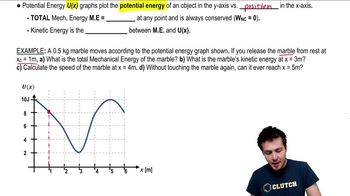
Potential Energy Graphs

Kinetic Energy and Energy Conservation

Kinetic energy is the energy of an object in motion, given by the formula KE = 0.5mv². As you descend the hill, the potential energy converts into kinetic energy, and at the bottom, all potential energy is transformed into kinetic energy. The principle of conservation of energy states that the total energy in a closed system remains constant, allowing us to equate the potential energy at the top with the kinetic energy at the bottom.
Video consigliato:
Percorso guidato
06:24
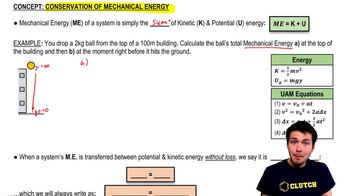
Conservation Of Mechanical Energy

Friction and Deceleration

Friction is a force that opposes motion between two surfaces in contact. On the level stretch, the coefficient of kinetic friction (0.30) determines the frictional force acting against your motion. This frictional force causes deceleration, which can be calculated using Newton's second law (F = ma), allowing us to determine how far you will slide before coming to a stop.
Video consigliato:
Percorso guidato
08:11
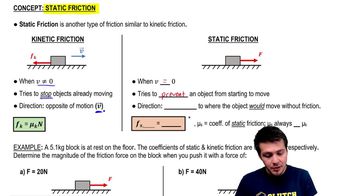
Static Friction & Equilibrium
Pratica correlata
Domanda del libro di testo

Consider the track shown in Fig. 8–39. The section AB is one quadrant of a circle of radius 2.0 m and is frictionless. B to C is a horizontal span 3.0 m long with a coefficient of kinetic friction μₖ = 0.25. The section CD under the spring is frictionless. A block of mass 1.0 kg is released from rest at A. After sliding on the track, it compresses the spring by 0.20 m. Determine the velocity of the block at point C.

1677
views
Domanda del libro di testo

Consider the track shown in Fig. 8–39. The section AB is one quadrant of a circle of radius 2.0 m and is frictionless. B to C is a horizontal span 3.0 m long with a coefficient of kinetic friction μₖ = 0.25. The section CD under the spring is frictionless. A block of mass 1.0 kg is released from rest at A. After sliding on the track, it compresses the spring by 0.20 m. Determine the velocity of the block at point B.

2022
views
Domanda del libro di testo

A skier of mass m starts from rest at the top of a solid sphere of radius r and slides down its frictionless surface. If friction is present, does the skier fly off at a greater or lesser angle?

1364
views
Domanda del libro di testo

Chris jumps off a bridge with a 15-m-long bungee cord (a heavy stretchable cord) tied around his ankle, Fig. 8–37. He falls 15 m before the bungee cord begins to stretch. Chris’s mass is 75 kg and we assume the cord obeys Hooke’s law, F = -kx with k = 55 N/m. If we neglect air resistance, estimate what distance d below the bridge Chris’s foot will be before coming to a stop. Ignore the mass of the cord (not realistic, however) and treat Chris as a particle.

1169
views
Domanda del libro di testo

The 9.0-kg mass in Fig. 8–36 is held just barely in contact with a spring for which k = 450 N/m . When that mass is released, it falls, compressing the spring and pulling the 3.0-kg mass up. How far does the 9.0-kg mass fall before momentarily coming to rest? Ignore friction in the pulley.

1909
views
Domanda del libro di testo

Consider the track shown in Fig. 8–39. The section AB is one quadrant of a circle of radius 2.0 m and is frictionless. B to C is a horizontal span 3.0 m long with a coefficient of kinetic friction μₖ = 0.25. The section CD under the spring is frictionless. A block of mass 1.0 kg is released from rest at A. After sliding on the track, it compresses the spring by 0.20 m. Determine the thermal energy produced as the block slides from B to C.

1501
views