
Ch. 09 - Linear Momentum
Giancoli Douglas - Physics for Scientists and Engineers 5th edition
Giancoli Douglas5th editionPhysics for Scientists and EngineersISBN: 9780137488179Non è quello che usi tu?Cambia libro di testo
Capitolo 9, Problema 42a

A 144-g baseball moving 28.0 m/s strikes a stationary 4.85-kg brick resting on small rollers so it moves without significant friction. After hitting the brick, the baseball bounces straight back, and the brick moves forward at 1.10 m/s. What is the baseball’s speed after the collision?

Guida verificata passo dopo passo
1
Convert the mass of the baseball from grams to kilograms. Since 1 gram = 0.001 kilograms, the mass of the baseball is \( m_1 = 144 \times 10^{-3} \, \text{kg} = 0.144 \, \text{kg} \).
Apply the principle of conservation of momentum. The total momentum before the collision equals the total momentum after the collision. The equation is: \( m_1 v_{1i} + m_2 v_{2i} = m_1 v_{1f} + m_2 v_{2f} \), where \( m_1 \) and \( m_2 \) are the masses of the baseball and brick, \( v_{1i} \) and \( v_{2i} \) are their initial velocities, and \( v_{1f} \) and \( v_{2f} \) are their final velocities.
Substitute the known values into the momentum equation. The initial velocity of the baseball is \( v_{1i} = 28.0 \, \text{m/s} \), the initial velocity of the brick is \( v_{2i} = 0 \, \text{m/s} \), the final velocity of the brick is \( v_{2f} = 1.10 \, \text{m/s} \), and the masses are \( m_1 = 0.144 \, \text{kg} \) and \( m_2 = 4.85 \, \text{kg} \). The equation becomes: \( (0.144)(28.0) + (4.85)(0) = (0.144)v_{1f} + (4.85)(1.10) \).
Simplify the equation to isolate \( v_{1f} \), the final velocity of the baseball. Rearrange the terms to solve for \( v_{1f} \): \( v_{1f} = \frac{(0.144)(28.0) - (4.85)(1.10)}{0.144} \).
Perform the calculations step by step to find \( v_{1f} \), ensuring that the units are consistent throughout. Note that the result will be the baseball's speed after the collision, and it will have a negative sign if the baseball bounces back in the opposite direction.

Risposta video verificata per un problema simile:

Questa soluzione video è stata consigliata dai nostri tutor come utile per risolvere questo problema.
Durata del video:
7m

Concetti chiave

Ecco i concetti essenziali che devi comprendere per rispondere correttamente alla domanda.

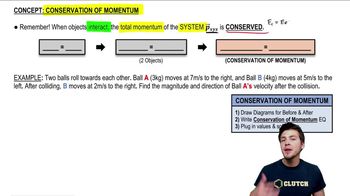
Conservation of Momentum

The principle of conservation of momentum states that in a closed system, the total momentum before a collision is equal to the total momentum after the collision. This is crucial for analyzing collisions, as it allows us to set up equations based on the masses and velocities of the objects involved.
Video consigliato:
Percorso guidato
05:58
Conservation Of Momentum

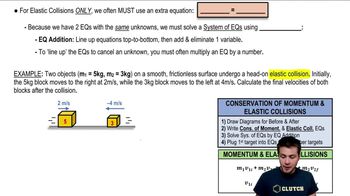
Elastic and Inelastic Collisions

Collisions can be classified as elastic or inelastic. In elastic collisions, both momentum and kinetic energy are conserved, while in inelastic collisions, momentum is conserved but kinetic energy is not. The scenario described involves an inelastic collision since the baseball bounces back, indicating some energy is lost.
Video consigliato:
Percorso guidato
08:56
Intro To Elastic Collisions

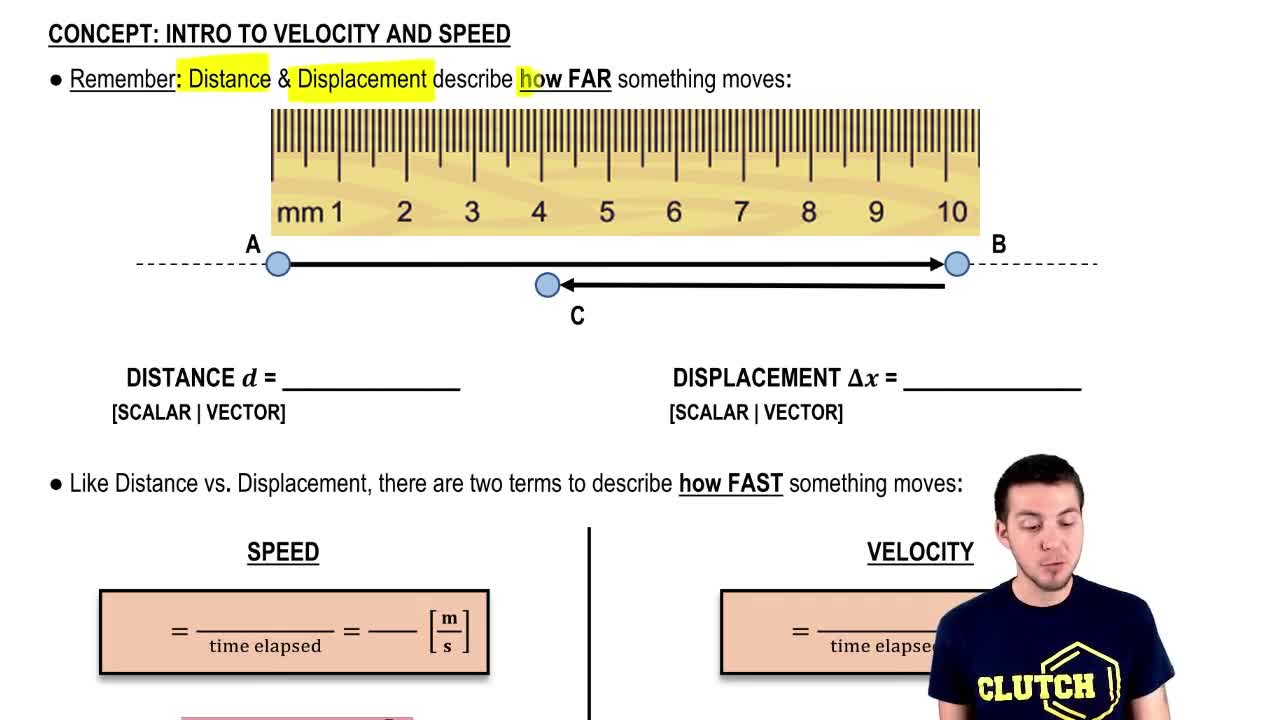
Velocity and Speed

Velocity is a vector quantity that includes both speed and direction, while speed is a scalar quantity that only measures how fast an object is moving. Understanding the difference is essential for solving the problem, as the direction of the baseball's velocity changes after the collision, affecting the final calculations.
Video consigliato:
Percorso guidato
05:35
Intro to Velocity and Speed
Pratica correlata
Domanda del libro di testo

The force on a bullet along the barrel of a firearm is given by the formula F = [740 ― (2.3 x 10⁵ s⁻¹ ) t] N over the time interval t = 0 to t = 3.0 x 10⁻³ s. Plot a graph of F versus t for t = 0 to t = 3.0 ms. Use the graph to estimate the impulse given the bullet.

1664
views
Domanda del libro di testo

A 144-g baseball moving 28.0 m/s strikes a stationary 4.85-kg brick resting on small rollers so it moves without significant friction. After hitting the brick, the baseball bounces straight back, and the brick moves forward at 1.10 m/s. Find the total kinetic energy before and after the collision.

1182
views
Domanda del libro di testo

A bullet of mass m = 0.0010 kg embeds itself in a wooden block with mass M = 0.999 kg, which then compresses a spring (k = 140 N/m) by a distance 𝓍 = 0.050 m before coming to rest. The coefficient of kinetic friction between the block and table is μ = 0.50. What fraction of the bullet’s initial kinetic energy is dissipated (in damage to the wooden block, rising temperature, etc.) in the collision between the bullet and the block?

1021
views
Domanda del libro di testo

The force on a bullet along the barrel of a firearm is given by the formula F = [740 ― (2.3 x 10⁵ s⁻¹ ) t] N over the time interval t = 0 to t = 3.0 x 10⁻³ s. Plot a graph of F versus t for t = 0 to t = 3.0 ms.

1783
views
Domanda del libro di testo

(II) A pendulum consists of a mass M hanging at the bottom end of a massless rod of length ℓ, which has a frictionless pivot at its top end. A mass m, moving horizontally as shown in Fig. 9–44 with velocity v, impacts M and becomes embedded. What is the smallest value of v sufficient to cause the pendulum (with embedded mass m) to swing clear over the top of its arc?

1798
views
Domanda del libro di testo

Croquet ball A moving at 4.3 m/s makes a head-on collision with ball B of equal mass initially at rest. Immediately after the collision, ball B moves forward at 3.0 m/s. What fraction of the initial kinetic energy is lost in the collision?

1449
views