
Ch. 09 - Linear Momentum
Giancoli Douglas - Physics for Scientists and Engineers 5th edition
Giancoli Douglas5th editionPhysics for Scientists and EngineersISBN: 9780137488179Non è quello che usi tu?Cambia libro di testo
Capitolo 9, Problema 45b

A bullet of mass m = 0.0010 kg embeds itself in a wooden block with mass M = 0.999 kg, which then compresses a spring (k = 140 N/m) by a distance 𝓍 = 0.050 m before coming to rest. The coefficient of kinetic friction between the block and table is μ = 0.50. What fraction of the bullet’s initial kinetic energy is dissipated (in damage to the wooden block, rising temperature, etc.) in the collision between the bullet and the block?

Guida verificata passo dopo passo
1
Step 1: Understand the problem. The bullet embeds itself in the block, forming a single system. The system then compresses a spring and comes to rest. We need to calculate the fraction of the bullet's initial kinetic energy that is dissipated during the collision. This involves analyzing energy transformations and losses.
Step 2: Calculate the total energy stored in the spring at maximum compression. The potential energy stored in the spring is given by the formula: Us = 12kx2, where k is the spring constant and x is the compression distance.
Step 3: Account for the work done against friction as the block compresses the spring. The work done by friction is given by: Wf = \, \(\mu\) \(\cdot\) \(\left\)( M + m \(\right\)) \(\cdot\) g \(\cdot\) x, where \(\mu\) is the coefficient of kinetic friction, M and m are the masses of the block and bullet, g is the acceleration due to gravity, and x is the compression distance.
Step 4: Determine the total kinetic energy of the block-bullet system after the collision. This is the sum of the spring potential energy and the work done against friction: K\(\text{system}\) = \(\left\)( \(\frac{1}{2}\) k x^2 \(\right\)) + \(\left\)( \(\mu\) \(\cdot\) \(\left\)( M + m \(\right\)) \(\cdot\) g \(\cdot\) x \(\right\)).
Step 5: Calculate the fraction of the bullet's initial kinetic energy dissipated. The initial kinetic energy of the bullet is K\(\text{initial}\) = \(\frac{1}{2}\) m v^2, where v is the bullet's initial velocity. The fraction of energy dissipated is: f = 1 - \(\frac{K_{\text{system}\)}}{K_{\(\text{initial}\)}}. Substitute the expressions for K\(\text{system}\) and K\(\text{initial}\) to find the fraction.

Risposta video verificata per un problema simile:

Questa soluzione video è stata consigliata dai nostri tutor come utile per risolvere questo problema.
Durata del video:
11m

Concetti chiave

Ecco i concetti essenziali che devi comprendere per rispondere correttamente alla domanda.

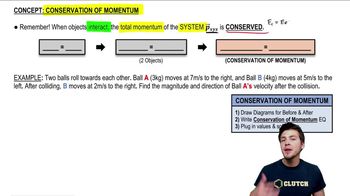
Conservation of Momentum

In a closed system, the total momentum before an event must equal the total momentum after the event. In this scenario, when the bullet embeds itself in the block, we can apply the conservation of momentum to determine the combined velocity of the bullet-block system immediately after the collision. This principle is crucial for analyzing the initial conditions of the system.
Video consigliato:
Percorso guidato
05:58
Conservation Of Momentum

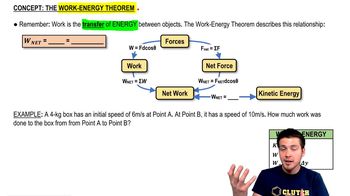
Kinetic Energy and Work-Energy Principle

Kinetic energy is the energy possessed by an object due to its motion, calculated as KE = 1/2 mv². The work-energy principle states that the work done on an object is equal to the change in its kinetic energy. In this problem, we need to evaluate how much of the bullet's initial kinetic energy is transformed into other forms of energy during the collision and subsequent compression of the spring.
Video consigliato:
Percorso guidato
04:10
The Work-Energy Theorem

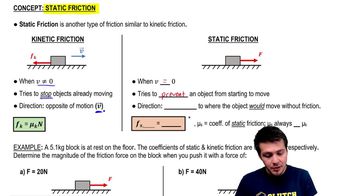
Friction and Energy Dissipation

Friction is a force that opposes motion between two surfaces in contact, and it converts kinetic energy into thermal energy, leading to energy dissipation. The coefficient of kinetic friction (μ) quantifies this effect. In this scenario, understanding how friction acts on the block after the bullet embeds itself is essential for calculating the fraction of the bullet's initial kinetic energy that is lost due to damage and heat during the collision.
Video consigliato:
Percorso guidato
08:11
Static Friction & Equilibrium
Pratica correlata
Domanda del libro di testo

A 144-g baseball moving 28.0 m/s strikes a stationary 4.85-kg brick resting on small rollers so it moves without significant friction. After hitting the brick, the baseball bounces straight back, and the brick moves forward at 1.10 m/s. What is the baseball’s speed after the collision?

1265
views
Domanda del libro di testo

A 144-g baseball moving 28.0 m/s strikes a stationary 4.85-kg brick resting on small rollers so it moves without significant friction. After hitting the brick, the baseball bounces straight back, and the brick moves forward at 1.10 m/s. Find the total kinetic energy before and after the collision.

1182
views
Domanda del libro di testo

The distance between a carbon atom (m = 12 u) and an oxygen atom (m = 16 u) in the CO molecule is 1.13 x 10⁻¹⁰ m. How far from the carbon atom is the center of mass of the molecule?

2022
views
Domanda del libro di testo

(II) A pendulum consists of a mass M hanging at the bottom end of a massless rod of length ℓ, which has a frictionless pivot at its top end. A mass m, moving horizontally as shown in Fig. 9–44 with velocity v, impacts M and becomes embedded. What is the smallest value of v sufficient to cause the pendulum (with embedded mass m) to swing clear over the top of its arc?

1798
views
Domanda del libro di testo

Find the center of mass of the ammonia molecule. The chemical formula is NH₃. The hydrogens are at the corners of an equilateral triangle (with sides 0.16 nm) that forms the base of a pyramid, with nitrogen at the apex (0.037 nm vertically above the plane of the triangle).

1599
views
Domanda del libro di testo

A huge balloon and its gondola, of mass M, are in the air and stationary with respect to the ground. A passenger, of mass m, then climbs out and slides down a rope with speed v, measured with respect to the balloon. With what speed and direction (relative to Earth) does the balloon then move? What happens if the passenger stops?

1592
views