Ch. 10 - Rotational Motion
Giancoli Douglas - Physics for Scientists and Engineers 5th edition
Giancoli Douglas5th editionPhysics for Scientists and EngineersISBN: 9780137488179Non è quello che usi tu?Cambia libro di testo
Capitolo 10, Problema 10.6

(II) A child rolls a ball on a level floor 3.1 m to another child. If the ball makes 12.0 revolutions, what is its diameter?

Guida verificata passo dopo passo
1
Calculate the circumference of the ball using the formula for the circumference of a circle, which is \(C = 2\pi r\), where \(r\) is the radius of the ball. Since the diameter \(d = 2r\), the formula can also be written as \(C = \pi d\).
Determine the total distance the ball travels using the number of revolutions and the circumference. The total distance \(D\) traveled by the ball is the product of the number of revolutions and the circumference, \(D = \text{number of revolutions} \times C\).
Set up the equation using the given total distance traveled by the ball (3.1 m) and the expression for \(D\) from step 2. Substitute \(D = 3.1 \text{ m}\) and solve for the diameter \(d\).
Rearrange the equation to isolate \(d\) on one side. This can be done by dividing both sides of the equation by \(\pi\) and the number of revolutions.
Simplify the equation to find the expression for the diameter \(d\) of the ball.

Risposta video verificata per un problema simile:

Questa soluzione video è stata consigliata dai nostri tutor come utile per risolvere questo problema.
Durata del video:
2m

Concetti chiave

Ecco i concetti essenziali che devi comprendere per rispondere correttamente alla domanda.

Circumference of a Circle

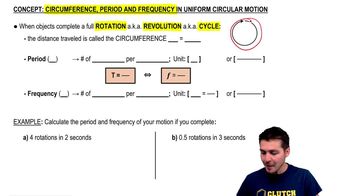
The circumference of a circle is the distance around it, calculated using the formula C = πd, where d is the diameter. In this problem, knowing the circumference is essential to relate the number of revolutions the ball makes to the distance it travels.
Video consigliato:
Percorso guidato
05:08
Circumference, Period, and Frequency in UCM

Revolutions and Distance

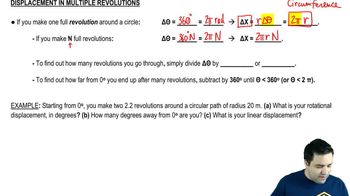
One complete revolution of a circular object corresponds to a distance equal to its circumference. Therefore, if a ball makes multiple revolutions, the total distance traveled can be found by multiplying the number of revolutions by the circumference. This relationship is crucial for determining the diameter from the given distance.
Video consigliato:
Percorso guidato
05:58
Displacement in Multiple Revolutions

Unit Conversion

In physics problems, it is often necessary to ensure that all measurements are in compatible units. In this case, the distance traveled by the ball (3.1 m) and the diameter must be expressed in the same unit system, typically meters, to accurately calculate the diameter based on the revolutions made.
Video consigliato:
Percorso guidato
07:46
Unit Conversions
Pratica correlata
Domanda del libro di testo

How fast (in rpm) must a centrifuge rotate if a particle 8.0 cm from the axis of rotation is to experience an acceleration of 100,000 g’s?

1321
views

Domanda del libro di testo

The axle of a wheel is mounted on supports that rest on a rotating turntable as shown in Fig. 10–52. The wheel has angular velocity ω₁ = 48.0 rad/s about its axle, and the turntable has angular velocity ω₂ = 35.0 rad/s about a vertical axis. (Note arrows showing these motions in the figure.) What are the directions of ω1→\(\overrightarrow{\omega_1}\) and ω2→\(\overrightarrow{\omega_2}\) at the instant shown?

1332
views
Domanda del libro di testo

A turntable of radius R₁ is turned by a circular rubber roller of radius R₂ in contact with it at their outer edges. What is the ratio of their angular velocities, ω₁/ω₂?

1439
views
Domanda del libro di testo

A child rolls a ball on a level floor 3.1 m to another child. If the ball makes 12.0 revolutions, what is its diameter?

1163
views
Domanda del libro di testo

The platter of the hard drive of a computer rotates at 7200 rpm (rpm = revolutions per minute = rev/min). If a single bit requires 0.50 μm of length along the direction of motion, how many bits per second can the writing head write when it is 3.00 cm from the axis?

1193
views
Domanda del libro di testo

The platter of the hard drive of a computer rotates at 7200 rpm (rpm = revolutions per minute = rev/min). If the reading head of the drive is located 3.00 cm from the rotation axis, what is the linear speed of the point on the platter just below it?

1582
views