

Ch. 11 - Angular Momentum; General Rotation
Giancoli Douglas - Physics for Scientists and Engineers 5th edition
Giancoli Douglas5th editionPhysics for Scientists and EngineersISBN: 9780137488179Non è quello che usi tu?Cambia libro di testo
Capitolo 11, Problema 23b

Show that  î x ĵ = k̂ , î x k̂ = - ĵ, and ĵ x k̂ = î.

Guida verificata passo dopo passo
1
Understand the problem: The task is to verify the cross products of unit vectors in a Cartesian coordinate system. The unit vectors î, ĵ, and k̂ represent the x, y, and z directions, respectively. The cross product of two vectors results in a vector perpendicular to both, following the right-hand rule.
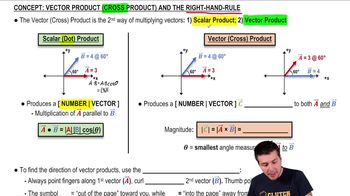
Recall the right-hand rule: To determine the direction of the cross product, point your right-hand fingers in the direction of the first vector (e.g., î), curl them toward the second vector (e.g., ĵ), and your thumb will point in the direction of the resulting vector (e.g., k̂).
Verify î x ĵ = k̂: Using the right-hand rule, point your fingers in the direction of î (x-axis) and curl them toward ĵ (y-axis). Your thumb points in the direction of k̂ (z-axis), confirming that î x ĵ = k̂.
Verify î x k̂ = -ĵ: Point your fingers in the direction of î (x-axis) and curl them toward k̂ (z-axis). Your thumb points in the negative y-direction, confirming that î x k̂ = -ĵ.
Verify ĵ x k̂ = î: Point your fingers in the direction of ĵ (y-axis) and curl them toward k̂ (z-axis). Your thumb points in the direction of î (x-axis), confirming that ĵ x k̂ = î.

Risposta video verificata per un problema simile:

Questa soluzione video è stata consigliata dai nostri tutor come utile per risolvere questo problema.

Concetti chiave

Ecco i concetti essenziali che devi comprendere per rispondere correttamente alla domanda.

Vector Cross Product

The vector cross product is a binary operation on two vectors in three-dimensional space, resulting in a third vector that is perpendicular to the plane formed by the original vectors. The magnitude of the cross product is given by the product of the magnitudes of the two vectors and the sine of the angle between them. This operation is denoted by the symbol '×' and is essential for determining torque, angular momentum, and other vector quantities.
Video consigliato:
Percorso guidato
10:30
Vector (Cross) Product and the Right-Hand-Rule

Unit Vectors

Unit vectors are vectors with a magnitude of one, used to indicate direction. In three-dimensional space, the standard unit vectors are î, ĵ, and k̂, which represent the x, y, and z axes, respectively. They are fundamental in vector analysis, allowing for the representation of any vector as a combination of these unit vectors, simplifying calculations involving direction and magnitude.
Video consigliato:

Right-Hand Rule

The right-hand rule is a mnemonic used to determine the direction of the resultant vector in a cross product. By aligning the fingers of the right hand in the direction of the first vector and curling them towards the second vector, the thumb points in the direction of the cross product. This rule is crucial for visualizing and understanding the orientation of vectors in three-dimensional space.
Video consigliato:
Percorso guidato
19:11
Force on Moving Charges & Right Hand Rule
Pratica correlata
Domanda del libro di testo

An engineer estimates that under the most adverse expected weather conditions, the total force on the highway sign in Fig. 11–33 will be F→\(\overrightarrow{F}\) = (± 2.4 î - 4.1 ĵ) kN, acting at the cm. What torque does this force exert about the base O?

1585
views
Domanda del libro di testo

A woman of mass m stands at the edge of a solid cylindrical platform of mass M and radius R. At t = 0, the platform is rotating with negligible friction at angular velocity ω0 about a vertical axis through its center, and the woman begins walking with speed υ (relative to the platform) toward the center of the platform. Determine the angular velocity of the system as a function of time.

1141
views
Domanda del libro di testo

Calculate the angular momentum of a particle of mass m moving with constant velocity υ for two cases (see Fig. 11–34): about O′.

1042
views
Domanda del libro di testo

A woman of mass m stands at the edge of a solid cylindrical platform of mass M and radius R. At t = 0, the platform is rotating with negligible friction at angular velocity ω0 about a vertical axis through its center, and the woman begins walking with speed υ (relative to the platform) toward the center of the platform. What will be the angular velocity when the woman reaches the center?

1076
views
Domanda del libro di testo

A person of mass 75 kg stands at the center of a rotating merry-go-round platform of radius 3.0 m and moment of inertia 920. kg·m². The platform rotates without friction with angular velocity 0.95 rad/s. The person walks radially to the edge of the platform. Calculate the rotational kinetic energy of the system of platform plus person before and after the person’s walk.

1099
views
Domanda del libro di testo

Calculate the angular momentum of a particle of mass m moving with constant velocity υ for two cases (see Fig. 11–34): about origin O.

1496
views