
Ch. 11 - Angular Momentum; General Rotation
Giancoli Douglas - Physics for Scientists and Engineers 5th edition
Giancoli Douglas5th editionPhysics for Scientists and EngineersISBN: 9780137488179Non è quello che usi tu?Cambia libro di testo
Capitolo 11, Problema 10b

A person of mass 75 kg stands at the center of a rotating merry-go-round platform of radius 3.0 m and moment of inertia 920. kg·m². The platform rotates without friction with angular velocity 0.95 rad/s. The person walks radially to the edge of the platform. Calculate the rotational kinetic energy of the system of platform plus person before and after the person’s walk.

Guida verificata passo dopo passo
1
Step 1: Understand the conservation of angular momentum. Since there is no external torque acting on the system, the total angular momentum of the system (platform + person) remains constant before and after the person walks to the edge. Angular momentum is given by \( L = I \omega \), where \( I \) is the moment of inertia and \( \omega \) is the angular velocity.
Step 2: Calculate the initial moment of inertia of the system. The initial moment of inertia is the sum of the platform's moment of inertia and the person's contribution. The person is initially at the center, so their contribution to the moment of inertia is zero. Thus, \( I_{\text{initial}} = I_{\text{platform}} = 920 \ \text{kg·m}^2 \).
Step 3: Calculate the final moment of inertia of the system. When the person walks to the edge of the platform, their contribution to the moment of inertia is \( m r^2 \), where \( m \) is the person's mass and \( r \) is the radius of the platform. Thus, \( I_{\text{final}} = I_{\text{platform}} + m r^2 \). Substitute \( m = 75 \ \text{kg} \) and \( r = 3.0 \ \text{m} \) into the equation.
Step 4: Use the conservation of angular momentum to find the final angular velocity. Since \( L_{\text{initial}} = L_{\text{final}} \), we have \( I_{\text{initial}} \omega_{\text{initial}} = I_{\text{final}} \omega_{\text{final}} \). Solve for \( \omega_{\text{final}} \) using the known values of \( I_{\text{initial}} \), \( \omega_{\text{initial}} \), and \( I_{\text{final}} \).
Step 5: Calculate the rotational kinetic energy before and after the person’s walk. Rotational kinetic energy is given by \( KE = \frac{1}{2} I \omega^2 \). Compute \( KE_{\text{initial}} = \frac{1}{2} I_{\text{initial}} \omega_{\text{initial}}^2 \) and \( KE_{\text{final}} = \frac{1}{2} I_{\text{final}} \omega_{\text{final}}^2 \). Compare the two values to observe the change in rotational kinetic energy.

Risposta video verificata per un problema simile:

Questa soluzione video è stata consigliata dai nostri tutor come utile per risolvere questo problema.
Durata del video:
10m

Concetti chiave

Ecco i concetti essenziali che devi comprendere per rispondere correttamente alla domanda.

Rotational Kinetic Energy

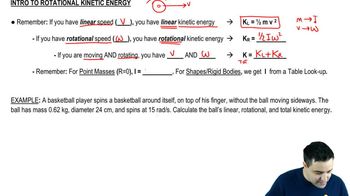
Rotational kinetic energy is the energy possessed by an object due to its rotation. It is calculated using the formula KE_rot = 0.5 * I * ω², where I is the moment of inertia and ω is the angular velocity. This concept is crucial for understanding how the energy of a rotating system changes when the distribution of mass changes, such as when a person moves on a merry-go-round.
Video consigliato:
Percorso guidato
06:07
Intro to Rotational Kinetic Energy

Moment of Inertia

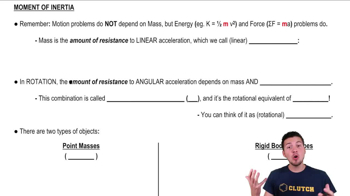
Moment of inertia is a measure of an object's resistance to changes in its rotational motion, depending on the mass distribution relative to the axis of rotation. It is calculated by summing the products of each mass element and the square of its distance from the axis. In this scenario, the moment of inertia of the system will change as the person moves from the center to the edge of the platform, affecting the overall rotational kinetic energy.
Video consigliato:
Percorso guidato
11:47
Intro to Moment of Inertia

Conservation of Angular Momentum

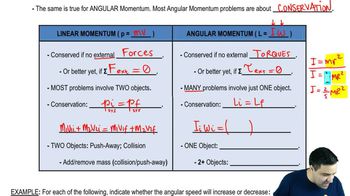
Conservation of angular momentum states that if no external torque acts on a system, its total angular momentum remains constant. In the context of the merry-go-round, as the person walks outward, the moment of inertia increases, which causes the angular velocity to decrease to conserve angular momentum. This principle is essential for analyzing the changes in the system's rotational dynamics during the person's movement.
Video consigliato:
Percorso guidato
12:12
Conservation of Angular Momentum