

Ch. 12 - Static Equilibrium; Elasticity and Fracture
Giancoli Douglas - Physics for Scientists and Engineers 5th edition
Giancoli Douglas5th editionPhysics for Scientists and EngineersISBN: 9780137488179Non è quello che usi tu?Cambia libro di testo
Capitolo 12, Problema 64a

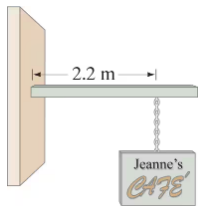
A pole projects horizontally from the front wall of a shop. A 6.1-kg sign hangs from the pole at a point 2.2 m from the wall (Fig. 12–88). What is the torque due to this sign calculated about the point where the pole meets the wall?
A horizontal pole extends from a wall, supporting a 6.1-kg sign hanging 2.2 m away from the wall.

Guida verificata passo dopo passo
1
Identify the formula for torque: Torque (τ) is calculated using the equation τ = r × F × sin(θ), where r is the distance from the pivot point to the point of force application, F is the force, and θ is the angle between the force and the lever arm.
Determine the force acting on the sign: The force is due to the weight of the sign, which is given by F = m × g, where m is the mass of the sign (6.1 kg) and g is the acceleration due to gravity (approximately 9.8 m/s²).
Substitute the values into the torque formula: The distance r is given as 2.2 m, and the angle θ is 90° because the weight acts vertically downward, perpendicular to the horizontal pole. Since sin(90°) = 1, the torque simplifies to τ = r × F.
Combine the expressions: Replace F with m × g in the torque formula, resulting in τ = r × m × g. Substitute the known values for r (2.2 m), m (6.1 kg), and g (9.8 m/s²) into this equation.
Perform the multiplication to find the torque: Multiply the values of r, m, and g to calculate the torque about the point where the pole meets the wall. Ensure the units are consistent, and the result will be in Newton-meters (N·m).

Risposta video verificata per un problema simile:

Questa soluzione video è stata consigliata dai nostri tutor come utile per risolvere questo problema.
Durata del video:
2m

Concetti chiave

Ecco i concetti essenziali che devi comprendere per rispondere correttamente alla domanda.

Torque

Torque is a measure of the rotational force applied to an object around a pivot point. It is calculated as the product of the force applied and the distance from the pivot point to the line of action of the force, often expressed in the formula τ = r × F, where τ is torque, r is the distance, and F is the force. In this scenario, the weight of the sign creates a downward force that generates torque about the point where the pole meets the wall.
Video consigliato:
Percorso guidato
08:55
Net Torque & Sign of Torque

Center of Mass

The center of mass is the point in an object where its mass is evenly distributed in all directions. For a uniform object, like the sign, the center of mass is typically at its geometric center. Understanding the location of the center of mass is crucial for calculating the torque, as the force of gravity acts through this point, affecting the torque produced about the pivot.
Video consigliato:
Percorso guidato
06:30
Intro to Center of Mass

Equilibrium

Equilibrium refers to a state where the sum of forces and the sum of torques acting on an object are zero, resulting in no net movement. In this problem, analyzing the torque due to the sign helps determine if the pole can support the sign without tipping or rotating. If the torque from the sign exceeds the counteracting torque from the pole's support, the system will not be in equilibrium.
Video consigliato:
Percorso guidato
10:13
Torque & Equilibrium
Pratica correlata
Domanda del libro di testo

A 50-story building is being planned. It is to be 180.0 m high with a base 46.0 m by 76.0 m. Its total mass will be about 1.8 x 10⁷ kg, and its weight therefore about 1.8 x 10⁸ N. Suppose a 200-km/h wind exerts a force of 950N/m² over the 76.0-m-wide face (Fig. 12–86). Calculate the torque about the potential pivot point, the rear edge of the building (where FE→\(\overrightarrow{F_{E}\)} acts in Fig. 12–86), and determine whether the building will topple. Assume the total force of the wind acts at the midpoint of the building’s face, and that the building is not anchored in bedrock. [Hint: FE→\(\overrightarrow{F_{E}\)} in Fig. 12–86 represents the force that the Earth would exert on the building in the case where the building would just begin to tip.]

1359
views
Domanda del libro di testo

A pole projects horizontally from the front wall of a shop. A 6.1-kg sign hangs from the pole at a point 2.2 m from the wall (Fig. 12–88). If the pole is not to fall off, there must be another torque exerted to balance it. What exerts this torque? Use a diagram to show how this torque must act.

1244
views
Domanda del libro di testo

The subterranean tension ring that surrounds the dome in Fig. 12–39 exerts the balancing horizontal force on the abutments for the dome and is 36-sided, so each segment makes a 10° angle with the adjacent one (Fig. 12–83). Calculate the tension F that must exist in each segment so that the required force of 4.2 x 10⁵ N can be exerted at each corner (Example 12–14).

1462
views
Domanda del libro di testo

When a mass of 25 kg is hung from the middle of a fixed straight aluminum wire, the wire sags to make an angle of 12° with the horizontal as shown in Fig. 12–90. Determine the radius of the wire.

1435
views
Domanda del libro di testo

A heavy load Mg = 62.0 kN hangs at point E of the single cantilever truss shown in Fig. 12–81. Use a torque equation for the truss as a whole to determine the tension FT in the support cable, and then determine the force FA→\(\overrightarrow{F_{A}\)} on the truss at pin A. Neglect the weight of the trusses, which is small compared to the load.

1353
views
1
rank
Domanda del libro di testo

A pole projects horizontally from the front wall of a shop. A 6.1-kg sign hangs from the pole at a point 2.2 m from the wall (Fig. 12–88). Discuss whether compression, tension, and/or shear play a role in part (b).

1167
views