
Ch. 12 - Static Equilibrium; Elasticity and Fracture
Giancoli Douglas - Physics for Scientists and Engineers 5th edition
Giancoli Douglas5th editionPhysics for Scientists and EngineersISBN: 9780137488179Non è quello che usi tu?Cambia libro di testo
Capitolo 12, Problema 67

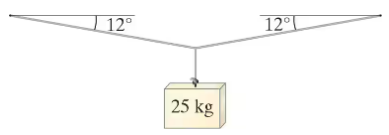
When a mass of 25 kg is hung from the middle of a fixed straight aluminum wire, the wire sags to make an angle of 12° with the horizontal as shown in Fig. 12–90. Determine the radius of the wire.
Diagram showing a 25 kg mass hanging from a wire, which sags at a 12° angle from the horizontal on both sides.

Guida verificata passo dopo passo
1
Identify the forces acting on the system: The weight of the mass (W = m * g) acts vertically downward, where m = 25 kg and g = 9.8 m/s². The tension in the wire has two components: a vertical component balancing the weight and a horizontal component maintaining equilibrium.
Express the vertical force equilibrium: The vertical components of the tension in both sides of the wire must add up to balance the weight of the mass. Let T be the tension in the wire. The vertical component of tension is T * sin(θ), where θ = 12°. Thus, 2 * T * sin(θ) = W.
Solve for the tension T: Rearrange the equation from the previous step to find T. T = W / (2 * sin(θ)). Substitute W = m * g to express T in terms of known quantities.
Relate the tension to the stress in the wire: Stress is defined as force per unit area. The cross-sectional area of the wire is A = π * r², where r is the radius of the wire. The stress is given by σ = T / A.
Use the material properties of aluminum: The stress in the wire is related to the strain (sagging) through Young's modulus (Y) of aluminum. Strain is the ratio of the elongation to the original length. Combine the equations for stress, strain, and Young's modulus to solve for the radius r of the wire.

Risposta video verificata per un problema simile:

Questa soluzione video è stata consigliata dai nostri tutor come utile per risolvere questo problema.
Durata del video:
10m

Concetti chiave

Ecco i concetti essenziali che devi comprendere per rispondere correttamente alla domanda.

Tension in a Wire

When a mass is suspended from a wire, it creates tension within the wire. This tension is the force exerted along the wire, counteracting the weight of the mass. The tension can be calculated using the formula T = mg, where m is the mass and g is the acceleration due to gravity. Understanding how tension works is crucial for analyzing the forces acting on the wire.
Video consigliato:
Percorso guidato
09:57
Magnetic Force on Current-Carrying Wire

Angles and Components of Forces

In this scenario, the wire makes an angle with the horizontal, which means the tension force can be resolved into horizontal and vertical components. The vertical component must balance the weight of the mass, while the horizontal components must be equal on both sides of the wire. This concept is essential for applying trigonometric functions to find the radius of the wire.
Video consigliato:
Percorso guidato
07:30
Vector Addition By Components

Geometry of the Wire

The radius of the wire can be determined by considering the geometry of the situation. The sagging wire forms a triangle with the horizontal and the vertical components of the tension. By applying trigonometric relationships, such as sine and cosine, one can relate the angle of sag to the radius of the wire, allowing for the calculation of its dimensions.
Video consigliato:
Percorso guidato
09:57
Magnetic Force on Current-Carrying Wire
Pratica correlata
Domanda del libro di testo

A uniform 95-kg flagpole of length 8.4 m is being erected by pulling on a rope attached 2/3 of the way to the top (Fig. 12–94). When the pole is inclined at 35° and the rope makes an angle with the ground of 18°, what is the tension in the rope?

1542
views
Domanda del libro di testo

A steel rod of radius R = 15 cm and length ℓ₀ stands upright on a firm surface. A 78-kg man climbs atop the rod. When a metal is compressed, each atom throughout its bulk moves closer to its neighboring atom by exactly the same fractional amount. If iron atoms in steel are normally 2.0 x 10⁻¹⁰ m apart, by what distance did this interatomic spacing have to change in order to produce the normal force required to support the man? [Note: Neighboring atoms repel each other, and this repulsion accounts for the observed normal force.]

1288
views
Domanda del libro di testo

A pole projects horizontally from the front wall of a shop. A 6.1-kg sign hangs from the pole at a point 2.2 m from the wall (Fig. 12–88). If the pole is not to fall off, there must be another torque exerted to balance it. What exerts this torque? Use a diagram to show how this torque must act.

1244
views
Domanda del libro di testo

A 25-kg object is being lifted by two people pulling on the ends of a 1.15-mm-diameter nylon cord that goes over two 3.00-m-high poles that are 4.5 m apart, as shown in Fig. 12–93. How high above the floor will the object be when the cord breaks?

1808
views
Domanda del libro di testo

A pole projects horizontally from the front wall of a shop. A 6.1-kg sign hangs from the pole at a point 2.2 m from the wall (Fig. 12–88). Discuss whether compression, tension, and/or shear play a role in part (b).

1167
views
Domanda del libro di testo

A pole projects horizontally from the front wall of a shop. A 6.1-kg sign hangs from the pole at a point 2.2 m from the wall (Fig. 12–88). What is the torque due to this sign calculated about the point where the pole meets the wall?

1216
views