Ch. 12 - Static Equilibrium; Elasticity and Fracture
Giancoli Douglas - Physics for Scientists and Engineers 5th edition
Giancoli Douglas5th editionPhysics for Scientists and EngineersISBN: 9780137488179Non è quello che usi tu?Cambia libro di testo
Capitolo 12, Problema 29

A refrigerator is approximately a uniform rectangular solid 1.9 m tall, 1.0 m wide, and 0.75 m deep. If it sits upright on a truck with its 1.0-m dimension in the direction of travel, and if the refrigerator cannot slide on the truck, how rapidly can the truck accelerate without tipping the refrigerator over? [Hint: The normal force would act at one corner.]

Guida verificata passo dopo passo
1
Determine the center of mass of the refrigerator. Since the refrigerator is a uniform rectangular solid, its center of mass is located at the geometric center. This would be at a height of 0.95 m (half of 1.9 m) from the base and at the midpoint of the width and depth dimensions (0.5 m and 0.375 m, respectively).
Identify the tipping point. The refrigerator will tip over if the line of action of the center of mass extends beyond the edge of the base. In this case, the edge of the base is at the corner of the rectangle in the direction of travel (1.0 m wide).
Analyze the forces and torques. When the truck accelerates, the refrigerator experiences a horizontal inertial force due to its mass and the truck's acceleration. This force creates a torque about the tipping edge. The normal force and gravitational force also create torques, which must balance to prevent tipping.
Set up the torque equation. Let the mass of the refrigerator be \( m \), the acceleration of the truck be \( a \), and the gravitational acceleration be \( g \). The torque due to the inertial force is \( \tau_{\text{inertial}} = m a \cdot 0.95 \), and the torque due to the gravitational force is \( \tau_{\text{gravitational}} = m g \cdot 0.5 \). For the refrigerator to remain stable, \( \tau_{\text{gravitational}} \geq \tau_{\text{inertial}} \).
Solve for the maximum acceleration. Rearrange the inequality \( m g \cdot 0.5 \geq m a \cdot 0.95 \) to isolate \( a \). The mass \( m \) cancels out, leaving \( a \leq \frac{g \cdot 0.5}{0.95} \). Substitute the value of \( g \) (9.8 m/s²) to find the maximum acceleration.

Risposta video verificata per un problema simile:

Questa soluzione video è stata consigliata dai nostri tutor come utile per risolvere questo problema.
Durata del video:
8m

Concetti chiave

Ecco i concetti essenziali che devi comprendere per rispondere correttamente alla domanda.

Torque

Torque is a measure of the rotational force acting on an object. In the context of the refrigerator, it is crucial to understand how the weight of the refrigerator creates a torque about the tipping point when the truck accelerates. The torque depends on the force applied (weight) and the distance from the pivot point (corner of the refrigerator). If the torque due to the weight exceeds the torque due to the normal force, the refrigerator will tip over.
Video consigliato:
Percorso guidato
08:55
Net Torque & Sign of Torque

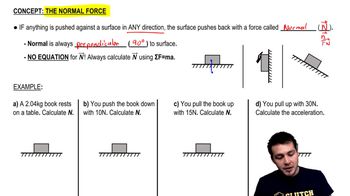
Normal Force

The normal force is the perpendicular force exerted by a surface to support the weight of an object resting on it. In this scenario, as the truck accelerates, the normal force acts at the corner of the refrigerator, creating a counteracting torque. Understanding how the normal force changes with acceleration is essential to determine the maximum acceleration before tipping occurs.
Video consigliato:
Percorso guidato
08:17
The Normal Force

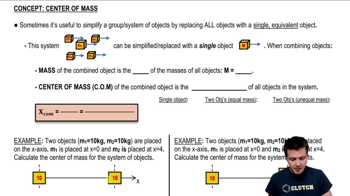
Center of Mass

The center of mass is the point at which the mass of an object is concentrated and around which its weight is evenly distributed. For the refrigerator, the center of mass is crucial in determining stability. When the truck accelerates, the center of mass shifts, and if it moves beyond the base of support (the area in contact with the truck), the refrigerator will tip over. Analyzing the position of the center of mass helps predict tipping behavior.
Video consigliato:
Percorso guidato
06:30
Intro to Center of Mass
Pratica correlata
Domanda del libro di testo

A 2300-kg trailer is attached to a stationary truck at point B, Fig. 12–64. Determine the normal force exerted by the road on the rear tires at A, and the vertical force exerted on the trailer by the support B.

1373
views

Domanda del libro di testo

The Leaning Tower of Pisa is 55 m tall and about 7.7 m in radius. The top is 4.5 m off center. Is the tower in stable equilibrium? If so, how much farther can it lean before it becomes unstable? Assume the tower is of uniform composition.

1564
views
Domanda del libro di testo

A uniform rod AB of length 4.5 m and mass M = 3.8 kg is hinged at A and held in equilibrium by a light cord, as shown in Fig. 12–69. A load W = 22 N hangs from the rod at a distance d so that the tension in the cord is 85 N. Draw a free-body diagram for the rod.

1182
views
Domanda del libro di testo

A 172-cm-tall person lies on a light (massless) board which is supported by two scales, one under the top of her head and one beneath the bottom of her feet (Fig. 12–65). The two scales read, respectively, 35.1 and 31.6 kg. What distance is the center of gravity of this person from the top of her head?

<IMAGE>

1425
views
Domanda del libro di testo

A marble column of cross-sectional area 1.4m² supports a mass of 22,000 kg. By how much is the column shortened if it is 8.6 m high?

1795
views
Domanda del libro di testo

A 15-cm-long tendon was found to stretch 3.7 mm by a force of 13.4 N. The tendon was approximately round with an average diameter of 8.5 mm. Calculate Young’s modulus of this tendon.

70
views