
Ch. 14 - Oscillations
Giancoli Douglas - Physics for Scientists and Engineers 5th edition
Giancoli Douglas5th editionPhysics for Scientists and EngineersISBN: 9780137488179Non è quello che usi tu?Cambia libro di testo
Capitolo 14, Problema 86b

A 280-kg wooden raft floats on a lake. When a 68-kg man stands on the raft, it sinks 3.5 cm deeper into the water. When he steps off, the raft oscillates for a while. What is the total energy of oscillation (ignoring damping)?

Guida verificata passo dopo passo
1
Determine the spring constant (k) of the raft-water system using Hooke's Law. The additional force exerted by the man is equal to his weight, which is given by \( F = mg \), where \( m = 68 \; \text{kg} \) and \( g = 9.8 \; \text{m/s}^2 \). The displacement caused by this force is \( x = 3.5 \; \text{cm} = 0.035 \; \text{m} \). Using Hooke's Law \( F = kx \), solve for \( k \): \( k = \frac{F}{x} = \frac{mg}{x} \).
Calculate the angular frequency (\( \omega \)) of the oscillation. The angular frequency for a mass-spring system is given by \( \omega = \sqrt{\frac{k}{m_\text{raft}}} \), where \( m_\text{raft} = 280 \; \text{kg} \) is the mass of the raft. Substitute the value of \( k \) from the previous step into this formula.
Determine the amplitude (A) of the oscillation. The amplitude is the maximum displacement of the raft, which is given as \( A = 0.035 \; \text{m} \) (the depth the raft sank when the man stood on it).
Calculate the total energy of oscillation (E). The total energy in a mass-spring system is given by \( E = \frac{1}{2}kA^2 \), where \( k \) is the spring constant and \( A \) is the amplitude. Substitute the values of \( k \) and \( A \) into this formula.
Combine all the results to express the total energy of oscillation in terms of the given quantities. Ensure all units are consistent and verify the formula \( E = \frac{1}{2}kA^2 \) is applied correctly.

Risposta video verificata per un problema simile:

Questa soluzione video è stata consigliata dai nostri tutor come utile per risolvere questo problema.
Durata del video:
5m

Concetti chiave

Ecco i concetti essenziali che devi comprendere per rispondere correttamente alla domanda.

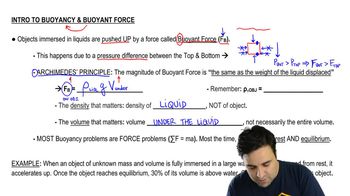
Buoyancy

Buoyancy is the upward force exerted by a fluid on an object submerged in it. This force is equal to the weight of the fluid displaced by the object, as described by Archimedes' principle. In this scenario, the wooden raft displaces a volume of water equal to its weight plus the weight of the man, which determines how much it sinks when he stands on it.
Video consigliato:
Percorso guidato
11:06
Intro to Buoyancy & Buoyant Force

Oscillation

Oscillation refers to the repetitive variation, typically in time, of some measure about a central value. In the context of the raft, when the man steps off, the raft's buoyancy causes it to move up and down, creating oscillations. The energy associated with these oscillations is related to the potential energy of the raft as it moves through its equilibrium position.
Video consigliato:
Percorso guidato
04:26
Oscillations in an LC Circuit

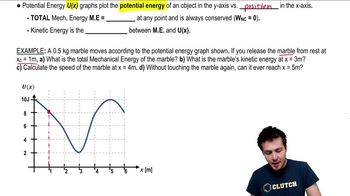
Potential Energy

Potential energy is the stored energy in an object due to its position or configuration. For the raft, when it sinks deeper into the water, it gains gravitational potential energy relative to its original position. The total energy of oscillation can be calculated by considering the potential energy change as the raft moves up and down in response to the man's weight.
Video consigliato:
Percorso guidato
07:24
Potential Energy Graphs