Ch. 14 - Oscillations
Giancoli Douglas - Physics for Scientists and Engineers 5th edition
Giancoli Douglas5th editionPhysics for Scientists and EngineersISBN: 9780137488179Non è quello che usi tu?Cambia libro di testo
Capitolo 14, Problema 67

An 1150-kg automobile has springs with k = 14,000 N/m. One of the tires is not properly balanced; it has a little extra mass on one side compared to the other, causing the car to shake at certain speeds. If the tire radius is 42 cm, at what speed will the wheel shake most?

Guida verificata passo dopo passo
1
Step 1: Recognize that the problem involves a resonance phenomenon. The car will shake most at the natural frequency of the spring-mass system. The natural frequency can be calculated using the formula \( f = \frac{1}{2\pi} \sqrt{\frac{k}{m}} \), where \( k \) is the spring constant and \( m \) is the mass of the automobile.
Step 2: Convert the given spring constant \( k = 14,000 \, \text{N/m} \) and mass \( m = 1150 \, \text{kg} \) into the formula. Substitute these values into \( f = \frac{1}{2\pi} \sqrt{\frac{k}{m}} \) to find the natural frequency of the system.
Step 3: Once the natural frequency \( f \) is determined, calculate the angular frequency \( \omega \) using the relationship \( \omega = 2\pi f \). This angular frequency corresponds to the rate at which the system oscillates.
Step 4: Relate the angular frequency \( \omega \) to the speed of the wheel. The speed \( v \) at which the wheel shakes most can be calculated using \( v = \omega \cdot r \), where \( r \) is the radius of the tire. Convert the radius \( r = 42 \, \text{cm} \) into meters (\( r = 0.42 \, \text{m} \)) before substituting into the formula.
Step 5: Substitute the calculated angular frequency \( \omega \) and the radius \( r \) into \( v = \omega \cdot r \) to determine the speed at which the wheel shakes most. Ensure all units are consistent throughout the calculation.

Risposta video verificata per un problema simile:

Questa soluzione video è stata consigliata dai nostri tutor come utile per risolvere questo problema.
Durata del video:
7m

Concetti chiave

Ecco i concetti essenziali che devi comprendere per rispondere correttamente alla domanda.

Simple Harmonic Motion

Simple Harmonic Motion (SHM) describes the oscillatory motion of an object where the restoring force is directly proportional to the displacement from its equilibrium position. In this context, the shaking of the automobile due to the unbalanced tire can be modeled as SHM, where the frequency of oscillation is influenced by the mass distribution and spring constant.
Video consigliato:
Percorso guidato
07:52
Simple Harmonic Motion of Pendulums

Natural Frequency

Natural frequency is the frequency at which a system tends to oscillate in the absence of any driving force. For the automobile's suspension system, the natural frequency can be calculated using the mass of the car and the spring constant. When the car reaches a speed that matches this frequency, resonance occurs, leading to increased shaking.
Video consigliato:
Percorso guidato
10:30
Ray Nature of Light

Resonance

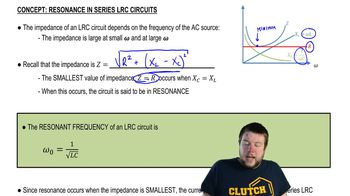
Resonance is a phenomenon that occurs when a system is driven at its natural frequency, resulting in large amplitude oscillations. In the case of the automobile, if the speed of the car matches the natural frequency of the tire's oscillation due to the imbalance, the shaking will be most pronounced, potentially causing discomfort and instability.
Video consigliato:
Percorso guidato
05:23
Resonance in Series LRC Circuits
Pratica correlata
Domanda del libro di testo

What is the period of a simple pendulum 47 cm long when it is in a freely falling elevator?

1733
views

Domanda del libro di testo

A clock pendulum oscillates at a frequency of 2.5 Hz. At t = 0, it is released from rest starting at an angle of 12° to the vertical. Ignoring friction, what will be the position (angle in radians) of the pendulum at t = 0.25 s?

1537
views
Domanda del libro di testo

In Section 14–5, the oscillation of a simple pendulum (Fig. 14–48) is viewed as linear motion along the arc length 𝓍 and analyzed via F = ma. Alternatively, the pendulum’s movement can be regarded as rotational motion about its point of support and analyzed using T = Iα. Carry out this alternative analysis and show that θ (t) = θₘₐₓ cos (gl\(\sqrt{\frac{g}{l}\)}t + θ), where θ (t) is the angular displacement of the pendulum from the vertical at time t, as long as its maximum value is less than about .

1567
views
Domanda del libro di testo

An energy-absorbing car bumper has a spring constant of 410 kN/m. Find the maximum compression of the bumper if the car, with mass 1300 kg, collides with a wall at a speed of 2.0 m/s (approximately 5 mi/h).

1608
views
Domanda del libro di testo

At t = 0, an 885-g mass at rest on the end of a horizontal spring (k = 184 N/m) is struck by a hammer which gives it an initial speed of 2.12 m/s. Determine the period and frequency of the motion.

793
views
Domanda del libro di testo

A 280-kg wooden raft floats on a lake. When a 68-kg man stands on the raft, it sinks 3.5 cm deeper into the water. When he steps off, the raft oscillates for a while. What is the total energy of oscillation (ignoring damping)?

1552
views