
Ch. 14 - Oscillations
Giancoli Douglas - Physics for Scientists and Engineers 5th edition
Giancoli Douglas5th editionPhysics for Scientists and EngineersISBN: 9780137488179Non è quello che usi tu?Cambia libro di testo
Capitolo 14, Problema 35a

A mass resting on a horizontal, frictionless surface is attached to one end of a spring; the other end of the spring is fixed to a wall. It takes 3.2 J of work to compress the spring by 0.13 m. The mass is then released from rest and experiences a maximum acceleration of 12m/s². Find the value of the spring constant.

Guida verificata passo dopo passo
1
Step 1: Recall the formula for the work done on a spring, which is given by \( W = \frac{1}{2} k x^2 \), where \( W \) is the work done, \( k \) is the spring constant, and \( x \) is the compression or extension of the spring. Here, \( W = 3.2 \; \text{J} \) and \( x = 0.13 \; \text{m} \). Rearrange the formula to solve for \( k \): \( k = \frac{2W}{x^2} \).
Step 2: Substitute the given values into the formula. Use \( W = 3.2 \; \text{J} \) and \( x = 0.13 \; \text{m} \). The equation becomes \( k = \frac{2(3.2)}{(0.13)^2} \).
Step 3: Simplify the denominator \( (0.13)^2 \) and the numerator \( 2(3.2) \). Then divide the numerator by the denominator to find the spring constant \( k \).
Step 4: Verify the units of \( k \). Since work \( W \) is in joules (\( \text{kg} \cdot \text{m}^2 / \text{s}^2 \)) and \( x \) is in meters, the units of \( k \) will be \( \text{N/m} \), which is consistent with the spring constant's unit.
Step 5: Conclude that the spring constant \( k \) has been determined using the given data and the work-energy relationship for a spring.

Risposta video verificata per un problema simile:

Questa soluzione video è stata consigliata dai nostri tutor come utile per risolvere questo problema.
Durata del video:
2m

Concetti chiave

Ecco i concetti essenziali che devi comprendere per rispondere correttamente alla domanda.

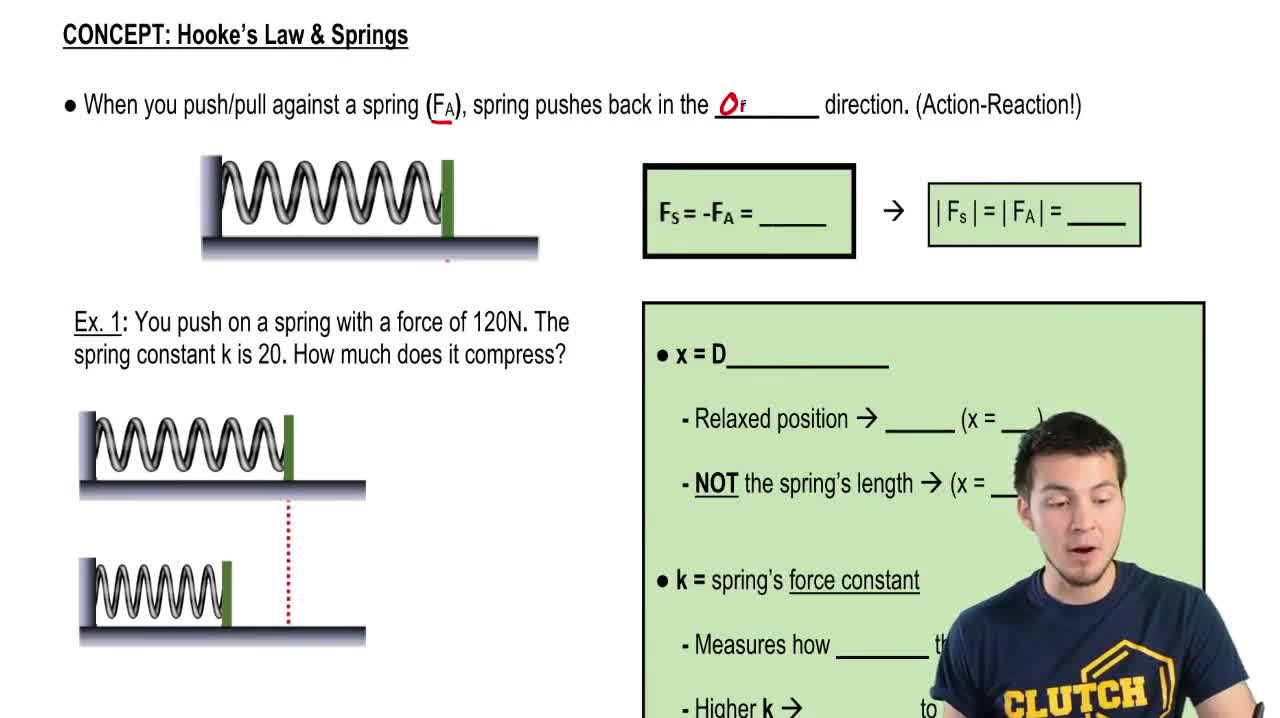
Hooke's Law

Hooke's Law states that the force exerted by a spring is directly proportional to its displacement from the equilibrium position, expressed as F = -kx, where F is the force, k is the spring constant, and x is the displacement. This principle is fundamental in understanding how springs behave under compression or extension.
Video consigliato:
Percorso guidato
05:27
Spring Force (Hooke's Law)

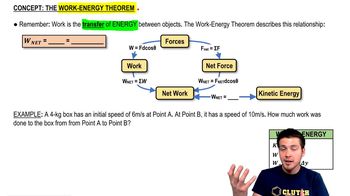
Work-Energy Principle

The Work-Energy Principle states that the work done on an object is equal to the change in its kinetic energy. In the context of the spring, the work done to compress it is stored as potential energy, which is converted into kinetic energy when the mass is released, allowing us to relate work to the spring's properties.
Video consigliato:
Percorso guidato
04:10
The Work-Energy Theorem

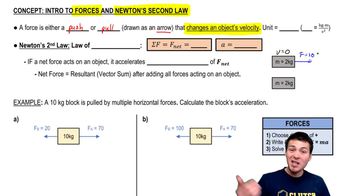
Acceleration and Newton's Second Law

Newton's Second Law states that the acceleration of an object is directly proportional to the net force acting on it and inversely proportional to its mass, expressed as F = ma. This relationship is crucial for determining the forces acting on the mass when it is released from the spring, allowing us to calculate the spring constant using the maximum acceleration experienced.
Video consigliato:
Percorso guidato
06:54
Intro to Forces & Newton's Second Law
Pratica correlata