Ch. 14 - Oscillations
Giancoli Douglas - Physics for Scientists and Engineers 5th edition
Giancoli Douglas5th editionPhysics for Scientists and EngineersISBN: 9780137488179Non è quello che usi tu?Cambia libro di testo
Capitolo 14, Problema 36

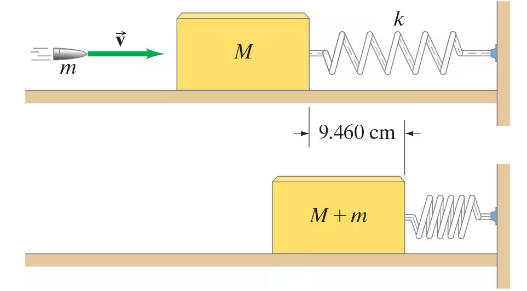
Agent Arlene devised the following method of measuring the muzzle velocity of a rifle (Fig. 14–34). She fires a bullet into a 4.148-kg wooden block resting on a smooth surface, and attached to a spring of spring constant k = 162.7 N/m. The bullet, whose mass is 7.450 g, remains embedded in the wooden block. She measures the maximum distance that the block compresses the spring to be 9.460 cm. What is the speed υ of the bullet?
Diagram showing a bullet impacting a block attached to a spring, illustrating spring compression and mass variables.

Guida verificata passo dopo passo
1
Convert all given quantities to SI units. The mass of the bullet is 7.450 g = 0.007450 kg, the spring constant k = 162.7 N/m, and the maximum compression of the spring is 9.460 cm = 0.09460 m.
Use the principle of conservation of energy to relate the spring's maximum compression to the kinetic energy of the block-bullet system. The potential energy stored in the spring at maximum compression is given by the formula: \( U = \frac{1}{2} k x^2 \), where \( x \) is the compression of the spring.
Calculate the total mass of the block-bullet system. Since the bullet embeds itself in the block, the total mass is \( m_{\text{total}} = m_{\text{block}} + m_{\text{bullet}} \).
Use the conservation of momentum to relate the initial velocity of the bullet to the velocity of the block-bullet system just after the collision. The equation is: \( m_{\text{bullet}} v_{\text{bullet}} = m_{\text{total}} v_{\text{system}} \), where \( v_{\text{system}} \) is the velocity of the block-bullet system immediately after the collision.
Combine the results from the energy conservation and momentum conservation equations. Solve for the initial velocity of the bullet \( v_{\text{bullet}} \) using the relationship between the spring's potential energy and the system's kinetic energy: \( \frac{1}{2} m_{\text{total}} v_{\text{system}}^2 = \frac{1}{2} k x^2 \). Substitute \( v_{\text{system}} \) from the momentum equation into this energy equation to find \( v_{\text{bullet}} \).

Risposta video verificata per un problema simile:

Questa soluzione video è stata consigliata dai nostri tutor come utile per risolvere questo problema.
Durata del video:
9m

Concetti chiave

Ecco i concetti essenziali che devi comprendere per rispondere correttamente alla domanda.

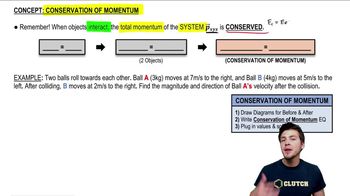
Conservation of Momentum

The principle of conservation of momentum states that in a closed system, the total momentum before an event must equal the total momentum after the event. In this scenario, when the bullet embeds itself in the wooden block, the momentum of the bullet-block system is conserved. This allows us to relate the initial momentum of the bullet to the combined momentum of the bullet and block after the collision.
Video consigliato:
Percorso guidato
05:58
Conservation Of Momentum

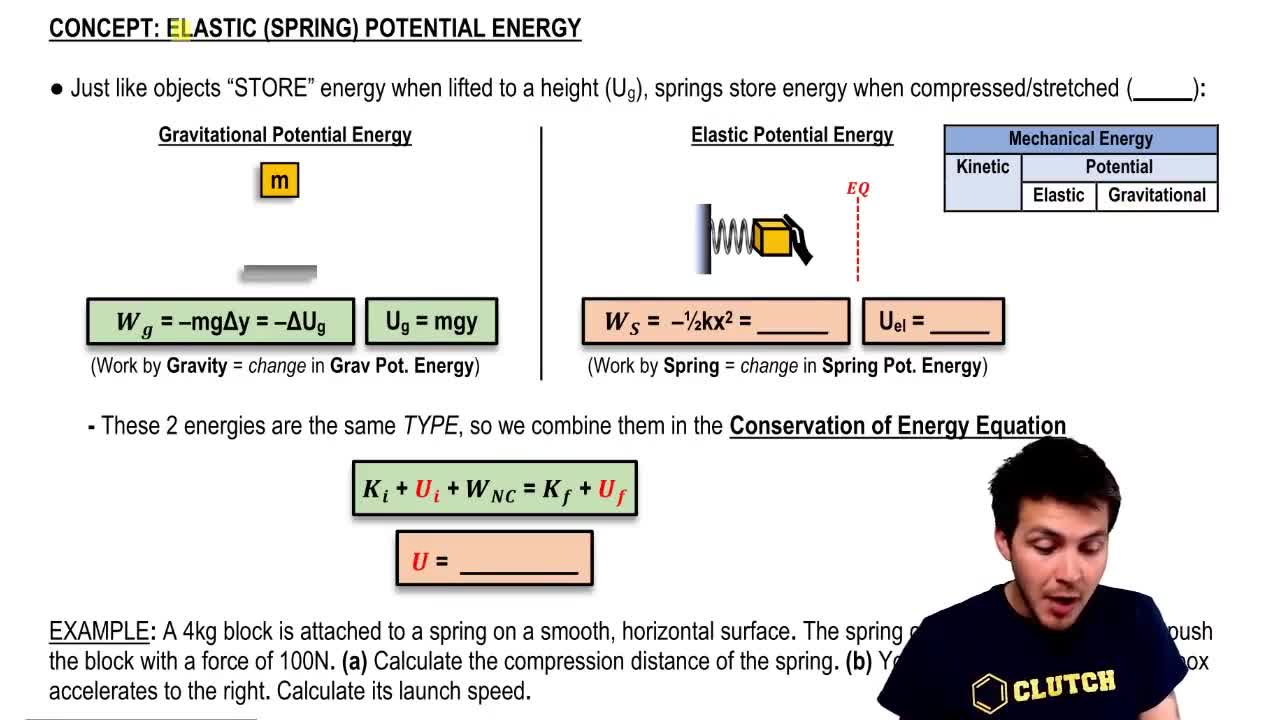
Spring Potential Energy

Spring potential energy is the energy stored in a compressed or stretched spring, calculated using the formula PE = (1/2)kx², where k is the spring constant and x is the displacement from the equilibrium position. In this problem, the maximum compression of the spring indicates the amount of kinetic energy transferred to the spring, which can be equated to the initial kinetic energy of the bullet-block system to find the bullet's speed.
Video consigliato:
Percorso guidato
06:18
Energy in Horizontal Springs

Kinetic Energy

Kinetic energy is the energy possessed by an object due to its motion, expressed as KE = (1/2)mv², where m is the mass and v is the velocity of the object. In this context, the kinetic energy of the bullet before it strikes the block is converted into potential energy in the spring when the block is compressed, allowing us to calculate the bullet's initial speed based on the energy transfer.
Video consigliato:
Percorso guidato
06:07
Intro to Rotational Kinetic Energy
Pratica correlata
Domanda del libro di testo

What is the period of a simple pendulum 47 cm long when it is in a freely falling elevator?

1733
views

Domanda del libro di testo

A mass resting on a horizontal, frictionless surface is attached to one end of a spring; the other end of the spring is fixed to a wall. It takes 3.2 J of work to compress the spring by 0.13 m. The mass is then released from rest and experiences a maximum acceleration of 12m/s². Find the value of the spring constant.

1774
views
Domanda del libro di testo

A clock pendulum oscillates at a frequency of 2.5 Hz. At t = 0, it is released from rest starting at an angle of 12° to the vertical. Ignoring friction, what will be the position (angle in radians) of the pendulum at t = 0.25 s?

1537
views
Domanda del libro di testo

At t = 0, an 885-g mass at rest on the end of a horizontal spring (k = 184 N/m) is struck by a hammer which gives it an initial speed of 2.12 m/s. Determine the period and frequency of the motion.

793
views
Domanda del libro di testo

A 0.25-kg mass at the end of a spring oscillates 3.2 times per second with an amplitude of 0.15 m. Determine the equation describing the motion of the mass, assuming that at t = 0, 𝓍 was a maximum.

704
views
Domanda del libro di testo

An object with mass 2.7 kg is executing simple harmonic motion, attached to a spring with spring constant k = 310 N/m. When the object is 0.020 m from its equilibrium position, it is moving with a speed of 0.60 m/s. Calculate the maximum speed attained by the object.

1681
views