
Ch. 17 - Temperature, Thermal Expansion, and the Ideal Gas Law
Giancoli Douglas - Physics for Scientists and Engineers 5th edition
Giancoli Douglas5th editionPhysics for Scientists and EngineersISBN: 9780137488179Non è quello che usi tu?Cambia libro di testo
Capitolo 17, Problema 86

A brass lid screws tightly onto a glass jar at 15°C. To help open the jar, it can be placed into a bath of hot water. After this treatment, the temperatures of the lid and the jar are both 55°C. The inside diameter of the lid is 7.0 cm. Find the size of the gap (difference in radius) that develops by this procedure.

Guida verificata passo dopo passo
1
Determine the formula for linear thermal expansion: ΔL = α × L₀ × ΔT, where ΔL is the change in length, α is the coefficient of linear expansion, L₀ is the original length, and ΔT is the change in temperature.
Identify the coefficients of linear expansion for brass and glass. For brass, α_brass ≈ 19 × 10⁻⁶ /°C, and for glass, α_glass ≈ 9 × 10⁻⁶ /°C.
Calculate the change in radius for the brass lid using the formula ΔL = α × L₀ × ΔT. Here, L₀ is the original radius of the lid (7.0 cm / 2 = 3.5 cm), and ΔT = 55°C - 15°C = 40°C.
Similarly, calculate the change in radius for the glass jar using the same formula, with the same ΔT and the same initial radius (3.5 cm). Use the coefficient of linear expansion for glass.
Find the size of the gap by subtracting the change in radius of the glass jar from the change in radius of the brass lid: Gap = ΔR_brass - ΔR_glass.

Risposta video verificata per un problema simile:

Questa soluzione video è stata consigliata dai nostri tutor come utile per risolvere questo problema.
Durata del video:
8m

Concetti chiave

Ecco i concetti essenziali che devi comprendere per rispondere correttamente alla domanda.

Thermal Expansion

Thermal expansion refers to the increase in size of materials as they are heated. Different materials expand at different rates, characterized by their coefficient of linear expansion. In this scenario, the brass lid will expand more than the glass jar when both are heated, which is crucial for understanding how the gap develops.
Video consigliato:
Percorso guidato
05:21
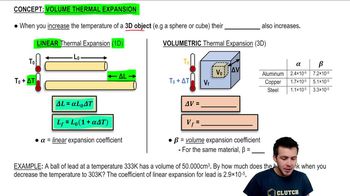
Volume Thermal Expansion

Coefficient of Linear Expansion

The coefficient of linear expansion is a material-specific value that quantifies how much a material expands per degree of temperature increase. For brass, this coefficient is higher than that of glass, meaning that for the same temperature change, brass will expand more than glass, leading to a change in the fit between the lid and the jar.
Video consigliato:
Percorso guidato
07:31
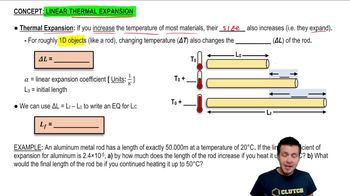
Linear Thermal Expansion

Gap Calculation

To find the size of the gap that develops between the lid and the jar, one must calculate the change in radius for both the lid and the jar due to thermal expansion. This involves using the formula for linear expansion, which is ΔL = αL0ΔT, where ΔL is the change in length (or radius), α is the coefficient of linear expansion, L0 is the original length (or radius), and ΔT is the change in temperature.
Video consigliato:
Percorso guidato
04:15
Calculating Dot Product Using Vector Components
Pratica correlata
Domanda del libro di testo

Why snorkels are not 4 feet long. Snorkelers breathe through short tubular “snorkels” while swimming under water very near the surface (Fig. 17–24). One end of the snorkel is in the snorkeler’s mouth and the other end protrudes just above the water’s surface. Unfortunately, snorkels cannot support breathing to any great depth: it is said that a typical snorkeler below a water depth of only about 30 cm cannot draw a breath through a snorkel. Based on this observation, what is the approximate change in a typical person’s lung pressure (in atm) when drawing a breath? (Note that your diaphragm muscles, which expand your lungs, must work also against the extra water pressure.)

<IMAGE>

1404
views
Domanda del libro di testo

Assume that in an alternate universe, the laws of physics are very different from ours and that “ideal” gases behave as follows: At constant pressure, the volume varies directly with the 2/3 power of the temperature.

1136
views
Domanda del libro di testo

Assume that in an alternate universe, the laws of physics are very different from ours and that “ideal” gases behave as follows: At 273.15 K and 1.00 atm pressure, 1.00 mole of an ideal gas is found to occupy 22.4 L. Obtain the form of the ideal gas law in this alternate universe, including the value of the gas constant R.

1187
views
Domanda del libro di testo

A helium balloon has volume V₀ and temperature T₀ at sea level where the pressure is P₀ and the air density is ρ₀. The balloon is allowed to float up in the air to altitude y where the temperature is T₁. Show that the buoyant force does not depend on altitude y. Assume that the skin of the balloon maintains the helium pressure at a constant factor of 1.05 times greater than the outside pressure. [Hint: Assume that the pressure change with altitude is P = P₀ e⁻ᶜʸ , Eq. 13–6c in Chapter 13.]

1290
views
Domanda del libro di testo

A copper wire sags 54.0 cm between two utility poles 30.0 m apart when the temperature is -15° C. Estimate the amount of sag when the temperature is + 35° C. [Hint: An estimate can be made by assuming the shape of the wire is approximately an arc of a circle; hard equations can sometimes be solved by guessing values.]

1180
views
Domanda del libro di testo

From the known value of atmospheric pressure at the surface of the Earth, estimate the total number of air molecules in the Earth’s atmosphere.

1073
views