
Ch. 17 - Temperature, Thermal Expansion, and the Ideal Gas Law
Giancoli Douglas - Physics for Scientists and Engineers 5th edition
Giancoli Douglas5th editionPhysics for Scientists and EngineersISBN: 9780137488179Non è quello che usi tu?Cambia libro di testo
Capitolo 17, Problema 76c

Assume that in an alternate universe, the laws of physics are very different from ours and that “ideal” gases behave as follows: At 273.15 K and 1.00 atm pressure, 1.00 mole of an ideal gas is found to occupy 22.4 L. Obtain the form of the ideal gas law in this alternate universe, including the value of the gas constant R.

Guida verificata passo dopo passo
1
Step 1: Begin by recalling the general form of the ideal gas law in our universe: \( PV = nRT \), where \( P \) is pressure, \( V \) is volume, \( n \) is the number of moles, \( R \) is the gas constant, and \( T \) is temperature.
Step 2: In this alternate universe, the problem specifies that at \( T = 273.15 \ \text{K} \), \( P = 1.00 \ \text{atm} \), \( n = 1.00 \ \text{mole} \), and \( V = 22.4 \ \text{L} \). Substitute these values into the ideal gas law to solve for \( R \).
Step 3: Rearrange the equation \( PV = nRT \) to isolate \( R \): \( R = \frac{PV}{nT} \). This will allow you to calculate the value of \( R \) in this alternate universe.
Step 4: Substitute the given values into the rearranged equation: \( R = \frac{(1.00 \ \text{atm})(22.4 \ \text{L})}{(1.00 \ \text{mole})(273.15 \ \text{K})} \). Ensure that the units are consistent and compatible for the calculation.
Step 5: The form of the ideal gas law in this alternate universe remains \( PV = nRT \), but the value of \( R \) is determined using the substitution above. The numerical value of \( R \) can be calculated using the provided data, but the process stops here without computing the final result.

Risposta video verificata per un problema simile:

Questa soluzione video è stata consigliata dai nostri tutor come utile per risolvere questo problema.
Durata del video:
4m

Concetti chiave

Ecco i concetti essenziali che devi comprendere per rispondere correttamente alla domanda.

Ideal Gas Law

The Ideal Gas Law is a fundamental equation in thermodynamics that relates the pressure, volume, temperature, and number of moles of a gas. It is typically expressed as PV = nRT, where P is pressure, V is volume, n is the number of moles, R is the gas constant, and T is temperature in Kelvin. This law assumes that gases behave ideally, meaning they follow certain assumptions about particle interactions and volume.
Video consigliato:
Percorso guidato
07:21
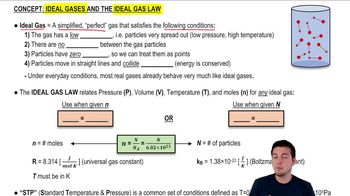
Ideal Gases and the Ideal Gas Law

Gas Constant (R)

The gas constant (R) is a proportionality factor in the Ideal Gas Law that relates the energy scale to the temperature scale. Its value depends on the units used for pressure, volume, and temperature. In standard conditions, R is commonly taken as 0.0821 L·atm/(K·mol) in the context of ideal gases. In the alternate universe described, R will need to be recalculated based on the new conditions provided.
Video consigliato:
Percorso guidato
08:59
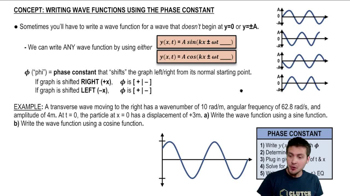
Phase Constant of a Wave Function

Conditions of Ideal Gases

Ideal gases are defined under specific conditions where they exhibit predictable behavior, typically at high temperatures and low pressures. The behavior of gases can deviate from ideality under extreme conditions, such as high pressure or low temperature. In this alternate universe scenario, understanding how the gas behaves at 273.15 K and 1.00 atm is crucial for deriving the modified form of the Ideal Gas Law and determining the new value of R.
Video consigliato:
Percorso guidato
07:21
Ideal Gases and the Ideal Gas Law
Pratica correlata
Domanda del libro di testo

Estimate how many molecules of air are in each 2.0-L breath you inhale that were also in the last breath Galileo took. Assume the atmosphere is about 10 km high and of constant density. What other assumptions did you make?

110
views
Domanda del libro di testo

A brass lid screws tightly onto a glass jar at 15°C. To help open the jar, it can be placed into a bath of hot water. After this treatment, the temperatures of the lid and the jar are both 55°C. The inside diameter of the lid is 7.0 cm. Find the size of the gap (difference in radius) that develops by this procedure.

1058
views
Domanda del libro di testo

Assume that in an alternate universe, the laws of physics are very different from ours and that “ideal” gases behave as follows: At constant pressure, the volume varies directly with the 2/3 power of the temperature.

1136
views
Domanda del libro di testo

A helium balloon has volume V₀ and temperature T₀ at sea level where the pressure is P₀ and the air density is ρ₀. The balloon is allowed to float up in the air to altitude y where the temperature is T₁. Show that the buoyant force does not depend on altitude y. Assume that the skin of the balloon maintains the helium pressure at a constant factor of 1.05 times greater than the outside pressure. [Hint: Assume that the pressure change with altitude is P = P₀ e⁻ᶜʸ , Eq. 13–6c in Chapter 13.]

1290
views
Domanda del libro di testo

Assume that in an alternate universe, the laws of physics are very different from ours and that “ideal” gases behave as follows: At constant temperature, pressure is inversely proportional to the square of the volume.

1309
views
Domanda del libro di testo

From the known value of atmospheric pressure at the surface of the Earth, estimate the total number of air molecules in the Earth’s atmosphere.

1073
views