Ch. 18 - Kinetic Theory of Gases
Giancoli Douglas - Physics for Scientists and Engineers 5th edition
Giancoli Douglas5th editionPhysics for Scientists and EngineersISBN: 9780137488179Non è quello che usi tu?Cambia libro di testo
Capitolo 18, Problema 46a

At about what pressure would the mean free path of air molecules be 0.30 m? Assume T = 20° C.

Guida verificata passo dopo passo
1
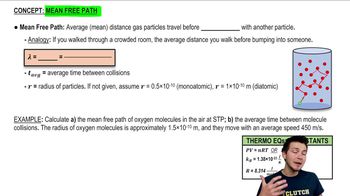
Determine the formula for the mean free path (λ) of air molecules. The mean free path is given by: λ=14πr2n, where r2 is the molecular radius squared, and n is the number density of molecules.
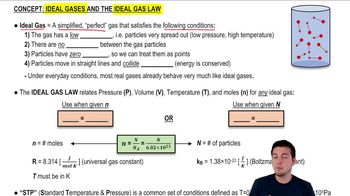
Relate the number density of molecules n to the pressure P using the ideal gas law: n=PkT, where k is the Boltzmann constant and T is the temperature in kelvins.
Substitute n from the ideal gas law into the mean free path formula: λ=k4πr2P. Rearrange this equation to solve for pressure P: P=kT4πr2λ.
Convert the given temperature from Celsius to kelvins using the formula: T=T°C+273.15. For 20°C, this gives T=293.15 K.
Substitute the known values into the rearranged formula for P: k=1.38×10⁻23 J/K, T=293.15 K, r2=0.2×10⁻9 m (assuming a typical molecular radius for air), and λ=0.30 m. Simplify to find the pressure.

Risposta video verificata per un problema simile:

Questa soluzione video è stata consigliata dai nostri tutor come utile per risolvere questo problema.
Durata del video:
5m

Concetti chiave

Ecco i concetti essenziali che devi comprendere per rispondere correttamente alla domanda.

Mean Free Path

The mean free path is the average distance a molecule travels between collisions with other molecules. It is influenced by the density of the gas and the size of the molecules. In gases, a longer mean free path indicates fewer collisions, which typically occurs at lower pressures.
Video consigliato:

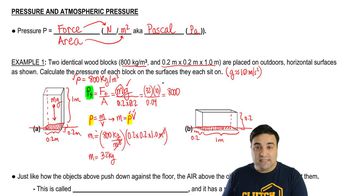
Gas Pressure

Gas pressure is the force exerted by gas molecules colliding with the walls of a container per unit area. It is directly related to the number of molecules and their kinetic energy, which is influenced by temperature. Lowering the pressure increases the mean free path, as there are fewer molecules in a given volume.
Video consigliato:
Percorso guidato
17:04
Pressure and Atmospheric Pressure

Ideal Gas Law

The Ideal Gas Law, expressed as PV = nRT, relates the pressure (P), volume (V), and temperature (T) of an ideal gas to the number of moles (n) and the universal gas constant (R). This law helps in calculating the conditions under which the mean free path can be determined, especially when considering changes in pressure and temperature.
Video consigliato:
Percorso guidato
07:21
Ideal Gases and the Ideal Gas Law
Pratica correlata
Domanda del libro di testo

At about what pressure would the mean free path of air molecules be equal to the diameter of air molecules, ≈ 3 x 10⁻¹⁰ m? Assume T = 20° C.

1385
views

Domanda del libro di testo

Water is in which phase when the pressure is 0.01 atm and the temperature is 90°C?

699
views
Domanda del libro di testo

Below a certain threshold pressure, the air molecules (0.3-nm diameter) within a research vacuum chamber are in the “collision-free regime,” meaning that a particular air molecule is as likely to cross the container and collide with the opposite wall as it is to collide with another air molecule. Estimate the threshold pressure for a vacuum chamber of side 1.0 m at 20°C.

1281
views
Domanda del libro di testo

The escape speed from the Earth is 1.12 x 10⁴ m/s (Section 8–7). So a gas molecule traveling away from Earth near the outer boundary of the Earth’s atmosphere would, at this speed, be able to escape from the Earth’s gravitational field and be lost to the atmosphere. Can you explain why our atmosphere contains oxygen but not helium?

955
views
Domanda del libro di testo

For what range of pressures and temperatures can CO₂ be a liquid? Refer to Fig. 18-6.

491
views
Domanda del libro di testo

Estimate the time needed for a glycine molecule (see Table 18–3) to diffuse a distance of 25μm in water at 20°C if its concentration varies over that distance from 1.00 mol/m³ to 0.50 mol/m³. Compare this “speed” to its rms (thermal) speed. The molecular mass of glycine is about 75 u.

72
views