Ch. 18 - Kinetic Theory of Gases
Giancoli Douglas - Physics for Scientists and Engineers 5th edition
Giancoli Douglas5th editionPhysics for Scientists and EngineersISBN: 9780137488179Non è quello che usi tu?Cambia libro di testo
Capitolo 18, Problema 45

Below a certain threshold pressure, the air molecules (0.3-nm diameter) within a research vacuum chamber are in the “collision-free regime,” meaning that a particular air molecule is as likely to cross the container and collide with the opposite wall as it is to collide with another air molecule. Estimate the threshold pressure for a vacuum chamber of side 1.0 m at 20°C.

Guida verificata passo dopo passo
1
Understand the problem: The threshold pressure is the pressure at which the mean free path of air molecules becomes comparable to the dimensions of the vacuum chamber. The mean free path is the average distance a molecule travels before colliding with another molecule. In this case, the mean free path should be approximately 1.0 m, the size of the chamber.
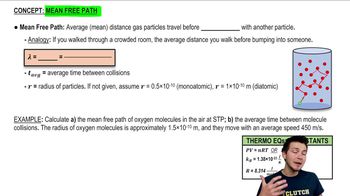
Use the formula for the mean free path (λ): λ = (k_B * T) / (√2 * π * d^2 * P), where k_B is the Boltzmann constant (1.38 × 10^-23 J/K), T is the temperature in kelvins, d is the diameter of the air molecule, and P is the pressure. Rearrange the formula to solve for P: P = (k_B * T) / (√2 * π * d^2 * λ).
Convert the given temperature from Celsius to Kelvin: T = 20°C + 273.15 = 293.15 K. Use this value for T in the formula.
Substitute the given values into the formula: k_B = 1.38 × 10^-23 J/K, T = 293.15 K, d = 0.3 × 10^-9 m (diameter of the air molecule), and λ = 1.0 m (mean free path).
Simplify the expression to calculate the threshold pressure P. Ensure all units are consistent (e.g., meters, kelvins, pascals) and perform the necessary arithmetic to find the result.

Risposta video verificata per un problema simile:

Questa soluzione video è stata consigliata dai nostri tutor come utile per risolvere questo problema.
Durata del video:
4m

Concetti chiave

Ecco i concetti essenziali che devi comprendere per rispondere correttamente alla domanda.

Collision-Free Regime

The collision-free regime occurs when the mean free path of gas molecules is significantly larger than the dimensions of the container. In this state, molecules travel long distances without colliding with one another, allowing them to interact more frequently with the walls of the container. This concept is crucial for understanding gas behavior in low-pressure environments, where the likelihood of molecular collisions decreases.
Video consigliato:

Mean Free Path

Mean free path is the average distance a molecule travels between collisions. It depends on the size of the molecules and the density of the gas. In the context of the vacuum chamber, calculating the mean free path helps determine the conditions under which the air molecules behave as if they are in a collision-free environment, which is essential for estimating the threshold pressure.
Video consigliato:

Ideal Gas Law

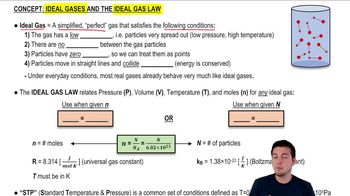
The Ideal Gas Law relates the pressure, volume, temperature, and number of moles of a gas through the equation PV = nRT. This law is fundamental in thermodynamics and helps in calculating the behavior of gases under various conditions. In this scenario, it can be used to estimate the threshold pressure by considering the volume of the chamber and the temperature of the air molecules.
Video consigliato:
Percorso guidato
07:21
Ideal Gases and the Ideal Gas Law