
Ch. 20 - Second Law of Thermodynamics
Giancoli Douglas - Physics for Scientists and Engineers 5th edition
Giancoli Douglas5th editionPhysics for Scientists and EngineersISBN: 9780137488179Non è quello che usi tu?Cambia libro di testo
Capitolo 20, Problema 38b

If 0.45 kg of water at 100°C is changed by a reversible process to steam at 100°C, determine the change in entropy of the surroundings.

Guida verificata passo dopo passo
1
Identify the key concept: The change in entropy of the surroundings is related to the heat exchanged with the surroundings and the temperature at which the exchange occurs. The formula for entropy change is ΔS = -Q/T, where Q is the heat exchanged and T is the absolute temperature.
Determine the heat exchanged (Q): The heat required to convert water to steam at 100°C is given by Q = mL, where m is the mass of the water (0.45 kg) and L is the latent heat of vaporization of water (L = 2.26 × 10^6 J/kg).
Substitute the values into the formula for Q: Q = (0.45 kg) × (2.26 × 10^6 J/kg). This gives the total heat exchanged during the phase change.
Calculate the temperature in absolute terms: Since the process occurs at 100°C, convert this to Kelvin using T(K) = T(°C) + 273.15. Thus, T = 100 + 273.15 = 373.15 K.
Substitute Q and T into the entropy formula: ΔS_surroundings = -Q/T. Use the value of Q from step 3 and T from step 4 to express the change in entropy of the surroundings.

Risposta video verificata per un problema simile:

Questa soluzione video è stata consigliata dai nostri tutor come utile per risolvere questo problema.
Durata del video:
4m

Concetti chiave

Ecco i concetti essenziali che devi comprendere per rispondere correttamente alla domanda.

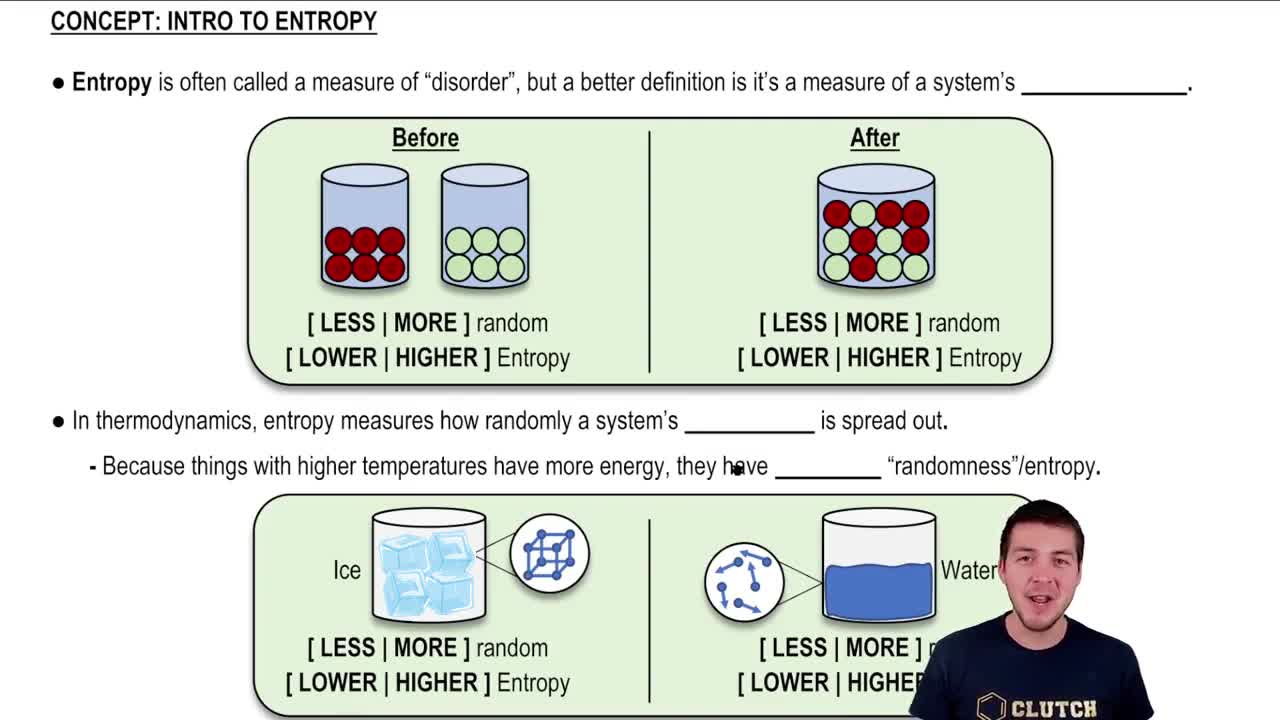
Entropy

Entropy is a measure of the disorder or randomness in a system. In thermodynamics, it quantifies the amount of energy in a system that is not available to do work. When a substance undergoes a phase change, such as from water to steam, the entropy of the system changes, reflecting the increased disorder as molecules move from a liquid to a gaseous state.
Video consigliato:
Percorso guidato
07:50
Intro to Entropy

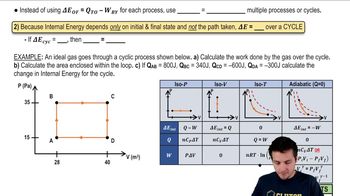
Reversible Process

A reversible process is an idealized process that occurs in such a way that the system and surroundings can be returned to their original states without any net change. In thermodynamics, reversible processes are characterized by equilibrium at every stage, allowing for maximum efficiency and the ability to calculate changes in properties like entropy accurately.
Video consigliato:
Percorso guidato
08:45
Properties of Cyclic Thermodynamic Processes

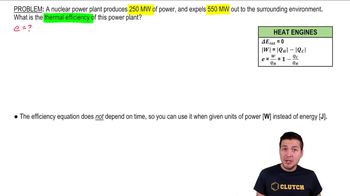
Surroundings

In thermodynamics, the surroundings refer to everything outside the system being studied. When analyzing changes in a system, such as the transition of water to steam, it is essential to consider the heat exchange with the surroundings, as this affects the overall entropy change. The surroundings can absorb or release heat, influencing the entropy of both the system and the environment.
Video consigliato:
Percorso guidato
03:55
Efficiency of a Nuclear Power Plant
Pratica correlata
Domanda del libro di testo

An ideal heat pump is used to maintain the inside temperature of a house at Tᵢₙ = 22°C when the outside temperature is Tₒᵤₜ. Assume the heat pump does work at a rate of 1700 W. Also assume that the house loses heat via conduction through its walls and other surfaces at a rate given by ( 650 W/C°) (Tᵢₙ - Tₒᵤₜ). If the outside temperature is less than you just calculated, what happens?

1050
views
Domanda del libro di testo

If 0.45 kg of water at 100°C is changed by a reversible process to steam at 100°C, determine the change in entropy of the water, the surroundings, and the universe as a whole. How would your answers differ if the process were irreversible?

1683
views
Domanda del libro di testo

Why would you expect the total entropy change in a Carnot cycle to be zero?

1550
views
Domanda del libro di testo

If 0.45 kg of water at 100°C is changed by a reversible process to steam at 100°C, determine the change in entropy of the universe as a whole.

1252
views
Domanda del libro di testo

What is the coefficient of performance of an ideal heat pump that extracts heat from 6°C air outside and deposits heat inside a house at 24°C?

1505
views
Domanda del libro di testo

How much less per year would it cost a family to operate a heat pump that has a coefficient of performance of 2.9 than an electric heater that costs \$2100 to heat their home for a year? If the conversion to the heat pump costs \$15,000, how long would it take the family to break even on heating costs? How much would the family save in 20 years?

1189
views