
Ch. 23 - Electric Potential
Giancoli Douglas - Physics for Scientists and Engineers 5th edition
Giancoli Douglas5th editionPhysics for Scientists and EngineersISBN: 9780137488179Non è quello che usi tu?Cambia libro di testo
Capitolo 22, Problema 44

A metal sphere of radius r₀ = 0.35 m carries a charge Q = 0.50 μC. Equipotential surfaces are to be drawn for 100-V intervals outside the sphere. Determine the radius r of the first equipotential from the surface.

Guida verificata passo dopo passo
1
Understand the concept: The problem involves equipotential surfaces around a charged sphere. For a charged sphere, the electric potential at a distance r from the center is given by the formula: V=kQr, where k is Coulomb's constant, Q is the charge, and r is the distance from the center of the sphere.
Set up the equation for the potential: The potential at the surface of the sphere (radius r0) is given by V0=kQr0. For the first equipotential surface, the potential decreases by 100 V, so the new potential is V=V0-100.
Rearrange the formula for the radius: Substitute the new potential into the formula for electric potential and solve for r. The equation becomes r=kQV, where V is the new potential.
Substitute the known values: Use the given values for k=8.99×10⁹ N·m²/C², Q=0.50×10⁻⁶ C, and the new potential V=V0-100 to calculate the radius r.
Interpret the result: The calculated radius r represents the distance from the center of the sphere to the first equipotential surface where the potential has decreased by 100 V. This process can be repeated for subsequent equipotential surfaces by further decreasing the potential in 100-V intervals.

Risposta video verificata per un problema simile:

Questa soluzione video è stata consigliata dai nostri tutor come utile per risolvere questo problema.
Durata del video:
5m

Concetti chiave

Ecco i concetti essenziali che devi comprendere per rispondere correttamente alla domanda.

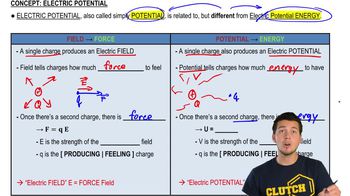
Electric Potential

Electric potential, or voltage, is the amount of electric potential energy per unit charge at a point in an electric field. It is measured in volts (V) and indicates how much work would be done to move a charge from a reference point to a specific point in the field. For a charged sphere, the potential outside the sphere can be calculated using the formula V = k * Q / r, where k is Coulomb's constant.
Video consigliato:
Percorso guidato
07:33
Electric Potential

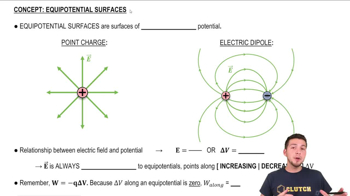
Equipotential Surfaces

Equipotential surfaces are three-dimensional surfaces where the electric potential is constant. No work is required to move a charge along an equipotential surface, as the potential difference is zero. In the context of a charged sphere, these surfaces are concentric spheres centered on the charge, with the potential increasing as one moves away from the sphere.
Video consigliato:
Percorso guidato
09:18
Equipotential Surfaces

Coulomb's Law

Coulomb's Law describes the force between two point charges. It states that the force (F) between two charges is directly proportional to the product of the magnitudes of the charges (Q₁ and Q₂) and inversely proportional to the square of the distance (r) between them. This law is fundamental in understanding how electric fields and potentials are generated by charged objects, such as the metal sphere in this problem.
Video consigliato:
Pratica correlata
Domanda del libro di testo

A dust particle with mass of 0.050 g and a charge of 2.0 x 10⁻⁶ C is in a region of space where the potential is given by V(x) = (2.0 V/m²) x² - (3.0 V/m³)x³. If the particle starts at x = 2.5m, what is the initial acceleration of the charge?

2155
views
Domanda del libro di testo

Calculate the electric potential due to a tiny dipole whose dipole moment is 4.8 x 10⁻³⁰ Cm at a point 4.1 x 10⁻⁹ m away if this point is along the axis of the dipole nearer the positive charge.

2156
views
Domanda del libro di testo

A thin rod of length 2ℓ is centered on the x axis as shown in Fig. 23–46. The rod carries a uniformly distributed charge Q. Determine the potential V as a function of y for points along the y axis. Let V = 0 at infinity.

2081
views
Domanda del libro di testo

A very long conducting cylinder (length ℓ) of radius R₀ (R₀ ≪ ℓ) carries a uniform surface charge density σ (C/m²). The cylinder is at an electric potential V₀. Determine the potential, at points far from the end, at a distance R from the center of the cylinder for

(a) R > R₀

(b) R < R₀.

(c) Is V = 0 at R = ∞ (assume ℓ = ∞ )? Explain. [Hint: Recall Gauss’s law.]

1652
views
Domanda del libro di testo

Calculate the electric potential due to a tiny dipole whose dipole moment is 4.8 x 10⁻³⁰ Cm at a point 4.1 x 10⁻⁹ m away if this point is 45° above the axis but nearer the positive charge.

1574
views
Domanda del libro di testo

Two point charges, 3.4 μC and -2.0 μC, are placed 8.0 cm apart on the x axis. At what points along the x axis are

(a) the electric field zero and

(b) the potential zero? Let V = 0 at r = ∞.

1727
views