
Ch. 26 - DC Circuits
Giancoli Douglas - Physics for Scientists and Engineers 5th edition
Giancoli Douglas5th editionPhysics for Scientists and EngineersISBN: 9780137488179Non è quello che usi tu?Cambia libro di testo
Capitolo 25, Problema 35

A voltage V is applied to n identical resistors connected in parallel. If the resistors are instead all connected in series with the applied voltage, show that the power transformed is decreased by a factor n².

Guida verificata passo dopo passo
1
Start by recalling the formula for power dissipated in a resistor: \( P = \frac{V^2}{R} \), where \( V \) is the voltage across the resistor and \( R \) is its resistance.
For the parallel configuration, the equivalent resistance \( R_{\text{eq,parallel}} \) of \( n \) identical resistors (each with resistance \( R \)) is given by \( \frac{1}{R_{\text{eq,parallel}}} = \frac{1}{R} + \frac{1}{R} + \dots + \frac{1}{R} = \frac{n}{R} \), so \( R_{\text{eq,parallel}} = \frac{R}{n} \). The power dissipated in this case is \( P_{\text{parallel}} = \frac{V^2}{R_{\text{eq,parallel}}} = \frac{V^2}{R/n} = n \frac{V^2}{R} \).
For the series configuration, the equivalent resistance \( R_{\text{eq,series}} \) of \( n \) identical resistors is \( R_{\text{eq,series}} = R + R + \dots + R = nR \). The power dissipated in this case is \( P_{\text{series}} = \frac{V^2}{R_{\text{eq,series}}} = \frac{V^2}{nR} \).
To find the factor by which the power is decreased, calculate the ratio \( \frac{P_{\text{series}}}{P_{\text{parallel}}} \). Substituting the expressions for \( P_{\text{series}} \) and \( P_{\text{parallel}} \), we get \( \frac{P_{\text{series}}}{P_{\text{parallel}}} = \frac{\frac{V^2}{nR}}{n \frac{V^2}{R}} = \frac{1}{n^2} \).
Thus, the power transformed in the series configuration is decreased by a factor of \( n^2 \) compared to the parallel configuration.

Risposta video verificata per un problema simile:

Questa soluzione video è stata consigliata dai nostri tutor come utile per risolvere questo problema.
Durata del video:
4m

Concetti chiave

Ecco i concetti essenziali che devi comprendere per rispondere correttamente alla domanda.

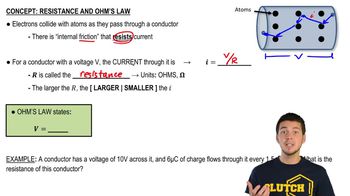
Ohm's Law

Ohm's Law states that the current (I) flowing through a conductor between two points is directly proportional to the voltage (V) across the two points and inversely proportional to the resistance (R) of the conductor. This relationship is expressed as V = IR, which is fundamental in analyzing electrical circuits, including those with resistors in series and parallel.
Video consigliato:
Percorso guidato
03:07
Resistance and Ohm's Law

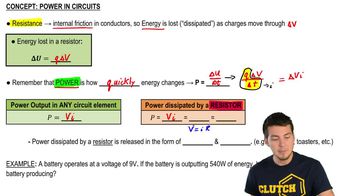
Power in Electrical Circuits

The power (P) consumed in an electrical circuit is defined as the rate at which energy is used or converted, calculated using the formula P = IV, where I is the current and V is the voltage. In resistive circuits, power can also be expressed as P = I²R or P = V²/R, depending on the configuration of the resistors, which is crucial for understanding how power changes with different connections.
Video consigliato:
Percorso guidato
06:18
Power in Circuits

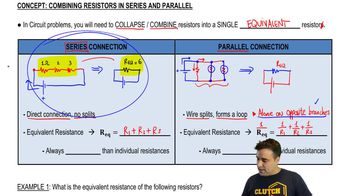
Resistor Configurations: Series vs. Parallel

In a series configuration, resistors are connected end-to-end, resulting in a total resistance that is the sum of individual resistances (R_total = R1 + R2 + ... + Rn). In contrast, in a parallel configuration, the total resistance is reduced and calculated using the formula 1/R_total = 1/R1 + 1/R2 + ... + 1/Rn. This difference in resistance affects the current and power distribution in the circuit, leading to the conclusion that power is decreased by a factor of n² when switching from parallel to series.
Video consigliato:
Percorso guidato
12:42
Combining Resistors in Series & Parallel