
Ch. 26 - DC Circuits
Giancoli Douglas - Physics for Scientists and Engineers 5th edition
Giancoli Douglas5th editionPhysics for Scientists and EngineersISBN: 9780137488179Non è quello che usi tu?Cambia libro di testo
Capitolo 25, Problema 43

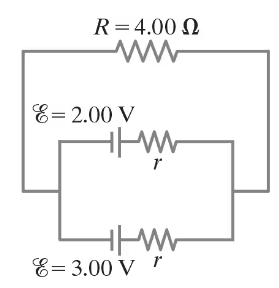
(II) Suppose two batteries, with unequal emfs of 2.00 V and 3.00 V, are connected as shown in Fig. 26–63. If each internal resistance is r = 0.350Ω and R = 4.00Ω, what is the voltage across the resistor R?

Guida verificata passo dopo passo
1
Step 1: Understand the circuit configuration. The two batteries are connected in series with their respective internal resistances (r = 0.350Ω each) and an external resistor R = 4.00Ω. The goal is to find the voltage across the resistor R.
Step 2: Calculate the total emf of the circuit. Since the batteries are connected in series, their emfs add algebraically. Let the total emf be \( \text{E}_{\text{total}} = \text{E}_1 + \text{E}_2 \), where \( \text{E}_1 = 2.00 \text{V} \) and \( \text{E}_2 = 3.00 \text{V} \).
Step 3: Determine the total resistance in the circuit. The total resistance is the sum of the internal resistances of the batteries and the external resistor R. Let \( R_{\text{total}} = r_1 + r_2 + R \), where \( r_1 = 0.350 \Omega \), \( r_2 = 0.350 \Omega \), and \( R = 4.00 \Omega \).
Step 4: Use Ohm's Law to calculate the total current in the circuit. Ohm's Law states \( I = \frac{\text{E}_{\text{total}}}{R_{\text{total}}} \). Substitute the values of \( \text{E}_{\text{total}} \) and \( R_{\text{total}} \) to find the current \( I \).
Step 5: Calculate the voltage across the resistor R. The voltage across R can be found using Ohm's Law: \( V_R = I \cdot R \). Substitute the value of \( I \) and \( R \) to determine \( V_R \).

Risposta video verificata per un problema simile:

Questa soluzione video è stata consigliata dai nostri tutor come utile per risolvere questo problema.
Durata del video:
9m

Concetti chiave

Ecco i concetti essenziali che devi comprendere per rispondere correttamente alla domanda.

Electromotive Force (emf)

Electromotive force (emf) is the voltage generated by a battery or other energy source when no current is flowing. It represents the maximum potential difference that can be provided by the source. In this scenario, the two batteries have emfs of 2.00 V and 3.00 V, which will influence the total voltage in the circuit when connected.

Internal Resistance

Internal resistance refers to the resistance within a battery that opposes the flow of current. It causes a drop in the voltage output when current flows, affecting the overall voltage available across external components. In this case, each battery has an internal resistance of 0.350Ω, which must be considered when calculating the voltage across the resistor R.

Ohm's Law

Ohm's Law states that the current (I) flowing through a conductor between two points is directly proportional to the voltage (V) across the two points and inversely proportional to the resistance (R) of the conductor. This fundamental principle is essential for analyzing circuits, as it allows us to calculate the current and voltage drops across various components, including the resistor R in this problem.