Ch. 29 - Electromagnetic Induction and Faraday's Law
Giancoli Douglas - Physics for Scientists and Engineers 5th edition
Giancoli Douglas5th editionPhysics for Scientists and EngineersISBN: 9780137488179Non è quello che usi tu?Cambia libro di testo
Capitolo 28, Problema 62

The primary windings of a transformer which has an 85% efficiency are connected to 110-V ac. The secondary windings are connected across a 2.4-Ω, 75-W lightbulb.
(a) Calculate the current through the primary windings of the transformer.
(b) Calculate the ratio of the number of primary windings of the transformer to the number of secondary windings of the transformer.

Guida verificata passo dopo passo
1
Step 1: Start by understanding the efficiency of the transformer. The efficiency (η) is given as 85%, which means that 85% of the power input to the primary windings is transferred to the secondary windings. Use the formula for efficiency: η = (P_secondary / P_primary) × 100, where P_secondary is the power delivered to the load and P_primary is the power input to the primary windings.
Step 2: Calculate the power delivered to the load (P_secondary). The lightbulb connected to the secondary windings has a resistance of 2.4 Ω and a power rating of 75 W. Since the lightbulb operates at its rated power, the voltage across the secondary windings (V_secondary) can be calculated using the formula P = V² / R. Rearrange to find V_secondary: V_secondary = √(P × R).
Step 3: Use the efficiency formula to calculate the power input to the primary windings (P_primary). Rearrange the efficiency formula to find P_primary: P_primary = P_secondary / η. Substitute the known values of P_secondary and η (converted to decimal form, 0.85).
Step 4: Calculate the current through the primary windings (I_primary). The voltage across the primary windings (V_primary) is given as 110 V. Use the formula P = IV to find I_primary: I_primary = P_primary / V_primary. Substitute the values of P_primary and V_primary to find I_primary.
Step 5: Calculate the turns ratio of the transformer. The turns ratio (N_primary / N_secondary) is related to the voltage ratio by the formula V_primary / V_secondary = N_primary / N_secondary. Rearrange to find the turns ratio: N_primary / N_secondary = V_primary / V_secondary. Substitute the values of V_primary and V_secondary to calculate the ratio.

Risposta video verificata per un problema simile:

Questa soluzione video è stata consigliata dai nostri tutor come utile per risolvere questo problema.
Durata del video:
6m

Concetti chiave

Ecco i concetti essenziali che devi comprendere per rispondere correttamente alla domanda.

Transformer Basics

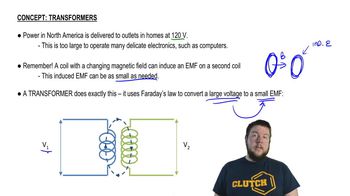
A transformer is an electrical device that transfers electrical energy between two or more circuits through electromagnetic induction. It consists of primary and secondary windings, where the primary winding receives input voltage and the secondary winding delivers output voltage. The voltage transformation ratio is determined by the ratio of the number of turns in the primary and secondary coils.
Video consigliato:

Efficiency of a Transformer

The efficiency of a transformer is the ratio of the output power to the input power, expressed as a percentage. In this case, an 85% efficiency means that 85% of the input electrical energy is converted into useful output energy, while the remaining 15% is lost, typically as heat. This efficiency is crucial for calculating the current and power in both primary and secondary circuits.
Video consigliato:

Ohm's Law and Power Calculation

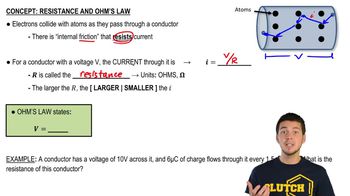
Ohm's Law states that the current through a conductor between two points is directly proportional to the voltage across the two points and inversely proportional to the resistance. This relationship is essential for calculating the current through the lightbulb and the primary windings. Additionally, power can be calculated using the formula P = IV, where P is power, I is current, and V is voltage.
Video consigliato:
Percorso guidato
03:07
Resistance and Ohm's Law
Pratica correlata
Domanda del libro di testo

(II) For the electric power transmission system shown in Fig. 29–26, what is the ratio Ns/Np for (a) the step-up transformer, (b) the step-down transformer next to the home?

1668
views

Domanda del libro di testo

(III) In a circular region, there is a uniform magnetic field B→\(\overrightarrow{B}\) pointing into the page (Fig. 29–56). An xy coordinate system has its origin at the circular region’s center. A free positive point charge +Q = 1.0 μC is initially at rest at a position x = +10 cm on the x axis. If the magnitude of the magnetic field is now decreased at a rate of -0.10 T/s, what force (magnitude and direction) will act on +Q?


1211
views
Domanda del libro di testo

A circular loop of area 12 m² encloses a magnetic field perpendicular to the plane of the loop; its magnitude is B(t) = (8.0 T/s)t. The loop is connected to a 7.5-Ω resistor and a 6.5-pF capacitor in series. When fully charged, how much charge is stored on the capacitor?

1285
views
Domanda del libro di testo

A high-intensity desk lamp is rated at 35 W but requires only 12 V. It contains a transformer that converts 120-V household voltage.

(c) What is the current in the primary coil?

(d) What is the resistance of the bulb when on?

1520
views
Domanda del libro di testo

Determine the magnetic field at a point P due to a very long wire with a square bend as shown in Fig. 28–63. The point P is halfway between the two corners.

710
views
Domanda del libro di testo

A high-intensity desk lamp is rated at 35 W but requires only 12 V. It contains a transformer that converts 120-V household voltage.

(a) Is the transformer step-up or step-down?

(b) What is the current in the secondary coil when the lamp is on?

1758
views