
Ch. 30 - Inductance, Electromagnetic Oscillations, and AC Circuits
Giancoli Douglas - Physics for Scientists and Engineers 5th edition
Giancoli Douglas5th editionPhysics for Scientists and EngineersISBN: 9780137488179Non è quello che usi tu?Cambia libro di testo
Capitolo 29, Problema 51b

An average power output of 150 W is sent into a 4-Ω loudspeaker (see Fig. 25–14). What are the rms voltage and the rms current fed to the speaker at 1.0 W when the volume is turned down?

Guida verificata passo dopo passo
1
Determine the relationship between power, resistance, and voltage using the formula for power: \( P = \frac{V_{\text{rms}}^2}{R} \), where \( P \) is the power, \( V_{\text{rms}} \) is the root mean square voltage, and \( R \) is the resistance.
Rearrange the formula to solve for \( V_{\text{rms}} \): \( V_{\text{rms}} = \sqrt{P \cdot R} \). Substitute \( P = 150 \; \text{W} \) and \( R = 4 \; \Omega \) to calculate the rms voltage for the first case.
To find the rms current, use the formula \( I_{\text{rms}} = \frac{V_{\text{rms}}}{R} \). Substitute the value of \( V_{\text{rms}} \) obtained in the previous step and \( R = 4 \; \Omega \) to calculate the rms current for the first case.
For the second case, when the power is reduced to \( P = 1.0 \; \text{W} \), repeat the process: use \( V_{\text{rms}} = \sqrt{P \cdot R} \) to calculate the new rms voltage.
Finally, calculate the new rms current for the second case using \( I_{\text{rms}} = \frac{V_{\text{rms}}}{R} \), substituting the new \( V_{\text{rms}} \) and \( R = 4 \; \Omega \).

Risposta video verificata per un problema simile:

Questa soluzione video è stata consigliata dai nostri tutor come utile per risolvere questo problema.
Durata del video:
3m

Concetti chiave

Ecco i concetti essenziali che devi comprendere per rispondere correttamente alla domanda.

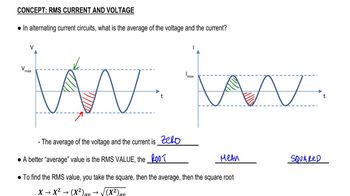
RMS Voltage and Current

RMS (Root Mean Square) voltage and current are effective values that represent the equivalent DC values for AC circuits. For a given power, the RMS voltage (V_rms) and RMS current (I_rms) can be calculated using the formulas P = V_rms * I_rms, where P is the power in watts. This concept is crucial for understanding how AC power is delivered to devices like loudspeakers.
Video consigliato:
Percorso guidato
07:14
RMS Current and Voltage

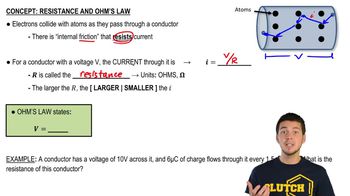
Ohm's Law

Ohm's Law states that the current (I) flowing through a conductor between two points is directly proportional to the voltage (V) across the two points and inversely proportional to the resistance (R) of the conductor. It is mathematically expressed as V = I * R. This law is fundamental in analyzing electrical circuits, especially when determining the relationship between voltage, current, and resistance in the loudspeaker.
Video consigliato:
Percorso guidato
03:07
Resistance and Ohm's Law

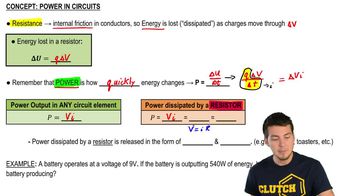
Power in Electrical Circuits

Power in electrical circuits is the rate at which electrical energy is transferred by an electric circuit. It is calculated using the formula P = V * I, where P is power in watts, V is voltage in volts, and I is current in amperes. Understanding how power relates to voltage and current is essential for solving the problem of determining the RMS values for different power outputs in the loudspeaker.
Video consigliato:
Percorso guidato
06:18
Power in Circuits
Pratica correlata
Domanda del libro di testo

The frequency of the ac voltage source (peak voltage Vo) in an LRC circuit is tuned to the circuit’s resonant frequency f₀ = 1 / (2π√LC). (a) Show that the peak voltage across the capacitor is Vco = VoTo/ (2πτ), where To ( =1/fo) is the period of the resonant frequency and τ = RC is the time constant for charging the capacitor C through a resistor R. (b) Define β = To/ (2πτ) so that Vco = βVo. Then β is the “amplification” of the source voltage across the capacitor. If a particular LRC circuit contains a 2.0-nF capacitor and has a resonant frequency of 5.0 kHz, what value of R will yield β = 125?

1375
views
Domanda del libro di testo

(II) (a) Show that oscillation of charge Q on the capacitor of an LRC circuit has amplitude


Q0=V0(ωR)2+(ω2L−1C)2.Q_0 = \(\frac{V_0}{\sqrt{(\omega R)^2 + \left(\omega^2 L - \frac{1}{C}\)\(\right\))^2}}.

1523
views
Domanda del libro di testo

An ac voltage source is connected in series with a 2.0-μF capacitor and a 750-Ω resistor. Using a digital ac voltmeter, the voltage source is measured to be 4.0 V rms, and the voltages across the resistor and across the capacitor are found to be 3.0 V rms and 2.7 V rms, respectively. Determine the frequency of the ac voltage source. Why is the voltage measured across the voltage source not equal to the sum of the voltages measured across the resistor and across the capacitor?

1550
views
Domanda del libro di testo

The output of an electrocardiogram amplifier has an impedance of 45 Ω. It is to be connected to an 8.0-Ω loudspeaker through a transformer. What should be the turns ratio of the transformer?

1070
views
Domanda del libro di testo

A 10.0-k Ω resistor is in series with a 34.0-mH inductor and an ac source. Calculate the impedance of the circuit if the source frequency is (a) 55.0 Hz; (b) 55.0 kHz.

1179
views
Domanda del libro di testo

A 1.50-k Ω resistor in series with a 370-mH inductor is driven by an ac power supply. At what frequency is the impedance double that of the impedance at 60.0 Hz?

1449
views