
Ch. 30 - Inductance, Electromagnetic Oscillations, and AC Circuits
Giancoli Douglas - Physics for Scientists and Engineers 5th edition
Giancoli Douglas5th editionPhysics for Scientists and EngineersISBN: 9780137488179Non è quello che usi tu?Cambia libro di testo
Capitolo 29, Problema 66

Show that the power delivered by a three-phase ac source equals a constant P = 3Vo²/2R, by combining the four equations in Section 30–11.

Guida verificata passo dopo passo
1
Start by recalling the key equations for a three-phase AC source. Each phase delivers a voltage described by \( V(t) = V_0 \sin(\omega t + \phi) \), where \( V_0 \) is the peak voltage, \( \omega \) is the angular frequency, and \( \phi \) is the phase angle. For a balanced three-phase system, the phase angles are separated by \( 120^\circ \) (or \( 2\pi/3 \) radians).
The instantaneous power delivered by one phase is given by \( P(t) = \frac{V^2(t)}{R} \), where \( R \) is the resistance of the load. Substituting \( V(t) = V_0 \sin(\omega t + \phi) \), we get \( P(t) = \frac{V_0^2 \sin^2(\omega t + \phi)}{R} \).
For a three-phase system, the total instantaneous power is the sum of the powers from all three phases. Using the phase angles \( \phi_1 = 0 \), \( \phi_2 = -120^\circ \), and \( \phi_3 = -240^\circ \), the total power is \( P_{\text{total}}(t) = \frac{V_0^2}{R} [\sin^2(\omega t) + \sin^2(\omega t - 120^\circ) + \sin^2(\omega t - 240^\circ)] \).
Use the trigonometric identity \( \sin^2(x) = \frac{1 - \cos(2x)}{2} \) to simplify each term. After simplification, the cosine terms cancel out due to symmetry, leaving \( P_{\text{total}}(t) = \frac{3V_0^2}{2R} \).
Conclude that the total power delivered by the three-phase AC source is constant and equals \( P = \frac{3V_0^2}{2R} \), as the time-dependent terms have been eliminated through the summation of the three phases.

Risposta video verificata per un problema simile:

Questa soluzione video è stata consigliata dai nostri tutor come utile per risolvere questo problema.
Durata del video:
8m

Concetti chiave

Ecco i concetti essenziali che devi comprendere per rispondere correttamente alla domanda.

Three-Phase AC Power

Three-phase AC power systems use three alternating currents that are offset in phase by 120 degrees. This configuration allows for a more efficient power delivery compared to single-phase systems, as it provides a constant power transfer and reduces the amount of conductor material needed. The total power in a three-phase system can be calculated using the formula P = √3 × V_L × I_L, where V_L is the line voltage and I_L is the line current.
Video consigliato:
Percorso guidato
05:37
Power in AC Circuits

Voltage and Resistance Relationship

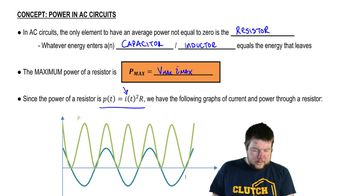
In electrical circuits, the relationship between voltage (V), current (I), and resistance (R) is described by Ohm's Law, which states V = I × R. This fundamental principle allows us to understand how voltage drops across resistors and how it affects the current flow in the circuit. In the context of power calculations, the power dissipated in a resistor can be expressed as P = V²/R, highlighting the importance of both voltage and resistance in determining power.
Video consigliato:
Percorso guidato
07:14
RMS Current and Voltage

Power Calculation in AC Circuits

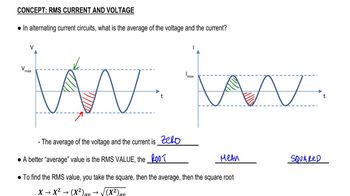
The power delivered by an AC source can be calculated using the root mean square (RMS) values of voltage and current. For a resistive load, the average power can be expressed as P = I_RMS² × R or P = V_RMS²/R. In three-phase systems, the total power is the sum of the power in each phase, leading to the formula P = 3V_o²/2R when considering the phase voltage and the resistive load, which is derived from the combination of the relevant equations.
Video consigliato:
Percorso guidato
05:37
Power in AC Circuits
Pratica correlata
Domanda del libro di testo

The frequency of the ac voltage source (peak voltage Vo) in an LRC circuit is tuned to the circuit’s resonant frequency f₀ = 1 / (2π√LC). (a) Show that the peak voltage across the capacitor is Vco = VoTo/ (2πτ), where To ( =1/fo) is the period of the resonant frequency and τ = RC is the time constant for charging the capacitor C through a resistor R. (b) Define β = To/ (2πτ) so that Vco = βVo. Then β is the “amplification” of the source voltage across the capacitor. If a particular LRC circuit contains a 2.0-nF capacitor and has a resonant frequency of 5.0 kHz, what value of R will yield β = 125?

1375
views
Domanda del libro di testo

(II) (a) Show that oscillation of charge Q on the capacitor of an LRC circuit has amplitude


Q0=V0(ωR)2+(ω2L−1C)2.Q_0 = \(\frac{V_0}{\sqrt{(\omega R)^2 + \left(\omega^2 L - \frac{1}{C}\)\(\right\))^2}}.

1523
views
Domanda del libro di testo

At t = 0, the current through a 60.0-mH inductor is 50.0 mA and is increasing at the rate of 78.0 mA/s. What is the initial energy stored in the inductor, and how long does it take for the energy to increase by a factor of 8.0 from the initial value?

1008
views
Domanda del libro di testo

The output of an electrocardiogram amplifier has an impedance of 45 Ω. It is to be connected to an 8.0-Ω loudspeaker through a transformer. What should be the turns ratio of the transformer?

1070
views
Domanda del libro di testo

At time t = 0, the switch in the circuit shown in Fig. 30–30 is closed. After a sufficiently long time, steady currents I₁, I₂, and I₃ flow through resistors R₁, R₂, and R₃, respectively. Determine these three currents.

973
views
Domanda del libro di testo

A pair of straight parallel thin wires, such as a lamp cord, each of radius r, are a distance 𝓁 apart and carry current to a circuit some distance away. Ignoring the field within each wire, show that the inductance per unit length is (μ₀/π) ln[(𝓁 - r) /r].

1577
views