

At what angle should the axes of two Polaroids be placed so as to reduce the intensity of the incident unpolarized light by an additional factor (after the first Polaroid cuts it in half) of (a) 4, (b) 10, (c) 100?
Ch. 34 - The Wave Nature of Light: Interference and Polarization
Giancoli Douglas5th editionPhysics for Scientists and EngineersISBN: 9780137488179Non è quello che usi tu?Cambia libro di testo
Tutti i libri di testo
Giancoli Douglas 5th edition
Ch. 34 - The Wave Nature of Light: Interference and Polarization
Problema 94
Giancoli Douglas 5th edition
Ch. 34 - The Wave Nature of Light: Interference and Polarization
Problema 94Capitolo 33, Problema 94
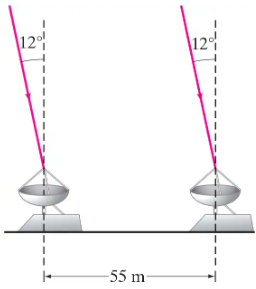
A radio telescope, whose two antennas are separated by 55 m, is designed to receive 3.0-MHz radio waves produced by astronomical objects. The received radio waves create 3.0-MHz electronic signals in the telescope’s left and right antennas. These signals then travel by equal-length cables to a centrally located amplifier, where they are added together. The telescope can be “pointed” to a certain region of the sky by adding the instantaneous signal from the right antenna to a “time-delayed” signal received by the left antenna a time ∆t ago. (This time delay of the left signal can be easily accomplished with the proper electronic circuit.) If a radio astronomer wishes to “view” radio signals arriving from an object oriented at a 12° angle to the vertical as in Fig. 34–54, what time delay ∆t is necessary?

Guida verificata passo dopo passo1
Determine the wavelength of the radio waves using the formula: λ = c / f, where c is the speed of light (approximately 3.0 × 10^8 m/s) and f is the frequency of the radio waves (3.0 MHz).
Calculate the path difference between the signals received by the two antennas. The path difference is given by d * sin(θ), where d is the separation between the antennas (55 m) and θ is the angle of the incoming wave relative to the vertical (12°).
Relate the path difference to the time delay ∆t. The time delay is given by ∆t = path difference / c, where c is the speed of light.
Substitute the values for the path difference and the speed of light into the formula for ∆t to calculate the required time delay.
Verify the units and ensure that the time delay ∆t is expressed in seconds, as this is the standard unit for time in physics.

Risposta video verificata per un problema simile:
Questa soluzione video è stata consigliata dai nostri tutor come utile per risolvere questo problema.
Durata del video:
3mConcetti chiave
Ecco i concetti essenziali che devi comprendere per rispondere correttamente alla domanda.
Wave Properties
Radio waves, like all electromagnetic waves, have properties such as frequency and wavelength. The frequency of a wave is the number of cycles that pass a point per second, measured in hertz (Hz). In this case, the radio waves have a frequency of 3.0 MHz, which influences their wavelength and how they interact with the antennas. Understanding these properties is crucial for analyzing how signals are received and processed.
Video consigliato:
Percorso guidato
Properties of Standing Waves from Wave Functions
Time Delay and Signal Processing
Time delay in signal processing refers to the intentional delay introduced to synchronize signals from different sources. In this scenario, the left antenna's signal is delayed by a time ∆t to align with the right antenna's signal. This synchronization is essential for accurately determining the direction of incoming radio waves, as it allows the telescope to effectively combine signals and enhance the detection of astronomical objects.
Video consigliato:
Percorso guidato
Traffic Signal
Angle of Arrival
The angle of arrival is the angle at which a wavefront reaches an observer or detector. In this case, the radio signals are arriving at a 12° angle to the vertical, which affects the path length of the signals received by the two antennas. This angle is critical for calculating the necessary time delay ∆t, as it determines how much longer the signal from one antenna takes to reach the amplifier compared to the other.
Video consigliato:
Percorso guidato
Critical Angle
Pratica correlata
Domanda del libro di testo
658
views
Domanda del libro di testo
Describe how to rotate the plane of polarization of a plane-polarized beam of light by 90° and produce only a 10% loss in intensity, using polarizers. Let N be the number of polarizers and θ be the (same) angle between successive polarizers.
3
views
Domanda del libro di testo
"Two identical sources S₁ and S₂, separated by distance d, coherently emit light of wavelength λ uniformly in all directions. Defining the x axis with its origin at S₁ as shown in Fig. 34–52, find the locations (expressed as multiples of λ ) where the signals from the two sources are out of phase along this axis for x > 0 , if d = 3λ.
79
views