
Ch. 34 - The Wave Nature of Light: Interference and Polarization
Giancoli Douglas - Physics for Scientists and Engineers 5th edition
Giancoli Douglas5th editionPhysics for Scientists and EngineersISBN: 9780137488179Non è quello che usi tu?Cambia libro di testo
Capitolo 33, Problema 92

Describe how to rotate the plane of polarization of a plane-polarized beam of light by 90° and produce only a 10% loss in intensity, using polarizers. Let N be the number of polarizers and θ be the (same) angle between successive polarizers.

Guida verificata passo dopo passo
1
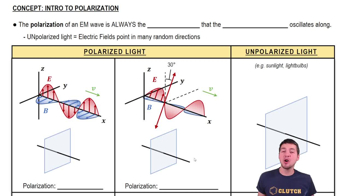
Understand the concept of polarization: Plane-polarized light has its electric field oscillating in one plane. To rotate the plane of polarization, we need to change the direction of this plane.
Use multiple polarizers: To achieve a 90° rotation with minimal intensity loss, use a series of polarizers, each set at an angle θ to the previous one. The total rotation will be Nθ = 90°, where N is the number of polarizers and θ is the angle between each.
Calculate the angle θ: Since the total rotation desired is 90°, divide this by the number of polarizers to find θ. For example, if using three polarizers, each should be rotated by θ = 90° / 3 = 30° relative to the previous one.
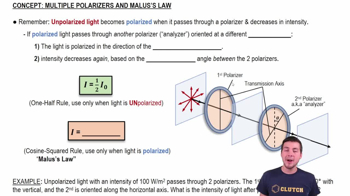
Minimize intensity loss: The intensity of light decreases with each polarizer according to Malus's Law, which states that the intensity I transmitted through a polarizer is I = I₀ cos²(θ), where I₀ is the initial intensity and θ is the angle between the light's initial polarization direction and the polarizer's axis. Choose a number of polarizers and an angle θ that results in at least 10% of the initial intensity being transmitted.
Experiment and adjust: The theoretical calculations might need adjustments based on experimental setups. It might be necessary to slightly tweak the number of polarizers or the angle θ to achieve exactly 90° rotation with only 10% loss in intensity.

Risposta video verificata per un problema simile:

Questa soluzione video è stata consigliata dai nostri tutor come utile per risolvere questo problema.
Durata del video:
8m

Concetti chiave

Ecco i concetti essenziali che devi comprendere per rispondere correttamente alla domanda.

Polarization of Light

Polarization refers to the orientation of the oscillations of light waves. In plane-polarized light, these oscillations occur in a single plane. Understanding polarization is crucial for manipulating light using polarizers, which can filter out certain orientations of light waves.
Video consigliato:
Percorso guidato
05:32
Introduction to Polarization

Malus's Law

Malus's Law states that when polarized light passes through a polarizer, the intensity of the transmitted light is proportional to the cosine square of the angle between the light's polarization direction and the polarizer's axis. This law is essential for calculating the intensity loss when light passes through multiple polarizers at specific angles.
Video consigliato:
Percorso guidato
09:47
Multiple Polarizers & Malus's Law

Stacking Polarizers

Stacking polarizers involves placing multiple polarizers in sequence, each oriented at a specific angle relative to the previous one. By carefully choosing the angle between successive polarizers, one can achieve desired effects, such as rotating the plane of polarization while minimizing intensity loss, as described by Malus's Law.
Video consigliato:
Pratica correlata
Domanda del libro di testo

At what angle should the axes of two Polaroids be placed so as to reduce the intensity of the incident unpolarized light by an additional factor (after the first Polaroid cuts it in half) of (a) 4, (b) 10, (c) 100?

658
views
Domanda del libro di testo

A radio telescope, whose two antennas are separated by 55 m, is designed to receive 3.0-MHz radio waves produced by astronomical objects. The received radio waves create 3.0-MHz electronic signals in the telescope’s left and right antennas. These signals then travel by equal-length cables to a centrally located amplifier, where they are added together. The telescope can be “pointed” to a certain region of the sky by adding the instantaneous signal from the right antenna to a “time-delayed” signal received by the left antenna a time ∆t ago. (This time delay of the left signal can be easily accomplished with the proper electronic circuit.) If a radio astronomer wishes to “view” radio signals arriving from an object oriented at a 12° angle to the vertical as in Fig. 34–54, what time delay ∆t is necessary?

56
views
Domanda del libro di testo

Two polarizers are oriented at 55° to each other and plane-polarized light is incident on them. If only 25% of the light gets through both of them, what was the initial polarization direction of the incident light?

78
views
Domanda del libro di testo

"Two identical sources S₁ and S₂, separated by distance d, coherently emit light of wavelength λ uniformly in all directions. Defining the x axis with its origin at S₁ as shown in Fig. 34–52, find the locations (expressed as multiples of λ ) where the signals from the two sources are out of phase along this axis for x > 0 , if d = 3λ.

79
views