

Ch. 35 - Diffraction
Giancoli Douglas - Physics for Scientists and Engineers 5th edition
Giancoli Douglas5th editionPhysics for Scientists and EngineersISBN: 9780137488179Non è quello che usi tu?Cambia libro di testo
Capitolo 34, Problema 6

Monochromatic light of wavelength 633 nm falls on a slit. If the angle between the first bright fringes on either side of the central maximum is 32°, estimate the slit width.

Guida verificata passo dopo passo
1
Identify the relevant formula for single-slit diffraction. The angular position of the minima in a single-slit diffraction pattern is given by: a \(\sin\)(\(\theta\)) = m \(\lambda\) , where a is the slit width, \(\theta\) is the angle to the m-th minimum, m is the order of the minimum, and \(\lambda\) is the wavelength of the light.
Recognize that the problem provides the total angle between the first bright fringes on either side of the central maximum as 32°. This means the angle to the first minimum on one side of the central maximum is half of this value: \(\theta\) = \(\frac{32^\circ}{2}\) = 16^\(\circ\).
Substitute the known values into the formula. For the first minimum, m = 1, \(\lambda\) = 633 \ \(\text{nm}\) = 633 \(\times\) 10^{-9} \ \(\text{m}\), and \(\theta\) = 16^\(\circ\). The equation becomes: a \(\sin\)(16^\(\circ\)) = 1 \(\cdot\) 633 \(\times\) 10^{-9}.
Rearrange the equation to solve for the slit width a: a = \(\frac{633 \times 10^{-9}\)}{\(\sin\)(16^\(\circ\))}.
Use a calculator to compute \(\sin\)(16^\(\circ\)) and substitute it into the equation to find the value of a. Ensure the angle is in degrees when calculating the sine function.

Risposta video verificata per un problema simile:

Questa soluzione video è stata consigliata dai nostri tutor come utile per risolvere questo problema.
Durata del video:
4m

Concetti chiave

Ecco i concetti essenziali che devi comprendere per rispondere correttamente alla domanda.

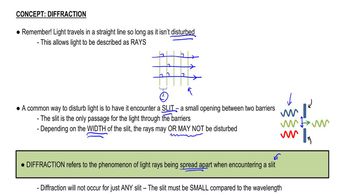
Diffraction

Diffraction is the bending of waves around obstacles and the spreading of waves when they pass through narrow openings. In the context of light, diffraction patterns are created when light waves encounter a slit, leading to the formation of bright and dark fringes on a screen. The extent of diffraction depends on the wavelength of the light and the size of the slit.
Video consigliato:

Young's Double Slit Experiment

Young's Double Slit Experiment demonstrates the wave nature of light through the interference pattern created by two closely spaced slits. The positions of the bright and dark fringes are determined by the path difference between light waves emanating from the slits. This experiment is foundational in understanding how light behaves as a wave, particularly in terms of constructive and destructive interference.
Video consigliato:
Percorso guidato
12:00
Young's Double Slit Experiment

Slit Width and Wavelength Relationship

The relationship between slit width, wavelength, and the angle of diffraction is described by the formula for single-slit diffraction. The width of the slit affects the angle at which the first bright fringe appears; narrower slits produce wider diffraction patterns. This relationship is crucial for calculating the slit width when given the wavelength of light and the angular separation of the fringes.
Video consigliato:
Percorso guidato
05:42
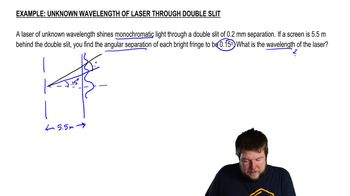
Unknown Wavelength of Laser through Double Slit
Pratica correlata
Domanda del libro di testo

Monochromatic light falls on a slit that is 2.60 x 10⁻³ mm wide. If the angle between the first dark fringes on either side of the central maximum is 29.0° (dark fringe to dark fringe), what is the wavelength of the light used?

1473
views
Domanda del libro di testo

Explain why the secondary maxima in the single-slit diffraction pattern do not occur precisely at β/2 = (m + 1/2)π where m = 1, 2, 3, ... Carefully and precisely plot the curves y = β/2 and y = tan β/2. From their intersections, determine the values of β for the first and second secondary maxima. What is the percent difference from β/2 = (m + 1/2)π?

88
views
Domanda del libro di testo

(a) Explain why the secondary maxima in the single-slit diffraction pattern do not occur precisely at β/2 = (m + 1/2)π where m = 1, 2, 3, ... .

(b) By differentiating Eq. 35–7 with respect to β show that the secondary maxima occur when β/2 satisfies the relation tan(β/2) = β/2.

(c) Carefully and precisely plot the curves y = β/2 and y = tan β/2. From their intersections, determine the values of β for the first and second secondary maxima. What is the percent difference from β/2 = (m + 1/2)π?

1503
views
Domanda del libro di testo

Light of wavelength 580 nm falls on a slit that is 3.50 x 10⁻³ mm wide. Estimate how far the first brightest diffraction fringe is from the strong central maximum if the screen is 10.0 m away.

68
views
Domanda del libro di testo

Two 0.010-mm-wide slits are 0.030 mm apart (center to center). Determine (a) the spacing between interference fringes for 520-nm light on a screen 1.0 m away and (b) the distance between the two diffraction minima on either side of the central maximum of the envelope.

74
views