
Ch. 35 - Diffraction
Giancoli Douglas - Physics for Scientists and Engineers 5th edition
Giancoli Douglas5th editionPhysics for Scientists and EngineersISBN: 9780137488179Non è quello che usi tu?Cambia libro di testo
Capitolo 34, Problema 14

(a) Explain why the secondary maxima in the single-slit diffraction pattern do not occur precisely at β/2 = (m + 1/2)π where m = 1, 2, 3, ... .
(b) By differentiating Eq. 35–7 with respect to β show that the secondary maxima occur when β/2 satisfies the relation tan(β/2) = β/2.
(c) Carefully and precisely plot the curves y = β/2 and y = tan β/2. From their intersections, determine the values of β for the first and second secondary maxima. What is the percent difference from β/2 = (m + 1/2)π?

Guida verificata passo dopo passo
1
Step 1: Understand the context of the problem. The single-slit diffraction pattern is described by the intensity equation I = I₀(sin(β/2)/(β/2))², where β = (2πa/λ)sinθ. The primary maxima occur at β = 0, and the secondary maxima are smaller peaks between the primary maxima. The goal is to analyze why the secondary maxima do not occur precisely at β/2 = (m + 1/2)π, derive the condition for their occurrence, and compare the results.
Step 2: Address part (a). The condition β/2 = (m + 1/2)π (where m = 1, 2, 3, ...) corresponds to the zeros of the denominator of the intensity function, sin(β/2). However, the secondary maxima occur at points where the intensity is locally maximized, not at these zeros. This is because the intensity depends on the square of the sinc function, and the maxima are determined by the balance between the numerator and denominator of the intensity equation.
Step 3: Solve part (b). To find the condition for secondary maxima, differentiate the intensity function with respect to β and set the derivative to zero. Start with the intensity equation I = I₀(sin(β/2)/(β/2))². The derivative involves the product rule and chain rule. After simplification, the condition for maxima reduces to tan(β/2) = β/2. This equation must be solved numerically to find the values of β/2 where the secondary maxima occur.
Step 4: For part (c), plot the curves y = β/2 and y = tan(β/2). These two functions intersect at the points where the condition tan(β/2) = β/2 is satisfied. Use a graphing tool or software to carefully plot these curves. The intersections correspond to the values of β/2 for the first and second secondary maxima. Note these values for further comparison.
Step 5: Calculate the percent difference. Compare the values of β/2 obtained from the intersections of the curves with the approximate values β/2 = (m + 1/2)π for m = 1 and m = 2. The percent difference is given by the formula: Percent Difference = |(Exact Value - Approximate Value)/Approximate Value| × 100%. Perform this calculation for both the first and second secondary maxima to determine the accuracy of the approximation.

Risposta video verificata per un problema simile:

Questa soluzione video è stata consigliata dai nostri tutor come utile per risolvere questo problema.
Durata del video:
9m

Concetti chiave

Ecco i concetti essenziali che devi comprendere per rispondere correttamente alla domanda.

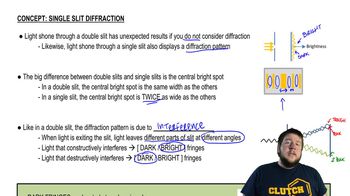
Single-Slit Diffraction

Single-slit diffraction refers to the phenomenon where light waves passing through a narrow slit spread out and create a pattern of bright and dark fringes on a screen. This occurs due to the wave nature of light, where different parts of the wavefront interfere with each other. The positions of the minima and maxima in the diffraction pattern are determined by the slit width and the wavelength of the light used.
Video consigliato:
Percorso guidato
12:33
Single Slit Diffraciton

Maxima and Minima Conditions

In diffraction patterns, maxima occur at points where waves constructively interfere, while minima occur where they destructively interfere. For single-slit diffraction, the condition for minima is given by the equation a sin(θ) = mλ, where 'a' is the slit width, 'θ' is the angle of diffraction, 'm' is an integer, and 'λ' is the wavelength. Secondary maxima appear between these minima but do not align perfectly with simple integer multiples of the wavelength due to the complex interference patterns.
Video consigliato:
Percorso guidato
05:55
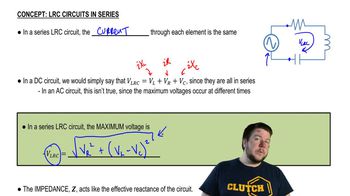
LRC Circuits in Series

Graphical Analysis of Functions

Graphical analysis involves plotting mathematical functions to visually interpret their behavior and find intersections. In this context, plotting y = β/2 and y = tan(β/2) allows us to identify points where these two functions intersect, which correspond to the values of β for the secondary maxima. This method provides a clear visual representation of the relationship between the two equations and helps in determining the percent difference from the expected values.
Video consigliato:
Percorso guidato
05:00
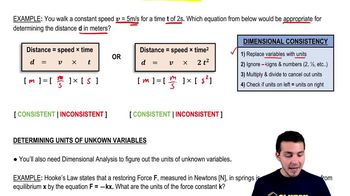
Dimensional Analysis
Pratica correlata
Domanda del libro di testo

Monochromatic light falls on a slit that is 2.60 x 10⁻³ mm wide. If the angle between the first dark fringes on either side of the central maximum is 29.0° (dark fringe to dark fringe), what is the wavelength of the light used?

1473
views
Domanda del libro di testo

Explain why the secondary maxima in the single-slit diffraction pattern do not occur precisely at β/2 = (m + 1/2)π where m = 1, 2, 3, ... Carefully and precisely plot the curves y = β/2 and y = tan β/2. From their intersections, determine the values of β for the first and second secondary maxima. What is the percent difference from β/2 = (m + 1/2)π?

88
views
Domanda del libro di testo

In a double-slit experiment, let d = 5.00D = 40.0λ. Compare (as a ratio) the intensity of the third-order interference maximum with that of the zero-order maximum.

1504
views
Domanda del libro di testo

Light of wavelength 580 nm falls on a slit that is 3.50 x 10⁻³ mm wide. Estimate how far the first brightest diffraction fringe is from the strong central maximum if the screen is 10.0 m away.

68
views
Domanda del libro di testo

Monochromatic light of wavelength 633 nm falls on a slit. If the angle between the first bright fringes on either side of the central maximum is 32°, estimate the slit width.

1585
views
Domanda del libro di testo

Two 0.010-mm-wide slits are 0.030 mm apart (center to center). Determine (a) the spacing between interference fringes for 520-nm light on a screen 1.0 m away and (b) the distance between the two diffraction minima on either side of the central maximum of the envelope.

74
views