
Ch. 36 - The Special Theory of Relativity
Giancoli Douglas - Physics for Scientists and Engineers 5th edition
Giancoli Douglas5th editionPhysics for Scientists and EngineersISBN: 9780137488179Non è quello che usi tu?Cambia libro di testo
Capitolo 35, Problema 87

A quasar emits familiar hydrogen lines whose wavelengths are 8.5% longer than what we measure in the laboratory.
(a) Using the Doppler formula for light, estimate the speed of this quasar.
(b) What result would you obtain if you used the “classical” Doppler shift discussed in Chapter 16?

Guida verificata passo dopo passo
1
Step 1: Understand the problem. The quasar's hydrogen lines are redshifted, meaning their wavelengths are longer than those measured in the laboratory. This redshift is due to the Doppler effect, which occurs when an object emitting light moves relative to the observer. We need to calculate the speed of the quasar using both the relativistic Doppler formula and the classical Doppler formula.
Step 2: Write down the relativistic Doppler formula for light. The formula is: 1+vc1-vc=λλ', where λ is the observed wavelength, λ' is the laboratory wavelength, v is the speed of the quasar, and c is the speed of light.
Step 3: Substitute the given information into the relativistic formula. The observed wavelength is 8.5% longer than the laboratory wavelength, so λ=λ'×1.085. Rearrange the formula to solve for v.
Step 4: Write down the classical Doppler formula for light. The formula is: Δλλ'=vc, where Δλ is the change in wavelength (λ-λ'). Substitute the given information into this formula to solve for v.
Step 5: Compare the results from the relativistic and classical formulas. The relativistic formula accounts for effects at high speeds close to the speed of light, while the classical formula assumes lower speeds. Discuss why the relativistic formula is more accurate for astronomical objects like quasars.

Risposta video verificata per un problema simile:

Questa soluzione video è stata consigliata dai nostri tutor come utile per risolvere questo problema.
Durata del video:
6m

Concetti chiave

Ecco i concetti essenziali che devi comprendere per rispondere correttamente alla domanda.

Doppler Effect

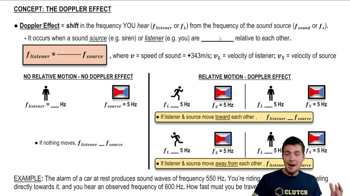
The Doppler Effect refers to the change in frequency or wavelength of a wave in relation to an observer moving relative to the source of the wave. In the context of light, when a source moves away from an observer, the observed wavelength increases (redshift), while it decreases (blueshift) when the source approaches. This effect is crucial for understanding how the motion of astronomical objects, like quasars, affects the light we receive from them.
Video consigliato:
Percorso guidato
07:40
The Doppler Effect

Redshift

Redshift is the phenomenon where light from an object is shifted to longer wavelengths due to the object's motion away from the observer. It is commonly used in astronomy to determine the speed and distance of celestial objects. The amount of redshift can be quantified and is directly related to the velocity of the object through the Doppler formula, making it essential for estimating the speed of quasars.

Classical vs. Relativistic Doppler Shift

The classical Doppler shift formula applies to speeds much less than the speed of light and assumes a simple relationship between the source and observer's velocities. In contrast, the relativistic Doppler shift accounts for the effects of special relativity, which become significant at high velocities, such as those of quasars. Using the correct formula is vital for accurate calculations of speed and wavelength shifts in high-velocity astrophysical contexts.
Video consigliato:
Percorso guidato
07:40
The Doppler Effect
Pratica correlata
Domanda del libro di testo

How much energy would be required to break a helium nucleus into its constituents, two protons and two neutrons? The rest masses of a proton (including an electron), a neutron, and neutral helium are, respectively, 1.00783 u, 1.00867 u, and 4.00260 u. (This energy difference is called the total binding energy of the 24He_2^4\(\text{He}\) nucleus.)

82
views
Domanda del libro di testo

A spaceship and its occupants have a total mass of 160,000 kg. The occupants would like to travel to a star that is 32 light-years away at a speed of 0.70c. To accelerate, the engine of the spaceship changes mass directly to energy.

(a) Estimate how much mass will be converted to energy to accelerate the spaceship to this speed.

(b) Assuming the acceleration is rapid, so the speed for the entire trip can be taken to be 0.70c, determine how long the trip will take according to the astronauts on board.

831
views
Domanda del libro di testo

For a 1.0-kg mass, make a plot of the kinetic energy as a function of speed for speeds from 0 to 0.9c, using both the classical formula ( K = 1/2 mv²) and the correct relativistic formula ( K = ( γ -1)mc²).

1133
views
Domanda del libro di testo

Using Example 36–2 as a guide, show that for objects that move slowly in comparison to c, the length contraction formula is roughly ℓ ≈ ℓ₀ (1 - 1/2 v²/c²) . Use this approximation to find the “length shortening” ∆ℓ = ℓ₀ - ℓ of the train in Example 36–6 if the train travels at 100 km/h (rather than 0.92c).

876
views
Domanda del libro di testo

A pi meson of mass mπ decays at rest into a muon (mass mμ) and a neutrino of negligible or zero mass. Show that the kinetic energy of the muon is Kμ = (mπ - mμ)² c² / (2mπ).

1238
views
Domanda del libro di testo

Two protons, each having a speed of 0.945c in the laboratory, are moving toward each other. Determine (a) the momentum of each proton in the laboratory, (b) the total momentum of the two protons in the laboratory, and (c) the momentum of one proton as seen by the other proton.

56
views