
Ch. 36 - The Special Theory of Relativity
Giancoli Douglas - Physics for Scientists and Engineers 5th edition
Giancoli Douglas5th editionPhysics for Scientists and EngineersISBN: 9780137488179Non è quello che usi tu?Cambia libro di testo
Capitolo 35, Problema 92

Using Example 36–2 as a guide, show that for objects that move slowly in comparison to c, the length contraction formula is roughly ℓ ≈ ℓ₀ (1 - 1/2 v²/c²) . Use this approximation to find the “length shortening” ∆ℓ = ℓ₀ - ℓ of the train in Example 36–6 if the train travels at 100 km/h (rather than 0.92c).

Guida verificata passo dopo passo
1
Identify the given values and relevant formulas. In this case, the original length of the train (ℓ₀) and its speed (v) are given. The speed of light (c) is a constant. The length contraction formula in special relativity is ℓ = ℓ₀√(1 - v²/c²).
Since the train moves much slower than the speed of light, we can use the binomial approximation for the square root in the length contraction formula when v is much smaller than c. This approximation is √(1 - x) ≈ 1 - 1/2 x for small x. Here, x corresponds to v²/c².
Substitute v²/c² into the binomial approximation to modify the length contraction formula: ℓ ≈ ℓ₀(1 - 1/2 v²/c²).
Calculate the approximate contracted length ℓ using the modified formula by substituting the values of v and c into the formula. Remember to convert the speed of the train from km/h to m/s for consistency with the units of c (which is in m/s).
Finally, find the length shortening ∆ℓ by subtracting the contracted length ℓ from the original length ℓ₀: ∆ℓ = ℓ₀ - ℓ.

Risposta video verificata per un problema simile:

Questa soluzione video è stata consigliata dai nostri tutor come utile per risolvere questo problema.
Durata del video:
5m

Concetti chiave

Ecco i concetti essenziali che devi comprendere per rispondere correttamente alla domanda.

Length Contraction

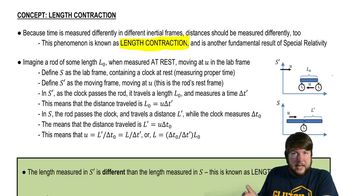
Length contraction is a phenomenon in special relativity where the length of an object moving at a significant fraction of the speed of light (c) is measured to be shorter than its proper length (ℓ₀) when at rest. The formula for length contraction is ℓ = ℓ₀√(1 - v²/c²), where ℓ is the contracted length, v is the object's velocity, and c is the speed of light. This effect becomes noticeable as the object's speed approaches c.
Video consigliato:
Percorso guidato
07:02
Length Contraction

Approximation for Low Speeds

For objects moving at speeds much lower than the speed of light, the effects of relativity can be approximated using a simplified formula. Specifically, when v is much less than c, the length contraction can be approximated as ℓ ≈ ℓ₀(1 - 1/2 v²/c²). This approximation allows for easier calculations without needing to use the full relativistic equations, making it practical for everyday speeds.
Video consigliato:
Percorso guidato
07:59
Speed Distribution & Special Speeds of Ideal Gases

Calculating Length Shortening

To find the length shortening (∆ℓ) of an object, one can use the difference between its proper length (ℓ₀) and its contracted length (ℓ). The formula is ∆ℓ = ℓ₀ - ℓ. By substituting the approximate length contraction formula into this equation, one can calculate how much shorter the object appears when moving at a given speed, such as 100 km/h in the context of the train example.
Video consigliato:
Percorso guidato
10:54
Spinning on a string of variable length
Pratica correlata
Domanda del libro di testo

What magnetic field B is needed to keep 998-GeV protons revolving in a circle of radius 1.0km? Use the relativistic mass. The proton’s “rest mass” is 0.938 GeV/c². ( 1 GeV = 10⁹ eV.) [Hint: In relativity, mᵣₑₗ v²/r = qvB is still valid in a magnetic field, where mᵣₑₗ = γm.]

755
views
Domanda del libro di testo

A spaceship and its occupants have a total mass of 160,000 kg. The occupants would like to travel to a star that is 32 light-years away at a speed of 0.70c. To accelerate, the engine of the spaceship changes mass directly to energy.

(a) Estimate how much mass will be converted to energy to accelerate the spaceship to this speed.

(b) Assuming the acceleration is rapid, so the speed for the entire trip can be taken to be 0.70c, determine how long the trip will take according to the astronauts on board.

831
views
Domanda del libro di testo

Astronomers measure the distance to a particular star to be 6.0 light-years (1ly = distance light travels in 1 year). A spaceship travels from Earth to the vicinity of this star at steady speed, arriving in 3.25 years as measured by clocks on the spaceship. (a) How long does the trip take as measured by clocks in Earth’s reference frame? (b) What distance does the spaceship travel as measured in its own reference frame?

934
views
Domanda del libro di testo

For a 1.0-kg mass, make a plot of the kinetic energy as a function of speed for speeds from 0 to 0.9c, using both the classical formula ( K = 1/2 mv²) and the correct relativistic formula ( K = ( γ -1)mc²).

1133
views
Domanda del libro di testo

A quasar emits familiar hydrogen lines whose wavelengths are 8.5% longer than what we measure in the laboratory.

(a) Using the Doppler formula for light, estimate the speed of this quasar.

(b) What result would you obtain if you used the “classical” Doppler shift discussed in Chapter 16?

60
views