
Ch. 36 - The Special Theory of Relativity
Giancoli Douglas - Physics for Scientists and Engineers 5th edition
Giancoli Douglas5th editionPhysics for Scientists and EngineersISBN: 9780137488179Non è quello che usi tu?Cambia libro di testo
Capitolo 35, Problema 18

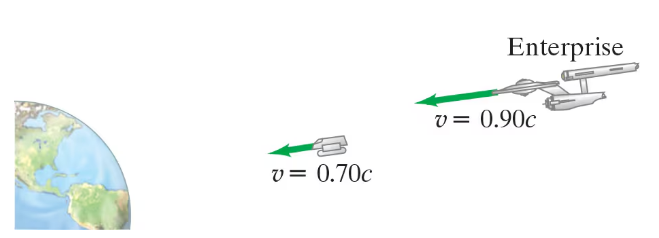
(I) An observer on Earth sees an alien vessel approach at a speed of 0.70c. The fictional starship Enterprise comes to the rescue (Fig. 36–17), overtaking the aliens while moving directly toward Earth at a speed of 0.90c relative to Earth. What is the relative speed of one vessel as seen by the other?

Guida verificata passo dopo passo
1
Step 1: Identify the problem as a relativistic velocity addition problem. In special relativity, when two objects are moving relative to each other at significant fractions of the speed of light, their relative velocity cannot be calculated using classical mechanics. Instead, we use the relativistic velocity addition formula.
Step 2: Write down the relativistic velocity addition formula: \( v_{rel} = \frac{v_1 + v_2}{1 + \frac{v_1 v_2}{c^2}} \), where \( v_1 \) and \( v_2 \) are the velocities of the two objects relative to a common reference frame, and \( c \) is the speed of light.
Step 3: Assign the given values: \( v_1 = 0.90c \) (Enterprise's speed relative to Earth) and \( v_2 = -0.70c \) (alien vessel's speed relative to Earth, negative because it is moving toward Earth). Substitute these values into the formula.
Step 4: Simplify the numerator: \( v_1 + v_2 = 0.90c - 0.70c = 0.20c \). Then calculate the denominator: \( 1 + \frac{v_1 v_2}{c^2} = 1 + \frac{(0.90c)(-0.70c)}{c^2} = 1 - 0.63 = 0.37 \).
Step 5: Combine the results to find the relative velocity: \( v_{rel} = \frac{0.20c}{0.37} \). This gives the relative speed of one vessel as seen by the other. You can simplify further if needed, but the process is complete.

Risposta video verificata per un problema simile:

Questa soluzione video è stata consigliata dai nostri tutor come utile per risolvere questo problema.
Durata del video:
2m

Concetti chiave

Ecco i concetti essenziali che devi comprendere per rispondere correttamente alla domanda.

Relativity of Velocity

In the context of special relativity, the relative velocity between two objects moving at significant fractions of the speed of light (c) cannot be calculated using classical addition of velocities. Instead, the relativistic velocity addition formula must be used, which accounts for the effects of time dilation and length contraction as objects approach the speed of light.
Video consigliato:
Percorso guidato
04:27
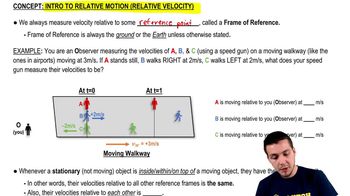
Intro to Relative Motion (Relative Velocity)

Lorentz Transformation

The Lorentz transformation equations relate the space and time coordinates of events as observed in different inertial frames. These transformations are essential for understanding how measurements of time and distance change for observers moving relative to one another, particularly at high speeds close to the speed of light.
Video consigliato:
Percorso guidato
13:39
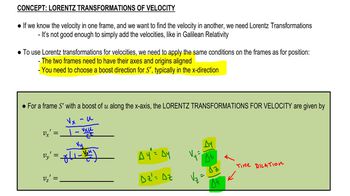
Lorentz Transformations of Velocity

Speed of Light (c)

The speed of light in a vacuum, denoted as c, is a fundamental constant in physics, approximately equal to 299,792,458 meters per second. It serves as the ultimate speed limit in the universe, influencing the behavior of objects moving at relativistic speeds and forming the basis for Einstein's theory of relativity, which reshapes our understanding of space and time.
Video consigliato:
Percorso guidato
06:03
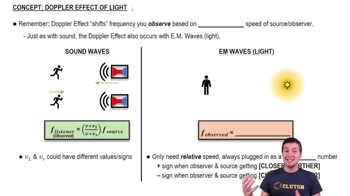
The Doppler Effect (Light)