
Ch. 36 - The Special Theory of Relativity
Giancoli Douglas - Physics for Scientists and Engineers 5th edition
Giancoli Douglas5th editionPhysics for Scientists and EngineersISBN: 9780137488179Non è quello che usi tu?Cambia libro di testo
Capitolo 35, Problema 20

(I) Repeat Problem 19 using the Lorentz transformation and a relative speed v = 1.60 x 10⁸ m/s, but choose the time t to be (a) 3.5μs and (b) 10.0 μs .

Guida verificata passo dopo passo
1
Identify the given values: relative speed v = 1.60 x 10^8 m/s, and times t = 3.5 \(\text{μs}\) and t = 10.0 \(\text{μs}\). Convert these times into seconds for consistency in units.
Recall the Lorentz transformation equations for time: t' = \(\gamma\) (t - \(\frac{vx}{c^2}\)), where \(\gamma\) is the Lorentz factor given by \(\gamma\) = \(\frac{1}{\sqrt{1 - \frac{v^2}{c^2}\)}}, c is the speed of light (approximately 3.00 x 10^8 m/s), and x is the position in the original frame.
Calculate the Lorentz factor (\(\gamma\)) using the given relative speed v.
Substitute the values of t, v, and \(\gamma\) into the Lorentz transformation equation for time to find t' for each case: (a) t = 3.5 \(\text{μs}\) and (b) t = 10.0 \(\text{μs}\). Assume x = 0 if the position is not specified.
Interpret the results to understand how time dilation occurs due to high relative speeds close to the speed of light.

Risposta video verificata per un problema simile:

Questa soluzione video è stata consigliata dai nostri tutor come utile per risolvere questo problema.
Durata del video:
9m

Concetti chiave

Ecco i concetti essenziali che devi comprendere per rispondere correttamente alla domanda.

Lorentz Transformation

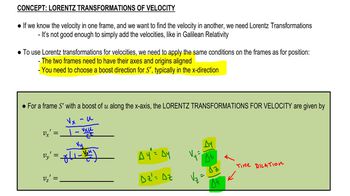
The Lorentz transformation is a set of equations in special relativity that relate the space and time coordinates of two observers moving at a constant velocity relative to each other. It accounts for the effects of time dilation and length contraction, ensuring that the speed of light remains constant in all inertial frames. This transformation is essential for analyzing scenarios involving high speeds, such as the one presented in the problem.
Video consigliato:
Percorso guidato
13:39
Lorentz Transformations of Velocity

Time Dilation

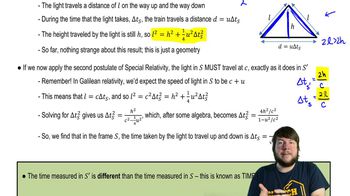
Time dilation is a phenomenon predicted by Einstein's theory of relativity, where time is observed to pass at different rates for observers in different inertial frames. Specifically, a moving clock ticks slower compared to a stationary clock as perceived by an observer. This concept is crucial for understanding how time intervals, such as the given 3.5 μs and 10.0 μs, will be perceived differently depending on the relative speed of the observers.
Video consigliato:

Relative Velocity

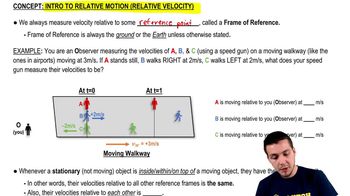
Relative velocity is the velocity of one object as observed from another object. In the context of special relativity, it is important to consider how the speed of light remains constant regardless of the relative motion of observers. The problem specifies a relative speed of 1.60 x 10⁸ m/s, which is significant enough to invoke relativistic effects, making it necessary to apply the Lorentz transformation to accurately analyze the situation.
Video consigliato:
Percorso guidato
04:27
Intro to Relative Motion (Relative Velocity)