
Ch. 40 - Molecules and Solids
Giancoli Douglas - Physics for Scientists and Engineers 5th edition
Giancoli Douglas5th editionPhysics for Scientists and EngineersISBN: 9780137488179Non è quello che usi tu?Cambia libro di testo
Capitolo 37, Problema 61

If the current gain of the transistor amplifier in Fig. 40–49 is β = ic/iB = 95, what value must Rc have if a 1.0-μA ac base current is to produce an ac output voltage of 0.40 V?

Guida verificata passo dopo passo
1
Identify the relationship between the base current (iB), collector current (iC), and the current gain (β). The formula is: icC=β×iBB. Use this to calculate the collector current.
Determine the relationship between the output voltage (Vout), the collector current (iC), and the collector resistor (Rc). The formula is: Voutout=iCC×Rcc. Rearrange this equation to solve for Rc: Rcc=VoutoutiCC.
Substitute the given values into the formula for iC. Use β=95 and iBB=1.0µA to calculate iCC.
Substitute the calculated value of iC and the given output voltage Voutout=0.40V into the formula for Rc to find its value.
Verify the units of Rc to ensure they are consistent (ohms, Ω). Double-check the calculations to confirm the result is reasonable and matches the problem's requirements.

Risposta video verificata per un problema simile:

Questa soluzione video è stata consigliata dai nostri tutor come utile per risolvere questo problema.
Durata del video:
2m

Concetti chiave

Ecco i concetti essenziali che devi comprendere per rispondere correttamente alla domanda.

Transistor Current Gain (β)

The current gain of a transistor, denoted as β (beta), is the ratio of the collector current (ic) to the base current (iB). It indicates how effectively a transistor can amplify current; a higher β means greater amplification. In this question, β = 95 implies that for every 1 μA of base current, the collector current will be 95 μA, which is crucial for determining the output voltage.
Video consigliato:
Percorso guidato
05:38
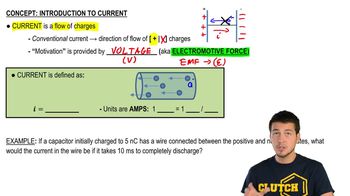
Intro to Current

Output Voltage (Vout)

The output voltage in a transistor amplifier is the voltage across the load resistor (Rc) due to the amplified collector current. It is calculated using Ohm's Law (V = IR), where I is the collector current. In this scenario, the desired output voltage is 0.40 V, which must be achieved by selecting an appropriate value for Rc based on the amplified current from the base input.
Video consigliato:
Percorso guidato
07:14
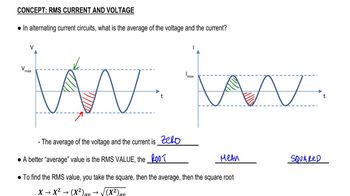
RMS Current and Voltage

Load Resistor (Rc)

The load resistor (Rc) in a transistor circuit is connected to the collector and is essential for converting the amplified current into a usable output voltage. The value of Rc directly affects the output voltage; a higher Rc will result in a higher output voltage for a given collector current. To find the correct Rc value, one must consider the relationship between the collector current, the desired output voltage, and Ohm's Law.
Video consigliato:
Percorso guidato
04:11
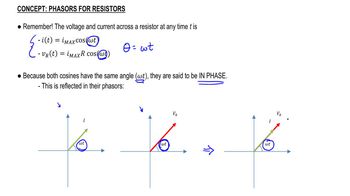
Phasors for Resistors