
Ch. 44 - Astrophysics and Cosmology
Giancoli Douglas - Physics for Scientists and Engineers 5th edition
Giancoli Douglas5th editionPhysics for Scientists and EngineersISBN: 9780137488179Non è quello che usi tu?Cambia libro di testo
Capitolo 39, Problema 36

Starting from Eq. 44–3, show that the Doppler shift in wavelength is ∆λ/λᵣₑₛₜ ≈ v/c (Eq. 44–6) for v ≪ c. [Hint: Use the binomial expansion.]

Guida verificata passo dopo passo
1
Start with the relativistic Doppler shift formula for wavelength: \(\lambda\) = \(\lambda\)_{\(\text{rest}\)} \(\sqrt{\frac{1 + v/c}{1 - v/c}\)}, where \(\lambda\) is the observed wavelength, \(\lambda\)_{\(\text{rest}\)} is the wavelength at rest, v is the relative velocity, and c is the speed of light.
Express the change in wavelength as \(\Delta\) \(\lambda\) = \(\lambda\) - \(\lambda\)_{\(\text{rest}\)}. Dividing through by \(\lambda\)_{\(\text{rest}\)}, we get \(\frac{\Delta \lambda}{\lambda_{\text{rest}\)}} = \(\frac{\lambda}{\lambda_{\text{rest}\)}} - 1.
Substitute the expression for \(\lambda\) from the Doppler shift formula into \(\frac{\lambda}{\lambda_{\text{rest}\)}}: \(\frac{\lambda}{\lambda_{\text{rest}\)}} = \(\sqrt{\frac{1 + v/c}{1 - v/c}\)}.
For v \(\ll\) c, use the binomial expansion approximation: \(\sqrt{1 + x}\) \(\approx\) 1 + \(\frac{x}{2}\) for small x. Apply this to both the numerator and denominator of \(\sqrt{\frac{1 + v/c}{1 - v/c}\)}, expanding to first order in v/c.
Simplify the resulting expression to show that \(\frac{\Delta \lambda}{\lambda_{\text{rest}\)}} \(\approx\) \(\frac{v}{c}\), which is the desired result for small velocities relative to the speed of light.

Risposta video verificata per un problema simile:

Questa soluzione video è stata consigliata dai nostri tutor come utile per risolvere questo problema.
Durata del video:
10m

Concetti chiave

Ecco i concetti essenziali che devi comprendere per rispondere correttamente alla domanda.

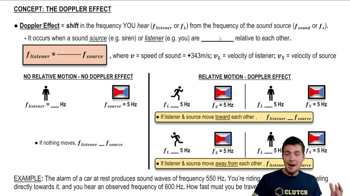
Doppler Effect

The Doppler Effect refers to the change in frequency or wavelength of a wave in relation to an observer moving relative to the source of the wave. In the context of light, when a source moves away from an observer, the observed wavelength increases (redshift), while if it moves towards the observer, the wavelength decreases (blueshift). This effect is crucial for understanding how motion affects the perception of waves, particularly in astrophysics.
Video consigliato:
Percorso guidato
07:40
The Doppler Effect

Wavelength Shift

Wavelength shift is the change in the wavelength of a wave due to relative motion between the source and the observer. In the case of the Doppler Effect, this shift can be quantified as ∆λ, which represents the difference between the observed wavelength and the rest wavelength (λᵣₑₛₜ). Understanding this shift is essential for analyzing how velocities affect wave properties, especially in scenarios where the source is moving at speeds much less than the speed of light (v ≪ c).
Video consigliato:
Percorso guidato
05:42
Unknown Wavelength of Laser through Double Slit

Binomial Expansion

The binomial expansion is a mathematical technique used to approximate expressions of the form (1 + x)ⁿ for small values of x. In the context of the Doppler shift, it allows for simplifying the relationship between the observed wavelength and the rest wavelength when the velocity of the source is much smaller than the speed of light. This approximation is key to deriving the relationship ∆λ/λᵣₑₛₜ ≈ v/c, making complex calculations more manageable.
Video consigliato:
Percorso guidato
05:21
Volume Thermal Expansion