Ch 01: Concepts of Motion
Knight Calc - Physics for Scientists and Engineers 5th Edition
Knight Calc5th EditionPhysics for Scientists and EngineersISBN: 9780137344796Non è quello che usi tu?Cambia libro di testo
Capitolo 1, Problema 28b

Perform the following calculations with the correct number of significant figures.
5.1125 + 0.67 + 3.2

Guida verificata passo dopo passo
1
Identify the number of significant figures in the decimal portion of each number: 5.1125 has 4 decimal places, 0.67 has 2 decimal places, and 3.2 has 1 decimal place.
When adding or subtracting numbers, the result should be rounded to the least number of decimal places among the numbers being added. In this case, the least number of decimal places is 1 (from 3.2).
Perform the addition: \( 5.1125 + 0.67 + 3.2 \). Add the numbers as they are without rounding yet.
After obtaining the sum, round the result to 1 decimal place, as determined in step 2.
Express the final answer with the correct number of significant figures, ensuring it adheres to the rules of significant figures for addition.

Risposta video verificata per un problema simile:

Questa soluzione video è stata consigliata dai nostri tutor come utile per risolvere questo problema.
Durata del video:
1m

Concetti chiave

Ecco i concetti essenziali che devi comprendere per rispondere correttamente alla domanda.

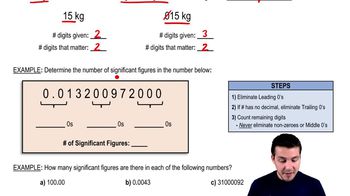
Significant Figures

Significant figures are the digits in a number that contribute to its precision. This includes all non-zero digits, any zeros between significant digits, and trailing zeros in the decimal portion. When performing calculations, the result should be reported with the same number of significant figures as the measurement with the least number of significant figures.
Video consigliato:
Percorso guidato
04:44
Counting Significant Figures

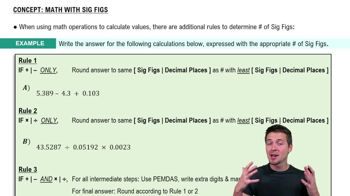
Addition of Numbers with Significant Figures

When adding numbers, the result should be rounded to the least precise decimal place of any number in the operation. This means that the final answer should reflect the smallest number of decimal places present in the numbers being added. For example, if one number has two decimal places and another has one, the result should be rounded to one decimal place.
Video consigliato:
Percorso guidato
08:22
Operations with Significant Figures

Order of Operations

The order of operations is a set of rules that dictates the sequence in which calculations should be performed to ensure consistent results. In the context of addition, it is straightforward since all operations are performed from left to right. However, understanding this concept is crucial when dealing with more complex calculations that involve multiple operations.
Video consigliato:
Percorso guidato
08:22
Operations with Significant Figures