Indietro
- A jet plane lands on the deck of an aircraft carrier and quickly comes to a halt. Draw a basic motion diagram, using the s from the video, from the time the jet touches down until it stops.
Problema 1
Problema 2a
You are watching a jet ski race. A racer speeds up from rest to 70 mph in 10 s, then continues at a constant speed. Draw a basic motion diagram of the jet ski, using s from the video, from its start until 10 s after reaching top speed.
Problema 6
You drop a soccer ball from your third-story balcony. Use the particle model to draw a motion diagram showing the ball's position and average velocity vectors from the time you release the ball until the instant it touches the ground.
Problema 8a
FIGURE EX1.8 shows the first three points of a motion diagram. Is the object's average speed between points 1 and 2 greater than, less than, or equal to its average speed between points 0 and 1? Explain how you can tell.
Problema 9
FIGURE EX1.9 shows five points of a motion diagram. Use Tactics Box 1.2 to find the average acceleration vectors at points 1, 2, and 3. Draw the completed motion diagram showing velocity vectors and acceleration vectors.
Problema 10b
FIGURE EX1.10 shows two dots of a motion diagram and vector. Copy this figure, then add dot 4 and the next velocity vector if the acceleration vector at dot 3 points left.
Problema 13
A speed skater accelerates from rest and then keeps skating at a constant speed. Draw a complete motion diagram of the skater.
Problema 14
A bowling ball rolls up an incline and then onto a smooth, level surface. Draw a complete motion diagram of the bowling ball. Don't try to find the acceleration vector at the point where the motion changes direction; that's an issue for Chapter 4.
Problema 17
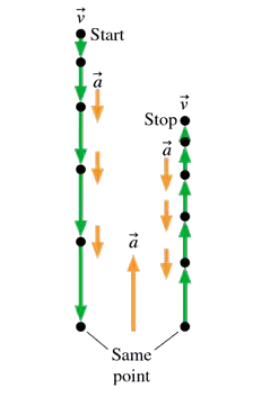
Your roommate drops a tennis ball from a third-story balcony. It hits the sidewalk and bounces as high as the second story. Draw a complete motion diagram of the tennis ball from the time it is released until it reaches the maximum height on its bounce. Be sure to determine and show the acceleration at the lowest point.
Problema 21
Draw a pictorial representation for the following problem. Do not solve the problem. What acceleration does a rocket need to reach a speed of 200 m/s at a height of 1.0 km?
Problema 23c
How many significant figures are there in each of the following values?
75.0
Problema 23d
How many significant figures are there in each of the following values?
0.07 x 10⁸
Problema 25c
Convert the following to basic SI units or a combination of basic SI units:
62 ft/day
Problema 25d
Convert the following to basic SI units or a combination of basic SI units:
2.2 x 10⁴ mi2
Problema 27b
Using the approximate conversion factors in Table 1.5, convert the following SI units to English units without using your calculator.
25 m/s
Problema 28a
Perform the following calculations with the correct number of significant figures.
159.31 x 204.6
Problema 28b
Perform the following calculations with the correct number of significant figures.
5.1125 + 0.67 + 3.2
Problema 28c
Perform the following calculations with the correct number of significant figures.
7.662 - 7.425
Problema 28d
Perform the following calculations with the correct number of significant figures.
16.5/3.45
Problema 29c
Compute the following numbers, applying the significant figure rules adopted in this textbook.
Problema 32
Estimate the average speed with which the hair on your head grows. Give your answer in both m/s and μm/hour. Briefly describe how you arrived at this estimate.
Problema 34
A jet plane is cruising at 300 m/s when suddenly the pilot turns the engines up to full throttle. After traveling 4.0 km, the jet is moving with a speed of 400 m/s. What is the jet's acceleration as it speeds up?
Problema 37
For Problems 34, 35, 36, 37, 38, 39, 40, 41, 42, and 43, draw a complete pictorial representation. Do not solve these problems or do any mathematics. A car starts from rest at a stop sign. It accelerates at 4.0 m/s² for 6.0 s, coasts for 2.0 s, and then slows at a rate of 2.5 m/s² for the next stop sign. How far apart are the stop signs?
Problema 41
A car traveling at 30 m/s runs out of gas while traveling up a 10° slope. How far up the hill will the car coast before starting to roll back down?
Problema 43
David is driving a steady 30 m/s when he passes Tina, who is sitting in her car at rest. Tina begins to accelerate at a steady 2.0 m/s² at the instant when David passes. How far does Tina drive before passing David?
Problema 46
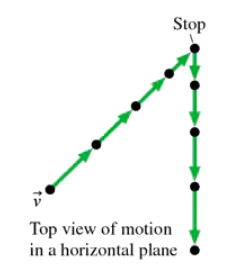
Problems 44, 45, 46, 47, and 48 show a motion diagram. For each of these problems, write a one or two sentence 'story' about a real object that has this motion diagram. Your stories should talk about people or objects by name and say what they are doing.
Problema 49a
Problems 49, 50, 51, and 52 show a partial motion diagram. For each: Complete the motion diagram by adding acceleration vectors.
Problema 49c
Problems 49, 50, 51, and 52 show a partial motion diagram. For each: Draw a pictorial representation for your problem.
Problema 51a
Problems 49, 50, 51, and 52 show a partial motion diagram. For each: Complete the motion diagram by adding acceleration vectors.
Problema 51c
Problems 49, 50, 51, and 52 show a partial motion diagram. For each: Draw a pictorial representation for your problem.