
Ch 02: Kinematics in One Dimension
Knight Calc - Physics for Scientists and Engineers 5th Edition
Knight Calc5th EditionPhysics for Scientists and EngineersISBN: 9780137344796Non è quello che usi tu?Cambia libro di testo
Capitolo 2, Problema 84c

A rubber ball is shot straight up from the ground with speed v₀. Simultaneously, a second rubber ball at height h directly above the first ball is dropped from rest. For what value of h does the collision occur at the instant when the first ball is at its highest point?

Guida verificata passo dopo passo
1
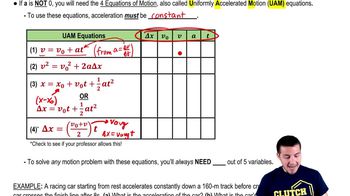
Determine the time it takes for the first ball to reach its highest point. At the highest point, the velocity of the first ball becomes zero. Use the kinematic equation: v=v0-gt, where v is the final velocity (0 at the highest point), v0 is the initial velocity, g is the acceleration due to gravity, and t is the time. Solve for t: t=v0g.
Calculate the height of the first ball at its highest point using the kinematic equation: y=v0t-12gt^2. Substitute t=v0g from Step 1 into this equation to find the maximum height ymax.
For the second ball, determine the time it takes to fall from height h to the collision point. Use the kinematic equation: y=h-12gt^2. At the collision point, the height of the second ball equals the maximum height of the first ball, so set y=ymax.
Equate the time for the first ball to reach its highest point (from Step 1) to the time it takes for the second ball to fall to the collision point (from Step 3). Solve for h in terms of v0 and g.
Simplify the expression for h to find the value of the initial height of the second ball such that the collision occurs at the highest point of the first ball. This will involve substituting ymax from Step 2 into the equation derived in Step 4.

Risposta video verificata per un problema simile:

Questa soluzione video è stata consigliata dai nostri tutor come utile per risolvere questo problema.
Durata del video:
13m

Concetti chiave

Ecco i concetti essenziali che devi comprendere per rispondere correttamente alla domanda.

Kinematics

Kinematics is the branch of mechanics that describes the motion of objects without considering the forces that cause the motion. It involves concepts such as displacement, velocity, and acceleration. In this scenario, understanding the kinematic equations is essential to determine the position of both balls over time, particularly the first ball's maximum height and the second ball's position as it falls.
Video consigliato:
Percorso guidato
08:25
Kinematics Equations

Free Fall

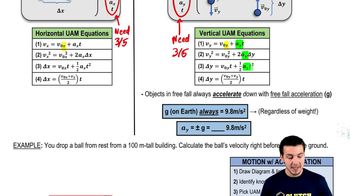
Free fall refers to the motion of an object under the influence of gravity alone, with no other forces acting on it. In this case, the second rubber ball is dropped from rest, meaning it accelerates downward at a rate of approximately 9.81 m/s². This concept is crucial for calculating the height from which the second ball falls and determining when it will collide with the first ball.
Video consigliato:
Percorso guidato
08:36
Vertical Motion & Free Fall

Maximum Height

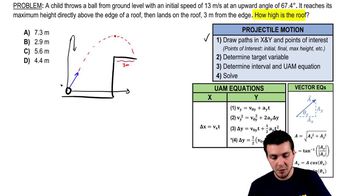
The maximum height of a projectile is the peak point reached during its upward motion, where its velocity becomes zero before it starts descending. For the first rubber ball shot upwards, this height can be calculated using the initial velocity and the acceleration due to gravity. Knowing this height is vital for finding the specific value of h at which the second ball will collide with the first ball at that instant.
Video consigliato:
Percorso guidato
08:17
Height of a Roof