Ch 02: Kinematics in One Dimension
Knight Calc - Physics for Scientists and Engineers 5th Edition
Knight Calc5th EditionPhysics for Scientists and EngineersISBN: 9780137344796Non è quello che usi tu?Cambia libro di testo
Capitolo 2, Problema 63

A very slippery block of ice slides down a smooth ramp tilted at angle θ. The ice is released from rest at vertical height h above the bottom of the ramp. Find an expression for the speed of the ice at the bottom.

Guida verificata passo dopo passo
1
Start by identifying the principle of conservation of energy. The total mechanical energy of the system is conserved because there is no friction or external work done. The potential energy at the top of the ramp is converted entirely into kinetic energy at the bottom.
Write the expression for gravitational potential energy at the top of the ramp: \( U = mgh \), where \( m \) is the mass of the ice, \( g \) is the acceleration due to gravity, and \( h \) is the vertical height.
Write the expression for kinetic energy at the bottom of the ramp: \( K = \frac{1}{2}mv^2 \), where \( v \) is the speed of the ice at the bottom.
Set the initial potential energy equal to the final kinetic energy using the conservation of energy principle: \( mgh = \frac{1}{2}mv^2 \). Notice that the mass \( m \) cancels out from both sides of the equation.
Solve for \( v \) by isolating it: \( v = \sqrt{2gh} \). This is the expression for the speed of the ice at the bottom of the ramp in terms of the given variables \( g \) and \( h \).

Risposta video verificata per un problema simile:

Questa soluzione video è stata consigliata dai nostri tutor come utile per risolvere questo problema.
Durata del video:
5m

Concetti chiave

Ecco i concetti essenziali che devi comprendere per rispondere correttamente alla domanda.

Conservation of Energy

The principle of conservation of energy states that energy cannot be created or destroyed, only transformed from one form to another. In this scenario, the potential energy of the ice at height h is converted into kinetic energy as it slides down the ramp. This relationship allows us to equate the initial potential energy to the final kinetic energy to find the speed of the ice.
Video consigliato:
Percorso guidato
06:24
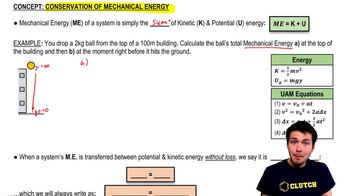
Conservation Of Mechanical Energy

Potential Energy

Potential energy is the energy stored in an object due to its position in a gravitational field. For an object at height h, the potential energy is given by the formula PE = mgh, where m is mass, g is the acceleration due to gravity, and h is the height. As the ice block descends the ramp, this potential energy decreases, converting into kinetic energy.
Video consigliato:
Percorso guidato
07:24
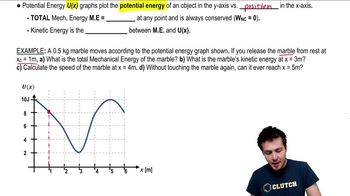
Potential Energy Graphs

Kinetic Energy

Kinetic energy is the energy of an object in motion, defined by the formula KE = 1/2 mv², where m is mass and v is velocity. At the bottom of the ramp, all the potential energy has been converted into kinetic energy, allowing us to solve for the speed of the ice. Understanding this relationship is crucial for deriving the expression for the speed at the bottom of the ramp.
Video consigliato:
Percorso guidato
06:07
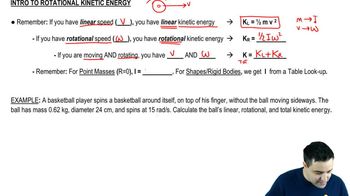
Intro to Rotational Kinetic Energy
Pratica correlata
Domanda del libro di testo

A steel ball rolls across a 30-cm-wide felt pad, starting from one edge. The ball's speed has dropped to half after traveling 20 cm. Will the ball stop on the felt pad or roll off?

2294
views

Domanda del libro di testo

Nicole throws a ball straight up. Chad watches the ball from a window 5.0 m above the point where Nicole released it. The ball passes Chad on the way up, and it has a speed of 10 m/s as it passes him on the way back down. How fast did Nicole throw the ball?

2001
views
Domanda del libro di testo

You are 9.0 m from the door of your bus, behind the bus, when it pulls away with an acceleration of 1.0 m/s². You instantly start running toward the still-open door at 4.5 m/s. What is the maximum time you can wait before starting to run and still catch the bus?

2781
views
Domanda del libro di testo

Ann and Carol are driving their cars along the same straight road. Carol is located at x = 2.4 mi at t = 0 h and drives at a steady 36 mph. Ann, who is traveling in the same direction, is located at x = 0.0 mi at t = 0.50 h and drives at a steady 50 mph. Draw a position-versus-time graph showing the motion of both Ann and Carol.

711
views
Domanda del libro di testo

A motorist is driving at 20 m/s when she sees that a traffic light 200 m ahead has just turned red. She knows that this light stays red for 15 s, and she wants to reach the light just as it turns green again. It takes her 1.0 s to step on the brakes and begin slowing. What is her speed as she reaches the light at the instant it turns green?

2199
views
1
rank
Domanda del libro di testo

FIGURE P2.64 shows a fixed vertical disk of radius R. A thin, frictionless rod is attached to the bottom point of the disk and to a point on the edge, making angle Φ (Greek phi) with the vertical. Find an expression for the time it takes a bead to slide from the top end of the rod to the bottom.

1592
views