Ch 02: Kinematics in One Dimension
Knight Calc - Physics for Scientists and Engineers 5th Edition
Knight Calc5th EditionPhysics for Scientists and EngineersISBN: 9780137344796Non è quello che usi tu?Cambia libro di testo
Capitolo 2, Problema 12b

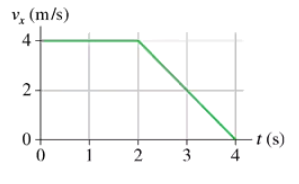
FIGURE EX2.12 shows the velocity-versus-time graph for a particle moving along the x-axis. Its initial position is at x0 = 2 m at t0 = 0 s. What are the particle's position, velocity, and acceleration at t = 3.0 s?

Guida verificata passo dopo passo
1
Step 1: Analyze the velocity-versus-time graph provided. From t = 0s to t = 20s, the velocity is constant at 3 m/s. From t = 20s to t = 50s, the velocity increases linearly from 3 m/s to 5 m/s, indicating a constant acceleration during this interval.
Step 2: Determine the velocity of the particle at t = 3.0s. Since t = 3.0s falls within the interval where the velocity is constant (0s to 20s), the velocity at t = 3.0s is 3 m/s.
Step 3: Calculate the position of the particle at t = 3.0s using the formula for position under constant velocity: \( x = x_0 + v_x \cdot t \). Here, \( x_0 = 2 \, \text{m} \), \( v_x = 3 \, \text{m/s} \), and \( t = 3.0 \, \text{s} \). Substitute these values into the formula.
Step 4: Determine the acceleration of the particle at t = 3.0s. Since the velocity is constant during the interval from t = 0s to t = 20s, the acceleration is zero (\( a = \frac{\Delta v}{\Delta t} \) where \( \Delta v = 0 \) for constant velocity).
Step 5: Summarize the results. At t = 3.0s, the particle's position can be calculated using the formula in Step 3, its velocity is 3 m/s (from the graph), and its acceleration is 0 m/s² (constant velocity implies no acceleration).

Risposta video verificata per un problema simile:

Questa soluzione video è stata consigliata dai nostri tutor come utile per risolvere questo problema.
Durata del video:
11m

Concetti chiave

Ecco i concetti essenziali che devi comprendere per rispondere correttamente alla domanda.

Velocity

Velocity is a vector quantity that describes the rate of change of an object's position with respect to time. It has both magnitude and direction, and in this context, it is represented on the y-axis of the velocity-time graph. The slope of the graph indicates the object's speed, while the value of velocity at a specific time gives the speed and direction of the particle's motion.
Video consigliato:
Percorso guidato
7:27
Escape Velocity

Acceleration

Acceleration is the rate of change of velocity over time. It can be calculated from the slope of the velocity-time graph. If the velocity is constant, as seen in the initial part of the graph, the acceleration is zero. However, if the velocity changes, the slope will indicate the magnitude and direction of the acceleration, which is crucial for understanding how the particle's motion evolves over time.
Video consigliato:
Percorso guidato
05:47
Intro to Acceleration

Position

Position refers to the location of an object at a specific time, typically measured from a reference point. In this scenario, the initial position of the particle is given as x0 = 2m at t0 = 0s. To find the position at t = 3.0s, one must integrate the velocity over time, taking into account any changes in velocity and the initial position to determine the particle's location along the x-axis.
Video consigliato:
Percorso guidato
14:03
Rotational Position & Displacement