Ch 02: Kinematics in One Dimension
Knight Calc - Physics for Scientists and Engineers 5th Edition
Knight Calc5th EditionPhysics for Scientists and EngineersISBN: 9780137344796Non è quello che usi tu?Cambia libro di testo
Capitolo 2, Problema 31

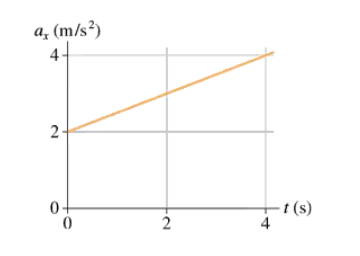
FIGURE EX2.31 shows the acceleration-versus-time graph of a particle moving along the x-axis. Its initial velocity is v0x = 8.0 m/s at t0 = 0 s. What is the particle’s velocity at t = 4.0s?

Guida verificata passo dopo passo
1
Step 1: Understand the relationship between acceleration, velocity, and time. The velocity of a particle can be determined by integrating the acceleration over time. Mathematically, this is expressed as: v(t)=v₀+∫0ta(t)dt, where v₀ is the initial velocity, and a(t) is the acceleration as a function of time.
Step 2: Analyze the acceleration-versus-time graph provided in the problem. Break the graph into segments where the acceleration is constant or changes linearly. For each segment, determine the mathematical expression for acceleration or its constant value.
Step 3: Compute the change in velocity for each segment by integrating the acceleration over the corresponding time interval. For a constant acceleration, the change in velocity is given by Δv=a×Δt. For a linearly changing acceleration, use the appropriate integration formula.
Step 4: Add the changes in velocity from all segments to the initial velocity v₀=8.0 m/s to find the final velocity at t=4.0 s.
Step 5: Verify the units and ensure the final velocity is consistent with the graph's trends. This involves checking that the direction and magnitude of the velocity align with the acceleration's behavior over time.

Risposta video verificata per un problema simile:

Questa soluzione video è stata consigliata dai nostri tutor come utile per risolvere questo problema.
Durata del video:
6m

Concetti chiave

Ecco i concetti essenziali che devi comprendere per rispondere correttamente alla domanda.

Acceleration

Acceleration is the rate of change of velocity of an object with respect to time. It is a vector quantity, meaning it has both magnitude and direction. In the context of the acceleration-versus-time graph, the area under the curve represents the change in velocity over a specific time interval.
Video consigliato:
Percorso guidato
05:47
Intro to Acceleration

Velocity

Velocity is the speed of an object in a specified direction. It is also a vector quantity and can be calculated by integrating acceleration over time. Given the initial velocity and the change in velocity from the acceleration graph, the final velocity can be determined at any point in time.
Video consigliato:
Percorso guidato
7:27
Escape Velocity

Integration of Acceleration

To find the velocity from an acceleration-time graph, one must integrate the acceleration function over the desired time interval. This process involves calculating the area under the acceleration curve, which directly gives the change in velocity, allowing us to update the initial velocity to find the final velocity at a specific time.
Video consigliato:
Percorso guidato
11:43
Finding Moment Of Inertia By Integrating