Ch 02: Kinematics in One Dimension
Knight Calc - Physics for Scientists and Engineers 5th Edition
Knight Calc5th EditionPhysics for Scientists and EngineersISBN: 9780137344796Non è quello che usi tu?Cambia libro di testo
Capitolo 2, Problema 24

When jumping, a flea accelerates at an astounding 1000 m/s2, but over only the very short distance of 0.50 mm. If a flea jumps straight up, and if air resistance is neglected (a rather poor approximation in this situation), how high does the flea go?

Guida verificata passo dopo passo
1
Identify the known values: The acceleration of the flea is \( a = 1000 \; \text{m/s}^2 \), the distance over which the flea accelerates is \( d = 0.50 \; \text{mm} = 0.0005 \; \text{m} \), and the initial velocity \( v_0 = 0 \; \text{m/s} \) (since the flea starts from rest).
Use the kinematic equation \( v^2 = v_0^2 + 2ad \) to calculate the velocity \( v \) of the flea at the end of the acceleration phase. Substitute \( v_0 = 0 \), \( a = 1000 \; \text{m/s}^2 \), and \( d = 0.0005 \; \text{m} \) into the equation.
After finding the velocity \( v \) at the end of the acceleration phase, use it as the initial velocity for the upward motion of the flea. The flea will decelerate due to gravity (\( g = 9.8 \; \text{m/s}^2 \)) until it comes to rest at the highest point of its jump.
Apply the kinematic equation \( v^2 = v_0^2 - 2gh \) to find the maximum height \( h \). Here, \( v = 0 \; \text{m/s} \) (at the highest point), \( v_0 \) is the velocity found in the previous step, and \( g = 9.8 \; \text{m/s}^2 \). Solve for \( h \).
Combine the height from the acceleration phase (\( d = 0.0005 \; \text{m} \)) with the height calculated from the upward motion to find the total height the flea reaches.

Risposta video verificata per un problema simile:

Questa soluzione video è stata consigliata dai nostri tutor come utile per risolvere questo problema.
Durata del video:
8m

Concetti chiave

Ecco i concetti essenziali che devi comprendere per rispondere correttamente alla domanda.

Acceleration

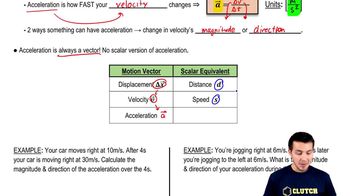
Acceleration is the rate of change of velocity of an object with respect to time. In this scenario, the flea experiences a high acceleration of 1000 m/s², which means its velocity increases rapidly as it jumps. Understanding acceleration is crucial for determining how quickly the flea reaches its maximum height during the jump.
Video consigliato:
Percorso guidato
05:47
Intro to Acceleration

Kinematics

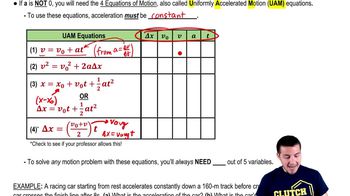
Kinematics is the branch of mechanics that describes the motion of objects without considering the forces that cause the motion. It involves equations that relate displacement, velocity, acceleration, and time. In this problem, kinematic equations can be used to calculate the maximum height the flea reaches based on its initial acceleration and the distance over which it accelerates.
Video consigliato:
Percorso guidato
08:25
Kinematics Equations

Energy Conservation

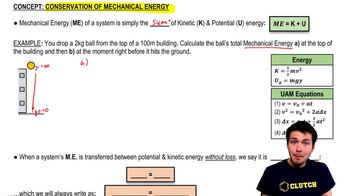
The principle of energy conservation states that energy cannot be created or destroyed, only transformed from one form to another. In the context of the flea's jump, the kinetic energy gained during acceleration is converted into gravitational potential energy at the peak of the jump. This concept is essential for calculating the maximum height reached by the flea after it has stopped accelerating.
Video consigliato:
Percorso guidato
06:24
Conservation Of Mechanical Energy