Ch 04: Kinematics in Two Dimensions
Knight Calc - Physics for Scientists and Engineers 5th Edition
Knight Calc5th EditionPhysics for Scientists and EngineersISBN: 9780137344796Non è quello che usi tu?Cambia libro di testo
Capitolo 4, Problema 8a

A particle moving in the xy-plane has velocity v = (2ti + (3-t2)j) m/s, where t is in s. What is the particle's acceleration vector at t = 4s?

Guida verificata passo dopo passo
1
Step 1: Recall that acceleration is the time derivative of velocity. To find the acceleration vector, differentiate the given velocity vector v = (2t i + (3 - t^2) j) m/s with respect to time t.
Step 2: Differentiate the x-component of the velocity, 2t, with respect to t. The derivative of 2t is 2, so the x-component of acceleration is 2 i m/s².
Step 3: Differentiate the y-component of the velocity, (3 - t^2), with respect to t. The derivative of 3 is 0, and the derivative of -t^2 is -2t. Thus, the y-component of acceleration is -2t j m/s².
Step 4: Combine the x- and y-components to express the acceleration vector as a = (2 i - 2t j) m/s².
Step 5: Substitute t = 4s into the acceleration vector expression to find the specific acceleration vector at t = 4s. This gives a = (2 i - 2(4) j) m/s².

Risposta video verificata per un problema simile:

Questa soluzione video è stata consigliata dai nostri tutor come utile per risolvere questo problema.
Durata del video:
3m

Concetti chiave

Ecco i concetti essenziali che devi comprendere per rispondere correttamente alla domanda.

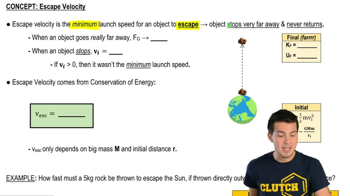
Velocity

Velocity is a vector quantity that describes the rate of change of an object's position with respect to time. It has both magnitude and direction, and in this case, it is given as a function of time in the xy-plane. Understanding velocity is crucial for determining how the position of the particle changes over time.
Video consigliato:
Percorso guidato
7:27
Escape Velocity

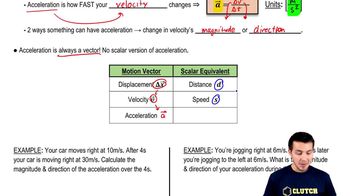
Acceleration

Acceleration is the rate of change of velocity with respect to time. It is also a vector quantity, indicating both how quickly the velocity of an object is changing and in which direction. To find the acceleration vector, one must differentiate the velocity vector with respect to time.
Video consigliato:
Percorso guidato
05:47
Intro to Acceleration

Differentiation

Differentiation is a fundamental concept in calculus that involves finding the derivative of a function. In physics, it is used to determine rates of change, such as how velocity changes over time to yield acceleration. For the given velocity function, applying differentiation will provide the acceleration vector at any specified time.
Video consigliato:
Percorso guidato
13:04
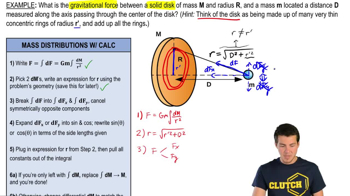
Gravitational Force from a Solid Disk
Pratica correlata
Domanda del libro di testo

You have a remote-controlled car that has been programmed to have velocity v=(−3ti+2t2j)m/s\(\mathbf{v}\) = (-3t\(\mathbf{i}\) + 2t^2\(\mathbf{j}\)) \, \(\text{m/s}\), where t is in s. At t = 0 s, the car is at r0=(3.0i+2.0j)m\(\mathbf{r}\)_0 = (3.0\(\mathbf{i}\) + 2.0\(\mathbf{j}\)) \, \(\text{m}\). What are the car's position vector?

1941
views

Domanda del libro di testo

A particle's trajectory is described by x=(12t3−2t2)mandy=(12t2−2t)m,x = \(\left\)(\(\frac{1}{2}\) t^3 - 2t^2\(\right\)) \, \(\text{m}\) \(\quad\) \(\text{and}\) \(\quad\) y = \(\left\)(\(\frac{1}{2}\) t^2 - 2t\(\right\)) \, \(\text{m}\), where tt is in ss. What are the particle's position and speed at t=0 st=0\(\text{ s}\) and t=4 st=4\(\text{ s}\)?

2967
views
1
rank
Domanda del libro di testo

A particle's trajectory is described by x=(12t3−2t2)mandy=(12t2−2t)m,x = \(\left\)(\(\frac{1}{2}\) t^3 - 2t^2\(\right\)) \, \(\text{m}\) \(\quad\) \(\text{and}\) \(\quad\) y = \(\left\)(\(\frac{1}{2}\) t^2 - 2t\(\right\)) \, \(\text{m}\), where tt is in ss. What is the particle's direction of motion, measured as an angle from the xx-axis, at t=0 st=0\(\text{ s}\) and t=4 st=4\(\text{ s}\)?

403
views
Domanda del libro di testo

A rocket-powered hockey puck moves on a horizontal frictionless table. FIGURE EX4.6 shows graphs of vx and vy, the x- and y-components of the puck's velocity. The puck starts at the origin. How far from the origin is the puck at t = 5s?

2158
views
Domanda del libro di testo

A rocket-powered hockey puck moves on a horizontal frictionless table. FIGURE EX4.6 shows graphs of vx and vy, the x- and y-components of the puck's velocity. The puck starts at the origin. In which direction is the puck moving at t = 2s? Give your answer as an angle from the x-axis.

2274
views
1
rank
Domanda del libro di testo

A rocket-powered hockey puck moves on a horizontal frictionless table. Figure EX4.7 shows graphs of vx and vy the x- and y-components of the puck's velocity. The puck starts at the origin. What is the magnitude of the puck's acceleration at t = 5s?

2504
views
1
rank