
Ch 06: Dynamics I: Motion Along a Line
Knight Calc - Physics for Scientists and Engineers 5th Edition
Knight Calc5th EditionPhysics for Scientists and EngineersISBN: 9780137344796Non è quello che usi tu?Cambia libro di testo
Capitolo 6, Problema 37

An E. coli bacterium can be modeled as a 0.50 μm diameter sphere that has the density of water. Rotating flagella propel a bacterium through 40°C water with a force of 65 fN, where 1 fN = 1femtonewton = 10-15 N. What is the bacterium's speed in μm/s?

Guida verificata passo dopo passo
1
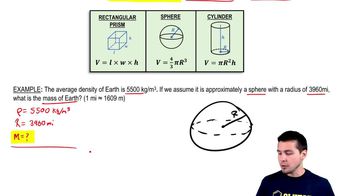
Model the bacterium as a sphere and calculate its volume using the formula for the volume of a sphere: Vsphere = 43πr3, where r is the radius of the bacterium.
Determine the mass of the bacterium using the density of water, which is approximately 1000 kg/m3. The mass is given by m = ρV, where ρ is the density and V is the volume.
Apply Stokes' law to calculate the drag force acting on the bacterium as it moves through the water. Stokes' law is given by Fdrag = 6πηrv, where η is the dynamic viscosity of water at 40°C (approximately 6.92×10⁻⁴ Pa s), r is the radius of the bacterium, and v is the speed.
Set the drag force equal to the propelling force exerted by the flagella, Fdrag = 65 fN, and solve for the speed v. Rearrange Stokes' law to isolate v: v = Fdrag/(6πηr).
Convert the calculated speed from meters per second to micrometers per second by multiplying by 106, since 1 μm = 10-6 m.

Risposta video verificata per un problema simile:

Questa soluzione video è stata consigliata dai nostri tutor come utile per risolvere questo problema.
Durata del video:
7m

Concetti chiave

Ecco i concetti essenziali che devi comprendere per rispondere correttamente alla domanda.

Density and Volume

Density is defined as mass per unit volume and is crucial for understanding how the mass of the E. coli bacterium relates to its size. Since the bacterium is modeled as a sphere, its volume can be calculated using the formula V = (4/3)πr³, where r is the radius. Knowing the density allows us to determine the mass of the bacterium, which is essential for calculating its motion in a fluid.
Video consigliato:
Percorso guidato
04:33
Problems with Mass, Volume, & Density

Force and Motion

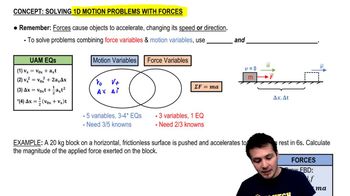
Newton's second law states that force equals mass times acceleration (F = ma). In this scenario, the force exerted by the rotating flagella propels the bacterium through water. By rearranging this equation, we can find the acceleration of the bacterium, which is necessary to determine its speed as it moves through the fluid medium.
Video consigliato:
Percorso guidato
05:29
Solving Motion Problems with Forces

Speed Calculation

Speed is defined as the distance traveled per unit of time. In this context, once we have the acceleration from the force and mass, we can calculate the speed of the bacterium. The final speed can be expressed in micrometers per second, requiring conversion from standard units, which is important for understanding the bacterium's movement in a biological context.
Video consigliato:
Percorso guidato
07:59
Speed Distribution & Special Speeds of Ideal Gases
Pratica correlata
Domanda del libro di testo

An accident victim with a broken leg is being placed in traction. The patient wears a special boot with a pulley attached to the sole. The foot and boot together have a mass of 4.0 kg, and the doctor has decided to hang a 6.0 kg mass from the rope. The boot is held suspended by the ropes, as shown in FIGURE P6.40, and does not touch the bed. Determine the amount of tension in the rope by using Newton's laws to analyze the hanging mass. Hint: If the pulleys are frictionless, which we will assume, the tension in the rope is constant from one end to the other.

2261
views
Domanda del libro di testo

So-called volcanic 'ash' is actually finely pulverized rock blown high into the atmosphere. A typical ash particle is a 50-μm\(\mu\) m-diameter piece of silica with a density of 2400 kg/m3. How long in hours does it take this ash particle to fall from a height of 5.0 km in still air? Use the properties of 20°C air at sea level.

2240
views
1
comments
Domanda del libro di testo

Seat belts and air bags save lives by reducing the forces exerted on the driver and passengers in an automobile collision. Cars are designed with a 'crumple zone' in the front of the car. In the event of an impact, the passenger compartment decelerates over a distance of about 1 m as the front of the car crumples. An occupant restrained by seat belts and air bags decelerates with the car. By contrast, an unrestrained occupant keeps moving forward with no loss of speed (Newton's first law!) until hitting the dashboard or windshield. These are unyielding surfaces, and the unfortunate occupant then decelerates over a distance of only about 5 mm. A 60 kg person is in a head-on collision. The car's speed at impact is 15 m/s. Estimate the net force on the person if he or she is wearing a seat belt and if the air bag deploys.

360
views
Domanda del libro di testo

So-called volcanic 'ash' is actually finely pulverized rock blown high into the atmosphere. A typical ash particle is a 50-μm-diameter piece of silica with a density of 2400 kg/m3. How long would it take this ash particle to fall from a height of 5.0 km in vacuum?

1231
views
Domanda del libro di testo

A medium-sized jet has a 3.8-m-diameter fuselage and a loaded mass of 85,000 kg. The drag on an airplane is primarily due to the cylindrical fuselage, and aerodynamic shaping gives it a drag coefficient of 0.37. How much thrust must the jet's engines provide to cruise at 230 m/s at an altitude where the air density is 1.0 kg/m3

2866
views
Domanda del libro di testo

A 2.0 kg object initially at rest at the origin is subjected to the time-varying force shown in FIGURE P6.38. What is the object's velocity at t = 4 s?

406
views