Ch 06: Dynamics I: Motion Along a Line
Knight Calc - Physics for Scientists and Engineers 5th Edition
Knight Calc5th EditionPhysics for Scientists and EngineersISBN: 9780137344796Non è quello che usi tu?Cambia libro di testo
Capitolo 6, Problema 16b

The position of a 2.0 kg mass is given by x = (2t3 - 3t2) where t is in seconds. What is the net horizontal force on the mass at t = 1s?

Guida verificata passo dopo passo
1
Step 1: Understand the problem. The position of the mass is given as a function of time, x(t) = 2t³ - 3t². To find the net horizontal force, we need to calculate the acceleration at t = 1s using Newton's second law, F = ma, where m is the mass and a is the acceleration.
Step 2: Differentiate the position function x(t) = 2t³ - 3t² with respect to time to find the velocity v(t). The velocity is the first derivative of position: v(t) = dx/dt = d/dt(2t³ - 3t²).
Step 3: Differentiate the velocity function v(t) with respect to time to find the acceleration a(t). The acceleration is the second derivative of position: a(t) = dv/dt = d²x/dt². Perform the differentiation to obtain a(t).
Step 4: Substitute t = 1s into the acceleration function a(t) to calculate the acceleration at that specific time.
Step 5: Use Newton's second law, F = ma, to calculate the net horizontal force. Substitute the mass m = 2.0 kg and the acceleration a(t) at t = 1s into the equation to find the force.

Risposta video verificata per un problema simile:

Questa soluzione video è stata consigliata dai nostri tutor come utile per risolvere questo problema.
Durata del video:
5m

Concetti chiave

Ecco i concetti essenziali che devi comprendere per rispondere correttamente alla domanda.

Newton's Second Law of Motion

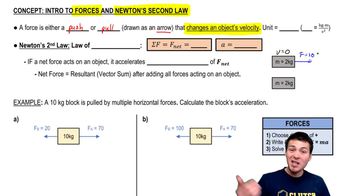
Newton's Second Law states that the net force acting on an object is equal to the mass of the object multiplied by its acceleration (F = ma). This principle is fundamental for analyzing motion, as it allows us to relate the forces acting on an object to its resulting acceleration and, consequently, its position over time.
Video consigliato:
Percorso guidato
06:54
Intro to Forces & Newton's Second Law

Acceleration

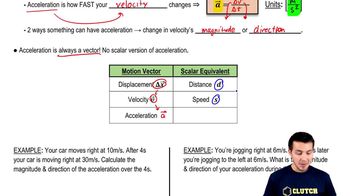
Acceleration is defined as the rate of change of velocity of an object with respect to time. It can be calculated as the second derivative of position with respect to time. In this problem, we need to find the acceleration of the mass by differentiating the position function twice, which will help us determine the net force acting on the mass.
Video consigliato:
Percorso guidato
05:47
Intro to Acceleration

Kinematics

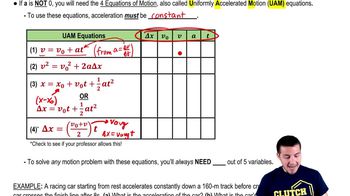
Kinematics is the branch of mechanics that deals with the motion of objects without considering the forces that cause the motion. It involves equations that describe the relationships between position, velocity, and acceleration. In this question, the position function provided allows us to analyze the motion of the mass and derive the necessary quantities to find the net force.
Video consigliato:
Percorso guidato
08:25
Kinematics Equations