
Ch 07: Newton's Third Law
Knight Calc - Physics for Scientists and Engineers 5th Edition
Knight Calc5th EditionPhysics for Scientists and EngineersISBN: 9780137344796Non è quello che usi tu?Cambia libro di testo
Capitolo 7, Problema 7b

How much force does the astronaut exert on his chair while accelerating straight up at 10 m/s2?

Guida verificata passo dopo passo
1
Step 1: Identify the forces acting on the astronaut. The two forces involved are the gravitational force (weight) and the force due to the upward acceleration. The net force exerted by the astronaut on the chair will be the sum of these forces.
Step 2: Write the formula for gravitational force: \( F_{gravity} = m \cdot g \), where \( m \) is the mass of the astronaut and \( g \) is the acceleration due to gravity (approximately \( 9.8 \, \text{m/s}^2 \)).
Step 3: Write the formula for the force due to upward acceleration: \( F_{acceleration} = m \cdot a \), where \( a \) is the upward acceleration (given as \( 10 \, \text{m/s}^2 \)).
Step 4: Add the two forces together to find the total force exerted by the astronaut on the chair: \( F_{total} = F_{gravity} + F_{acceleration} \). Substitute the expressions for \( F_{gravity} \) and \( F_{acceleration} \) into this equation: \( F_{total} = m \cdot g + m \cdot a \).
Step 5: Factor out \( m \) from the equation: \( F_{total} = m \cdot (g + a) \). To find the force, you need the astronaut's mass \( m \), which should be provided or assumed in the problem.

Risposta video verificata per un problema simile:

Questa soluzione video è stata consigliata dai nostri tutor come utile per risolvere questo problema.
Durata del video:
5m

Concetti chiave

Ecco i concetti essenziali che devi comprendere per rispondere correttamente alla domanda.

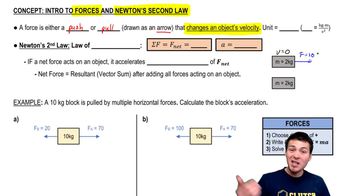
Newton's Second Law of Motion

Newton's Second Law states that the force acting on an object is equal to the mass of that object multiplied by its acceleration (F = ma). This principle is fundamental in understanding how forces affect the motion of objects, including the astronaut in the question, as it allows us to calculate the force exerted based on the mass and the acceleration experienced.
Video consigliato:
Percorso guidato
06:54
Intro to Forces & Newton's Second Law

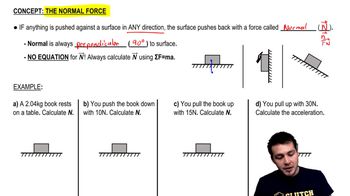
Weight and Normal Force

Weight is the force exerted by gravity on an object, calculated as the product of mass and gravitational acceleration (W = mg). When an astronaut accelerates upwards, the normal force exerted by the chair must counteract both the weight of the astronaut and provide the additional force needed for upward acceleration, which is crucial for determining the total force exerted on the chair.
Video consigliato:
Percorso guidato
08:17
The Normal Force

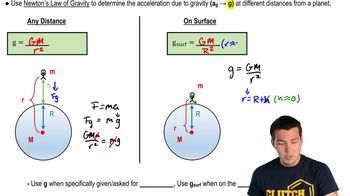
Acceleration due to Gravity

Acceleration due to gravity is the rate at which an object accelerates towards the Earth, approximately 9.81 m/s². In the context of the astronaut's upward acceleration, this gravitational force must be considered alongside the upward acceleration to find the total force exerted on the chair, as it influences the net force acting on the astronaut.
Video consigliato:
Percorso guidato
05:20
Acceleration Due to Gravity
Pratica correlata
Domanda del libro di testo

A 1000 kg car is pushing an out-of-gear 2000 kg truck that has a dead battery. When the driver steps on the accelerator, the drive wheels of the car push horizontally against the ground with a force of 4500 N. Rolling friction can be neglected. What is the magnitude of the force of the car on the truck?

3356
views
Domanda del libro di testo

Block A in FIGURE EX7.4 is sliding down the incline. The rope is massless, and the massless pulley turns on frictionless bearings, but the surface is not frictionless. The rope and the pulley are among the interacting objects, but you'll have to decide if they're part of the system. Draw an interaction diagram.

1355
views
Domanda del libro di testo

The foot of a 55 kg sprinter is on the ground for 0.25 s while her body accelerates from rest to 2.0 m/s. What is the magnitude of the friction force?

2135
views
Domanda del libro di testo

Blocks with masses of 1 kg, 2 kg, and 3 kg are lined up in a row on a frictionless table. All three are pushed forward by a 12 N force applied to the 1 kg block. How much force does the 2 kg block exert on the 1 kg block?

3660
views
Domanda del libro di testo

Block A in FIGURE EX7.4 is sliding down the incline. The rope is massless, and the massless pulley turns on frictionless bearings, but the surface is not frictionless. The rope and the pulley are among the interacting objects, but you'll have to decide if they're part of the system. Draw a free-body diagram for each object in the system. Use dashed lines to connect members of an action/reaction pair.

1804
views
1
rank
Domanda del libro di testo

A heavy steel cable attached to a motor is lifting a girder. The girder is speeding up. Draw an interaction diagram.

1709
views