
Ch 08: Dynamics II: Motion in a Plane
Knight Calc - Physics for Scientists and Engineers 5th Edition
Knight Calc5th EditionPhysics for Scientists and EngineersISBN: 9780137344796Non è quello che usi tu?Cambia libro di testo
Capitolo 8, Problema 70

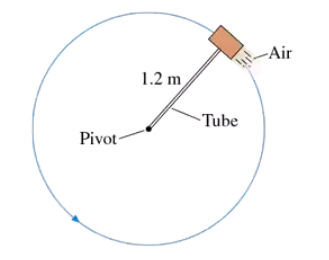
A 500 g steel block rotates on a steel table while attached to a 1.2-m-long hollow tube as shown in FIGURE CP8.70. Compressed air fed through the tube and ejected from a nozzle on the back of the block exerts a thrust force of 4.0 N perpendicular to the tube. The maximum tension the tube can withstand without breaking is 50 N. If the block starts from rest, how many revolutions does it make before the tube breaks?

Guida verificata passo dopo passo
1
Convert the mass of the steel block from grams to kilograms. Since 1 g = 0.001 kg, the mass of the block is \( m = 0.5 \; \text{kg} \).
Determine the net force acting on the block. The thrust force \( F_t = 4.0 \; \text{N} \) acts perpendicular to the tube, providing the centripetal force necessary for circular motion. The tension in the tube will increase as the block accelerates.
Use Newton's second law for rotational motion to relate the centripetal force \( F_c \) to the tension in the tube. The centripetal force is given by \( F_c = \frac{m v^2}{r} \), where \( v \) is the tangential velocity and \( r = 1.2 \; \text{m} \) is the radius of the circular path.
Calculate the work done by the thrust force to increase the kinetic energy of the block. The work-energy principle states that \( W = \Delta KE \), where \( W = F_t \cdot d \) and \( \Delta KE = \frac{1}{2} m v^2 \). Here, \( d \) is the distance traveled by the block along the circular path, which can be expressed as \( d = 2 \pi r \cdot n \), where \( n \) is the number of revolutions.
Set the maximum tension \( T_{max} = 50 \; \text{N} \) equal to the centripetal force \( F_c \) and solve for the tangential velocity \( v \). Then, substitute \( v \) into the work-energy equation to solve for \( n \), the number of revolutions before the tube breaks.

Risposta video verificata per un problema simile:

Questa soluzione video è stata consigliata dai nostri tutor come utile per risolvere questo problema.

Concetti chiave

Ecco i concetti essenziali che devi comprendere per rispondere correttamente alla domanda.

Newton's Second Law of Motion

Newton's Second Law states that the acceleration of an object is directly proportional to the net force acting on it and inversely proportional to its mass. This principle is crucial for understanding how the thrust force from the compressed air affects the steel block's motion, allowing us to calculate the resulting acceleration and subsequent revolutions.
Video consigliato:
Percorso guidato
06:54
Intro to Forces & Newton's Second Law

Centripetal Force

Centripetal force is the net force required to keep an object moving in a circular path, directed towards the center of the circle. In this scenario, the thrust force contributes to the centripetal force needed to maintain the block's circular motion, and understanding this relationship is essential for determining how long the block can rotate before the tube breaks.
Video consigliato:
Percorso guidato
06:48
Intro to Centripetal Forces

Tension in the Tube

Tension refers to the force transmitted through the tube when the block rotates. The maximum tension the tube can withstand (50 N) is a critical factor in this problem, as it sets the limit for the forces acting on the block. By analyzing the forces involved, we can determine how many revolutions the block can make before reaching this breaking point.
Video consigliato:
Percorso guidato
18:29
Pressure Gauges: U-Shaped Tube
Pratica correlata
Domanda del libro di testo

The 10 mg bead in FIGURE CP8.69 is free to slide on a frictionless wire loop. The loop rotates about a vertical axis with angular velocity ω. If ω is less than some critical value ω꜀, the bead sits at the bottom of the spinning loop. When ω > ω꜀, the bead moves out to some angle θ. What is ω꜀ in rpm for the loop shown in the figure?

2536
views
Domanda del libro di testo

In the absence of air resistance, a projectile that lands at the elevation from which it was launched achieves maximum range when launched at a 45° angle. Suppose a projectile of mass m is launched with speed into a headwind that exerts a constant, horizontal retarding force F⃗wind=−Fwindı^.\(\vec{F}\)_{\(\text{wind}\)} = -F_{\(\text{wind}\)} \(\hat{\imath}\). By what percentage is the maximum range of a 0.50 kg ball reduced if Fwind=0.60 NF_{\(\text{wind}\)}=0.60\(\text{ N}\)?

2355
views
Domanda del libro di testo

If a vertical cylinder of water (or any other liquid) rotates about its axis, as shown in FIGURE CP8.72, the surface forms a smooth curve. Assuming that the water rotates as a unit (i.e., all the water rotates with the same angular velocity), show that the shape of the surface is a parabola described by the equation z = (ω2 / 2g) r2. Hint: Each particle of water on the surface is subject to only two forces: gravity and the normal force due to the water underneath it. The normal force, as always, acts perpendicular to the surface.

1899
views
Domanda del libro di testo

In the absence of air resistance, a projectile that lands at the elevation from which it was launched achieves maximum range when launched at a 45° angle. Suppose a projectile of mass m is launched with speed into a headwind that exerts a constant, horizontal retarding force F⃗wind=−Fwindı^.\(\vec{F}\)_{\(\text{wind}\)} = -F_{\(\text{wind}\)} \(\hat{\imath}\).. Find an expression for the angle at which the range is maximum.

2638
views