
Ch 08: Dynamics II: Motion in a Plane
Knight Calc - Physics for Scientists and Engineers 5th Edition
Knight Calc5th EditionPhysics for Scientists and EngineersISBN: 9780137344796Non è quello che usi tu?Cambia libro di testo
Capitolo 8, Problema 9

Suppose the moon were held in its orbit not by gravity but by a massless cable attached to the center of the earth. What would be the tension in the cable? Use the table of astronomical data inside the back cover of the book.

Guida verificata passo dopo passo
1
Step 1: Identify the forces acting on the moon. In this scenario, the tension in the cable is the force providing the centripetal force required to keep the moon in its circular orbit around the Earth. Gravity is not contributing to the centripetal force since the problem specifies that the moon is held by a massless cable.
Step 2: Write the formula for centripetal force. The centripetal force is given by \( F_c = \frac{m v^2}{r} \), where \( m \) is the mass of the moon, \( v \) is its orbital velocity, and \( r \) is the radius of its orbit (distance from the center of the Earth to the moon).
Step 3: Express the orbital velocity \( v \) in terms of the orbital period \( T \). The moon's orbital velocity can be calculated using \( v = \frac{2 \pi r}{T} \), where \( T \) is the orbital period of the moon.
Step 4: Substitute \( v = \frac{2 \pi r}{T} \) into the centripetal force formula. This gives \( F_c = \frac{m (2 \pi r / T)^2}{r} \). Simplify the expression to \( F_c = \frac{4 \pi^2 m r}{T^2} \).
Step 5: Use the astronomical data provided in the table (mass of the moon \( m \), orbital radius \( r \), and orbital period \( T \)) to calculate the tension in the cable. Plug these values into the formula \( F_c = \frac{4 \pi^2 m r}{T^2} \) to determine the tension.

Risposta video verificata per un problema simile:

Questa soluzione video è stata consigliata dai nostri tutor come utile per risolvere questo problema.
Durata del video:
3m

Concetti chiave

Ecco i concetti essenziali che devi comprendere per rispondere correttamente alla domanda.

Centripetal Force

Centripetal force is the net force required to keep an object moving in a circular path, directed towards the center of the circle. In this scenario, the tension in the cable would act as the centripetal force necessary to maintain the moon's circular orbit around the Earth. The formula for centripetal force is F = mv²/r, where m is the mass of the moon, v is its orbital velocity, and r is the radius of the orbit.
Video consigliato:
Percorso guidato
06:48
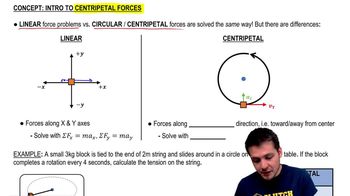
Intro to Centripetal Forces

Gravitational Force

Gravitational force is the attractive force between two masses, described by Newton's law of universal gravitation. In the context of the moon's orbit, this force is what typically keeps the moon in its path around the Earth. However, in this hypothetical scenario, the gravitational force is replaced by the tension in the cable, which must equal the gravitational force for the moon to remain in orbit.
Video consigliato:
Percorso guidato
05:41
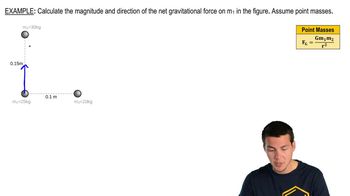
Gravitational Forces in 2D

Orbital Mechanics

Orbital mechanics is the study of the motion of objects in space under the influence of gravitational forces. It encompasses the principles governing how celestial bodies move in their orbits. Understanding orbital mechanics is crucial for calculating the tension in the cable, as it involves analyzing the balance of forces acting on the moon and how they relate to its velocity and distance from the Earth.
Video consigliato:
Percorso guidato
04:45
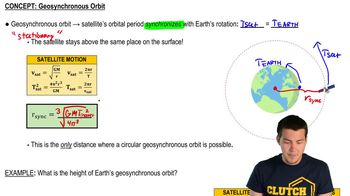
Geosynchronous Orbits
Pratica correlata
Domanda del libro di testo
Three satellites orbit a planet of radius R, as shown in FIGUREEX13.24. Satellites S₁ and S₃ have mass m. Satellite S₂ has mass 2m. Satellite S₁ orbits in 250 minutes and the force on S₁ is 10,000 N. (b) What are the forces of S₂ and S₃?

2068
views
Domanda del libro di testo

A 200 g block on a 50-cm-long string swings in a circle on a horizontal, frictionless table at 75 rpm. What is the tension in the string?

2186
views
Domanda del libro di testo

It is proposed that future space stations create an artificial gravity by rotating. Suppose a space station is constructed as a 1000-m-diameter cylinder that rotates about its axis. The inside surface is the deck of the space station. What rotation period will provide 'normal' gravity?

3112
views
Domanda del libro di testo

A 200 g block on a 50-cm-long string swings in a circle on a horizontal, frictionless table at 75 rpm. What is the speed of the block?

1984
views
Domanda del libro di testo

In the Bohr model of the hydrogen atom, an electron (mass m = 9.1 x 10⁻³¹ kg) orbits a proton at a distance of 5.3 x 10⁻¹¹ m. The proton pulls on the electron with an electric force of 8.2 x 10⁻⁸ N. How many revolutions per second does the electron make?

2435
views
1
rank
Domanda del libro di testo

A 5.0 g coin is placed 15 cm from the center of a turntable. The coin has static and kinetic coefficients of friction with the turntable surface of μs = 0.80 and μk = 0.50. The turntable very slowly speeds up to 60 rpm. Does the coin slide off?

1303
views