Ch 09: Work and Kinetic Energy
Knight Calc - Physics for Scientists and Engineers 5th Edition
Knight Calc5th EditionPhysics for Scientists and EngineersISBN: 9780137344796Non è quello che usi tu?Cambia libro di testo
Capitolo 9, Problema 32

A 55 kg softball player slides into second base, generating 950 J of thermal energy in her legs and the ground. How fast was she running?

Guida verificata passo dopo passo
1
Identify the type of energy conversion taking place: The kinetic energy of the softball player is being converted into thermal energy due to friction. The thermal energy generated is given as 950 J.
Write the formula for kinetic energy: \( KE = \frac{1}{2} m v^2 \), where \( m \) is the mass of the player (55 kg) and \( v \) is her velocity (to be determined).
Set the kinetic energy equal to the thermal energy generated: \( \frac{1}{2} m v^2 = 950 \).
Rearrange the equation to solve for \( v \): \( v = \sqrt{\frac{2 \cdot 950}{m}} \).
Substitute the given mass \( m = 55 \ \text{kg} \) into the equation: \( v = \sqrt{\frac{2 \cdot 950}{55}} \). Simplify the expression to find the velocity.

Risposta video verificata per un problema simile:

Questa soluzione video è stata consigliata dai nostri tutor come utile per risolvere questo problema.
Durata del video:
4m

Concetti chiave

Ecco i concetti essenziali che devi comprendere per rispondere correttamente alla domanda.

Kinetic Energy

Kinetic energy is the energy an object possesses due to its motion, calculated using the formula KE = 1/2 mv², where m is mass and v is velocity. In this scenario, the kinetic energy of the softball player can be equated to the thermal energy generated during the slide, allowing us to solve for her running speed.
Video consigliato:
Percorso guidato
06:07
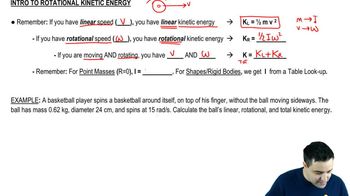
Intro to Rotational Kinetic Energy

Conservation of Energy

The principle of conservation of energy states that energy cannot be created or destroyed, only transformed from one form to another. In this case, the kinetic energy of the player is converted into thermal energy as she slides, which is crucial for understanding how to relate her speed to the energy generated.
Video consigliato:
Percorso guidato
06:24
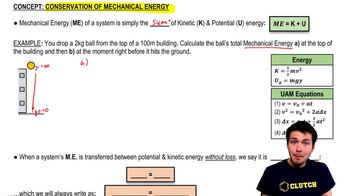
Conservation Of Mechanical Energy

Work-Energy Principle

The work-energy principle asserts that the work done on an object is equal to the change in its kinetic energy. When the player slides into second base, the work done by friction between her legs and the ground results in the generation of thermal energy, which can be quantified to find her initial speed before the slide.
Video consigliato:
Percorso guidato
04:10
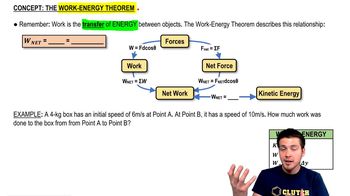
The Work-Energy Theorem
Pratica correlata
Domanda del libro di testo

Justin, with a mass of 30 kg, is going down an 8.0-m-high water slide. He starts at rest, and his speed at the bottom is 11 m/s. How much thermal energy is created by friction during his descent?

2019
views

Domanda del libro di testo

An 8.0 kg crate is pulled 5.0 m up a 30° incline by a rope angled 18 ° above the incline. The tension in the rope is 120 N, and the crate's coefficient of kinetic friction on the incline is 0.25. What is the increase in thermal energy of the crate and incline?

3398
views
2
rank
Domanda del libro di testo

A baggage handler throws a 15 kg suitcase along the floor of an airplane luggage compartment with a speed of 1.2 m/s. The suitcase slides 2.0 m before stopping. Use work and energy to find the suitcase's coefficient of kinetic friction on the floor.

3199
views
1
comments
Domanda del libro di testo

A 10-cm-long spring is attached to the ceiling. When a 2.0 kg mass is hung from it, the spring stretches to a length of 15 cm. How long is the spring when a 3.0 kg mass is suspended from it?

2055
views
Domanda del libro di testo

A horizontal spring with spring constant 85 N/m extends outward from a wall just above floor level. A 1.5 kg box sliding across a frictionless floor hits the end of the spring and compresses it 6.5 cm before the spring expands and shoots the box back out. How fast was the box going when it hit the spring?

2278
views
Domanda del libro di testo

A 5.0 kg mass hanging from a spring scale is slowly lowered onto a vertical spring, as shown in FIGURE EX9.28. The scale reads in newtons. The scale reads 20 N when the lower spring has been compressed by 2.0 cm. What is the value of the spring constant for the lower spring?

235
views