Ch 09: Work and Kinetic Energy
Knight Calc - Physics for Scientists and Engineers 5th Edition
Knight Calc5th EditionPhysics for Scientists and EngineersISBN: 9780137344796Non è quello che usi tu?Cambia libro di testo
Capitolo 9, Problema 26

A horizontal spring with spring constant 750 N/m is attached to a wall. An athlete presses against the free end of the spring, compressing it 5.0 cm. How hard is the athlete pushing?

Guida verificata passo dopo passo
1
Step 1: Identify the formula for the force exerted by a spring, which is given by Hooke's Law: F=k⁢x, where F is the force, k is the spring constant, and x is the displacement of the spring from its equilibrium position.
Step 2: Convert the displacement from centimeters to meters, as SI units are required for calculations. Since 1 cm = 0.01 m, the displacement x is 5.0⁢cm=0.050⁢m.
Step 3: Substitute the given values into Hooke's Law. The spring constant k is 750⁢N/m, and the displacement x is 0.050⁢m. The formula becomes: F=750⁢N/m⁢⁢0.050⁢m.
Step 4: Perform the multiplication to find the force. Multiply the spring constant 750 by the displacement 0.050. This will give the magnitude of the force exerted by the spring.
Step 5: Interpret the result. The force calculated represents how hard the athlete is pushing against the spring to compress it by 5.0 cm. Ensure the units of the final answer are in Newtons (N), as force is measured in Newtons in the SI system.

Risposta video verificata per un problema simile:

Questa soluzione video è stata consigliata dai nostri tutor come utile per risolvere questo problema.
Durata del video:
2m

Concetti chiave

Ecco i concetti essenziali che devi comprendere per rispondere correttamente alla domanda.

Hooke's Law

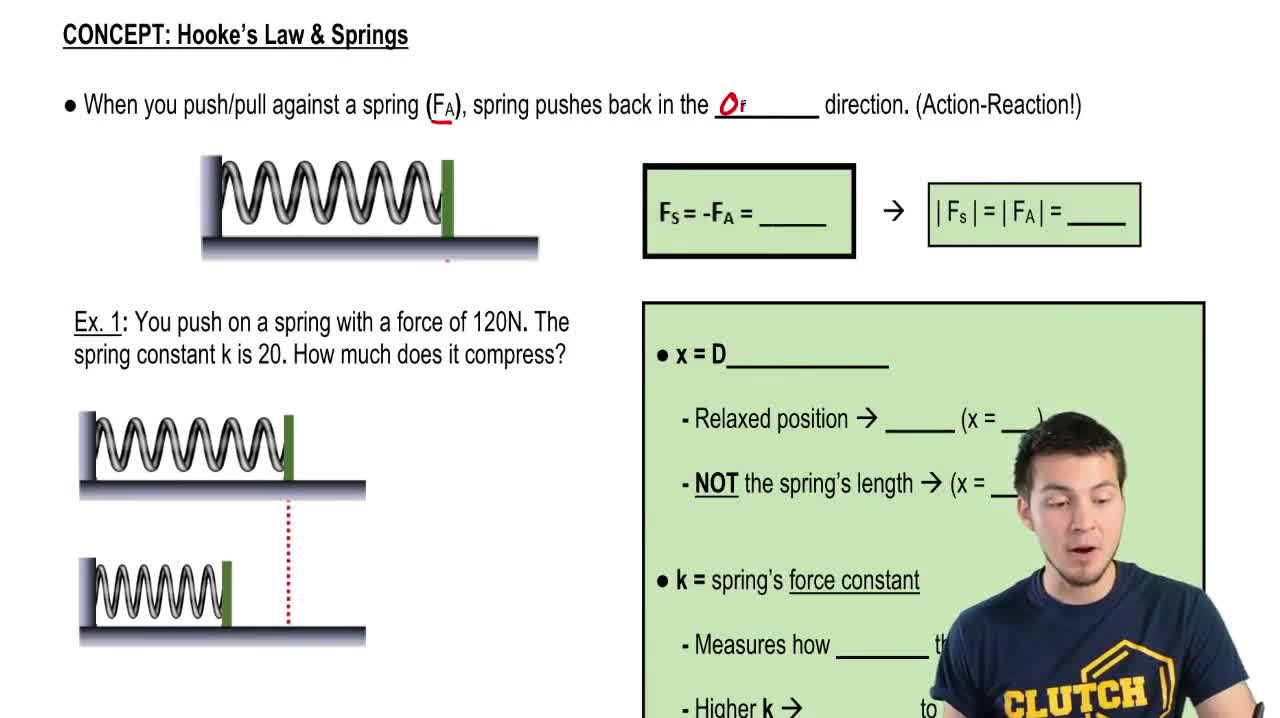
Hooke's Law states that the force exerted by a spring is directly proportional to its displacement from the equilibrium position, provided the elastic limit is not exceeded. Mathematically, it is expressed as F = -kx, where F is the force, k is the spring constant, and x is the displacement. This principle is essential for understanding how the spring responds to compression or extension.
Video consigliato:
Percorso guidato
05:27
Spring Force (Hooke's Law)

Spring Constant

The spring constant, denoted as k, is a measure of a spring's stiffness. It is defined as the force required to compress or extend the spring by a unit distance. A higher spring constant indicates a stiffer spring that requires more force to compress or stretch, which is crucial for calculating the force exerted by the athlete in this scenario.
Video consigliato:
Percorso guidato
08:59
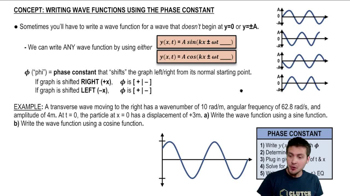
Phase Constant of a Wave Function

Force Calculation

To determine how hard the athlete is pushing against the spring, one must calculate the force using Hooke's Law. By substituting the values of the spring constant and the displacement into the formula F = kx, where k is 750 N/m and x is 0.05 m (5.0 cm), we can find the force exerted by the athlete, which directly correlates to the compression of the spring.
Video consigliato:
Percorso guidato
06:09
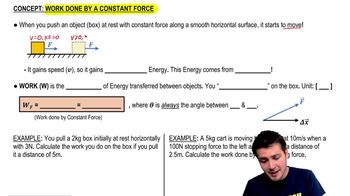
Work Done by a Constant Force
Pratica correlata
Domanda del libro di testo

A particle moving on the x-axis experiences a force given by Fx = qx², where q is a constant. How much work is done on the particle as it moves from x = 0 to x = d?

2537
views
1
rank

Domanda del libro di testo

A 35-cm-long vertical spring has one end fixed on the floor. Placing a 2.2 kg physics textbook on the spring compresses it to a length of 29 cm. What is the spring constant?

1229
views
Domanda del libro di testo

A 10-cm-long spring is attached to the ceiling. When a 2.0 kg mass is hung from it, the spring stretches to a length of 15 cm. How long is the spring when a 3.0 kg mass is suspended from it?

2055
views
Domanda del libro di testo

A horizontal spring with spring constant 85 N/m extends outward from a wall just above floor level. A 1.5 kg box sliding across a frictionless floor hits the end of the spring and compresses it 6.5 cm before the spring expands and shoots the box back out. How fast was the box going when it hit the spring?

2278
views
Domanda del libro di testo

A 5.0 kg mass hanging from a spring scale is slowly lowered onto a vertical spring, as shown in FIGURE EX9.28. The scale reads in newtons. The scale reads 20 N when the lower spring has been compressed by 2.0 cm. What is the value of the spring constant for the lower spring?

235
views
Domanda del libro di testo

A 2.0 kg particle moving along the x-axis experiences the force shown in FIGURE EX9.22. The particle's velocity is 3.0 m/s at x = 0 m. At what point on the x-axis does the particle have a turning point?

4027
views