
Ch 09: Work and Kinetic Energy
Knight Calc - Physics for Scientists and Engineers 5th Edition
Knight Calc5th EditionPhysics for Scientists and EngineersISBN: 9780137344796Non è quello che usi tu?Cambia libro di testo
Capitolo 9, Problema 47

A pile driver lifts a 250 kg weight and then lets it fall onto the end of a steel pipe that needs to be driven into the ground. A fall from an initial height of 1.5 m drives the pipe in 35 cm. What is the average force that the weight exerts on the pipe?

Guida verificata passo dopo passo
1
Step 1: Identify the given values. The mass of the weight is \( m = 250 \, \text{kg} \), the initial height is \( h = 1.5 \, \text{m} \), and the distance the pipe is driven into the ground is \( d = 0.35 \, \text{m} \). The goal is to find the average force exerted on the pipe.
Step 2: Calculate the gravitational potential energy of the weight before it falls using the formula \( E_p = m g h \), where \( g \) is the acceleration due to gravity (\( g = 9.8 \, \text{m/s}^2 \)). This energy is converted into work done on the pipe.
Step 3: Relate the work done to the average force exerted on the pipe. The work-energy principle states that \( W = F_{\text{avg}} \cdot d \), where \( W \) is the work done, \( F_{\text{avg}} \) is the average force, and \( d \) is the distance the pipe is driven into the ground.
Step 4: Substitute \( W = E_p \) into the work formula. This gives \( F_{\text{avg}} = \frac{E_p}{d} \). Replace \( E_p \) with \( m g h \) to get \( F_{\text{avg}} = \frac{m g h}{d} \).
Step 5: Plug in the known values \( m = 250 \, \text{kg} \), \( g = 9.8 \, \text{m/s}^2 \), \( h = 1.5 \, \text{m} \), and \( d = 0.35 \, \text{m} \) into the formula \( F_{\text{avg}} = \frac{m g h}{d} \) to calculate the average force exerted on the pipe.

Risposta video verificata per un problema simile:

Questa soluzione video è stata consigliata dai nostri tutor come utile per risolvere questo problema.
Durata del video:
4m

Concetti chiave

Ecco i concetti essenziali che devi comprendere per rispondere correttamente alla domanda.

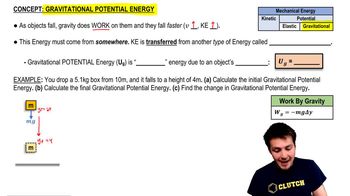
Gravitational Potential Energy

Gravitational potential energy (GPE) is the energy an object possesses due to its height above the ground. It is calculated using the formula GPE = mgh, where m is mass, g is the acceleration due to gravity (approximately 9.81 m/s²), and h is the height. In this scenario, the weight of the pile driver has GPE when lifted, which is converted to kinetic energy as it falls.
Video consigliato:
Percorso guidato
06:35
Gravitational Potential Energy

Kinetic Energy and Impact Force

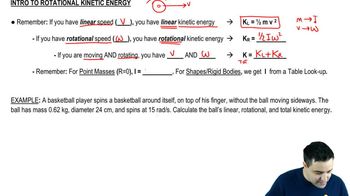
Kinetic energy (KE) is the energy of an object in motion, given by the formula KE = 0.5mv², where m is mass and v is velocity. When the weight falls and strikes the pipe, its kinetic energy is transferred to the pipe, causing it to move. The average force exerted on the pipe can be determined by analyzing the change in kinetic energy and the distance over which the force acts.
Video consigliato:
Percorso guidato
06:07
Intro to Rotational Kinetic Energy

Newton's Second Law of Motion

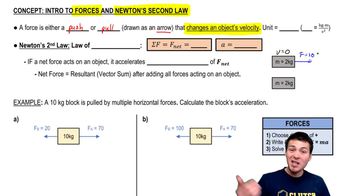
Newton's Second Law states that the force acting on an object is equal to the mass of the object multiplied by its acceleration (F = ma). This principle is crucial for calculating the average force exerted by the weight on the pipe, as it relates the net force to the mass of the falling weight and the deceleration experienced by the pipe as it is driven into the ground.
Video consigliato:
Percorso guidato
06:54
Intro to Forces & Newton's Second Law
Pratica correlata
Domanda del libro di testo

A 50 kg ice skater is gliding along the ice, heading due north at 4.0 m/s. The ice has a small coefficient of static friction, to prevent the skater from slipping sideways, but μk = 0. Suddenly, a wind from the northeast exerts a force of 4.0 N on the skater. What is the minimum value of μs that allows her to continue moving straight north?

642
views
Domanda del libro di testo

Doug uses a 25 N horizontal force to push a 5.0 kg crate up a 2.0-m-high, 20° frictionless slope. What is the speed of the crate at the top of the slope?

1746
views
3
rank
Domanda del libro di testo

A ball shot straight up with kinetic energy K₀ reaches height h. What height will it reach if the initial kinetic energy is doubled?

2061
views
Domanda del libro di testo

A 150 g particle at x = 0 is moving at 2.00 m/s in the + x - direction. As it moves, it experiences a force given by Fₓ = (0.250 N) sin (x/2.00 m). What is the particle's speed when it reaches x = 3.14 m?

2739
views
Domanda del libro di testo

Susan's 10 kg baby brother Paul sits on a mat. Susan pulls the mat across the floor using a rope that is angled 30° above the floor. The tension is a constant 30 N and the coefficient of friction is 0.20. Use work and energy to find Paul's speed after being pulled 3.0 m.

2334
views
1
comments
Domanda del libro di testo

A 50 kg ice skater is gliding along the ice, heading due north at 4.0 m/s. The ice has a small coefficient of static friction, to prevent the skater from slipping sideways, but μk = 0. Suddenly, a wind from the northeast exerts a force of 4.0 N on the skater. Use work and energy to find the skater's speed after gliding 100 m in this wind.

2734
views